
Table of Contents
Behraam is a powerful masculine name with ancient roots stretching back to pre-Islamic Persia. Carrying the triumphant meaning of ‘victorious’, this name has traveled through centuries from Zoroastrian mythology to contemporary Muslim communities. Its association with the planet Mars adds an astrological dimension that has fascinated cultures across Central and South Asia. Today, Behraam remains a name that embodies strength, success, and celestial connection.
Meaning of Behraam
The name Behraam originates from the Middle Persian ‘Vahrām’, which itself derives from the Avestan ‘Verethragna’ — the Zoroastrian yazata (divine being) of victory. The linguistic root ‘verethra-‘ means ‘obstacle’ or ‘resistance’, and ‘-gna’ means ‘smiter’ or ‘striker’, giving the complete meaning ‘smiter of resistance’ or ‘victorious’. In Persian tradition, the name evolved to signify triumph and success in both spiritual and worldly matters. The association with the planet Mars (Nāhir-e Bahram in Persian astrology) developed because Mars was seen as the celestial embodiment of the warrior god Verethragna. This dual meaning — both victorious and connected to Mars — has been preserved in Persian, Urdu, and other languages influenced by Persian culture.
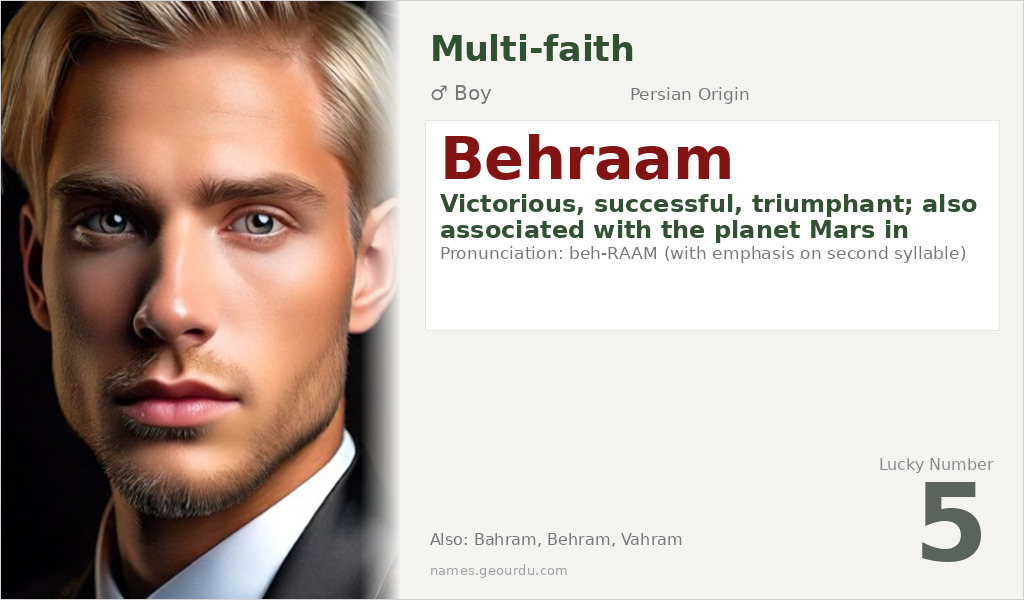
| 📛 Name | Behraam |
| 💎 Meaning | Victorious, successful, triumphant; also associated with the planet Mars in Persian mythology |
| 👤 Gender | Boy |
| 🕌 Religion | Multi-faith |
| 🌍 Origin | Persian |
| 🗣 Pronunciation | beh-RAAM (with emphasis on second syllable) |
| ✍️ Urdu | بہرام |
| ✍️ Arabic | بهرام |
| 🔢 Numerology | 5 |
| ✨ Spellings | Bahram, Behram, Vahram, Vahrām, Bahrām |
Origin & Cultural Significance
Behraam has its origins in ancient Iranian culture, specifically from the Zoroastrian religious tradition where Verethragna was worshipped as a god of victory and war. The name entered Persian literature and history through Sassanian kings, most notably Bahram V (Bahram Gur), who ruled from 420–438 CE and became a legendary figure in Persian epic poetry. With the spread of Islam, the name was adopted by Muslim communities across Persia, Central Asia, and the Indian subcontinent, where it retained its positive connotations while shedding some of its explicitly Zoroastrian religious associations. Today, it is used by various religious groups including Muslims, Zoroastrians, and others in regions from Iran to Pakistan and Afghanistan, demonstrating its cross-cultural appeal.
Personality Traits
Those named Behraam are often associated with leadership qualities and a competitive nature. They tend to approach life with determination and courage, much like the victorious warrior suggested by the name’s etymology. Their connection to Mars symbolism may manifest as passion, energy, and a drive to overcome obstacles. While strong-willed, they often balance this with a sense of justice and protection toward those they care about.
Similar Names
If you like Behraam, consider: Bahram, Farhad, Rustam, Khosrow, Jamshid
Famous People Named Behraam
- Bahram V — Sassanian Persian king (420–438 CE) known as Bahram Gur, celebrated in Persian literature
- Bahram Beyzai — influential Iranian playwright, screenwriter and film director
Frequently Asked Questions About Behraam
What does Behraam mean?
Behraam means 'victorious' or 'triumphant' in Persian, originating from the Avestan 'Verethragna', the Zoroastrian god of victory. It is also associated with the planet Mars in Persian astrology.
Is Behraam a boy or girl name?
Behraam is exclusively a masculine name in all cultures where it is used, from its ancient Zoroastrian origins to contemporary Muslim communities.
What is the origin of Behraam?
Behraam originates from ancient Persian culture, specifically from the Avestan language of Zoroastrianism. It evolved through Middle Persian into modern Persian and spread to Urdu, Pashto, and other languages through cultural exchange.





