
Table of Contents
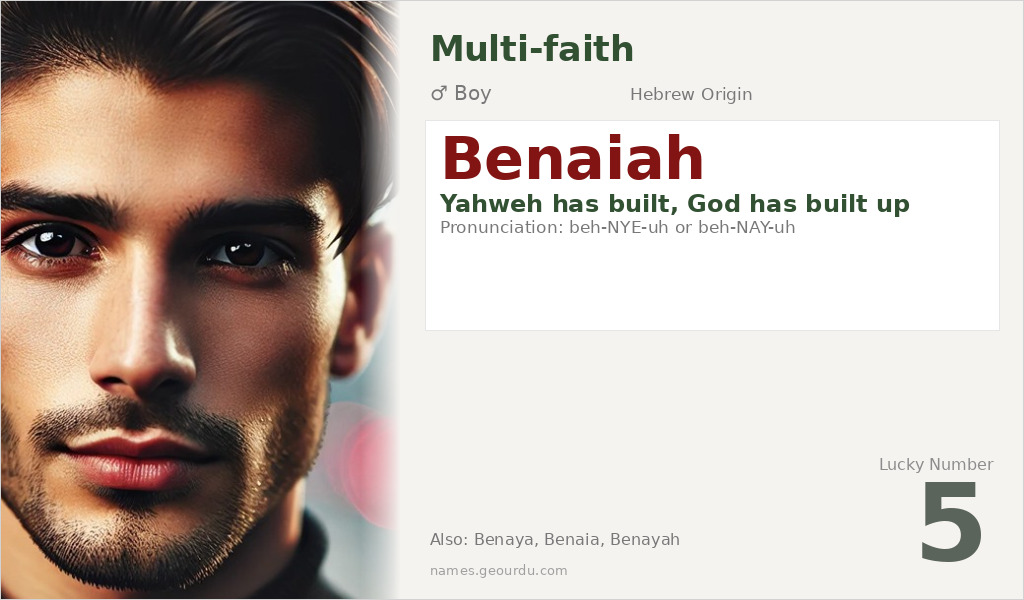
Benaiah is a powerful Biblical name with deep roots in ancient Hebrew tradition. Meaning ‘Yahweh has built’ or ‘God has established,’ this name carries centuries of religious and historical significance. Most famously borne by one of King David’s mighty warriors, Benaiah represents strength, faithfulness, and divine favor. While primarily used in Jewish and Christian contexts, its timeless appeal continues to resonate with parents seeking a name with spiritual depth.
Meaning of Benaiah
Benaiah is a Hebrew theophoric name composed of two elements: ‘ben’ (בֶּן) meaning ‘son of’ and ‘Yah’ (יָה), a contraction of Yahweh, the personal name of God in the Hebrew Bible. Thus, the literal translation is ‘son of Yahweh,’ though it’s commonly interpreted as ‘Yahweh has built’ or ‘God has established.’ This construction follows a common pattern in ancient Semitic naming conventions where names expressed relationship with or action by the divine. The ‘building’ or ‘establishing’ connotation suggests divine creation, foundation, or support. In linguistic context, similar Hebrew names include Ben-ammi (‘son of my people’) and Ben-hur (‘son of nobility’), though Benaiah’s direct reference to Yahweh gives it particular theological weight.
| 📛 Name | Benaiah |
| 💎 Meaning | Yahweh has built, God has built up |
| 👤 Gender | Boy |
| 🕌 Religion | Multi-faith |
| 🌍 Origin | Hebrew |
| 🗣 Pronunciation | beh-NYE-uh or beh-NAY-uh |
| ✍️ Urdu | بینایاہ |
| ✍️ Arabic | بناياه |
| 🔢 Numerology | 5 |
| ✨ Spellings | Benaya, Benaia, Benayah, Benaijah |
Origin & Cultural Significance
Benaiah originates from ancient Hebrew culture and appears multiple times in the Hebrew Bible (Tanakh), which is also part of the Christian Old Testament. The most prominent bearer was Benaiah son of Jehoiada, a valiant warrior who served King David and later became commander of King Solomon’s army, executing Solomon’s rivals and leading military campaigns. This historical context places the name within Israelite military and leadership circles during the United Monarchy period (approximately 11th-10th centuries BCE). While fundamentally Jewish in origin, the name has been adopted by Christians through Biblical transmission and appears in various Christian traditions worldwide. There is no evidence of the name originating in or being widely used in Islamic, Hindu, Sikh, Buddhist, or other religious contexts, though it could theoretically be used by anyone appreciating its Biblical heritage.
Personality Traits
Drawing from the Biblical Benaiah’s character, individuals with this name are often associated with traits of courage, loyalty, and strength. The original Benaiah was known for his military prowess, defeating formidable opponents and remaining steadfastly loyal through political transitions. This suggests someone who faces challenges head-on, protects what they value, and maintains integrity under pressure. While these associations are cultural rather than deterministic, they contribute to the name’s enduring appeal for parents seeking to imbue their child’s identity with historical resonance of faithfulness and capability.
Similar Names
If you like Benaiah, consider: Benjamin, Benedict, Ben, Nathaniel, Ezekiel
Famous People Named Benaiah
- Benaiah son of Jehoiada — Biblical warrior and commander under Kings David and Solomon, known for his military exploits
- Benaiah — Several other minor Biblical figures including priests and Levites mentioned in the Books of Chronicles
Frequently Asked Questions About Benaiah
What does Benaiah mean?
Benaiah means 'Yahweh has built' or 'God has established' in Hebrew, derived from 'ben' (son of) and 'Yah' (short for Yahweh).
Is Benaiah a boy or girl name?
Benaiah is exclusively a masculine name in all historical and contemporary usage, originating as the name of male Biblical figures.
What is the origin of Benaiah?
Benaiah originates from ancient Hebrew language and culture, appearing in the Hebrew Bible/Tanakh as the name of several figures, most notably a warrior serving Kings David and Solomon.





