
Table of Contents
Benet is a distinguished boy’s name with deep Christian roots and a beautiful meaning that has endured for centuries. Derived from the Latin word for ‘blessed’, this name carries spiritual significance and historical weight. Whether you’re considering it for your child or researching its background, Benet offers a connection to ancient traditions while remaining timeless in its appeal. Let’s explore the rich history and meaning behind this classic name.
Meaning of Benet
The name Benet originates from the Late Latin name Benedictus, which directly translates to ‘blessed’ or ‘the blessed one’. This meaning comes from the Latin verb ‘benedicere’, composed of ‘bene’ (well) and ‘dicere’ (to speak), literally meaning ‘to speak well of’ or ‘to bless’. The name gained prominence through Saint Benedict of Nursia in the 6th century, whose Rule of Saint Benedict became foundational for Western monasticism. As Christianity spread throughout Europe, variations of Benedictus evolved into numerous forms across languages, with Benet representing one of these adaptations. The name’s enduring popularity stems from both its beautiful meaning and its association with one of Christianity’s most influential saints.
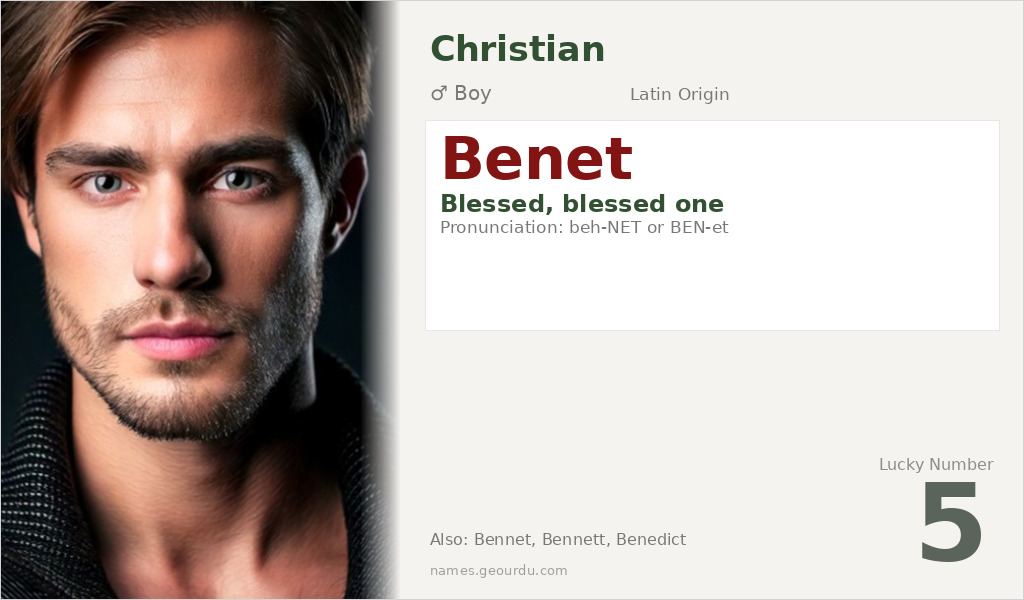
| 📛 Name | Benet |
| 💎 Meaning | Blessed, blessed one |
| 👤 Gender | Boy |
| 🕌 Religion | Christian |
| 🌍 Origin | Latin |
| 🗣 Pronunciation | beh-NET or BEN-et |
| ✍️ Urdu | بینٹ |
| ✍️ Arabic | بينيت |
| 🔢 Numerology | 5 |
| ✨ Spellings | Bennet, Bennett, Benedict, Benoit, Benedetto |
Origin & Cultural Significance
Benet has its origins in Latin-speaking Christian communities of late antiquity, specifically evolving from the name Benedictus. The name’s widespread adoption began with Saint Benedict of Nursia (480–547), whose monastic rule transformed Western Christian spirituality. During the Middle Ages, the name spread throughout Europe, adapting to local languages and cultures while maintaining its core meaning. In English-speaking countries, Benet emerged as a variant alongside Bennett and Benedict, with all forms preserving the original Latin meaning of ‘blessed’. The name remains particularly significant in Catholic and Anglican traditions due to its saintly association and continues to be used globally in Christian communities.
Personality Traits
Those named Benet often embody qualities associated with their name’s meaning of being blessed. They frequently demonstrate natural grace under pressure, intellectual depth, and a balanced perspective on life’s challenges. Many exhibit leadership qualities combined with humility, reflecting the spiritual heritage of their name’s most famous bearer, Saint Benedict. Their blessed nature often manifests as resilience, wisdom, and the ability to inspire others through both words and actions.
Similar Names
If you like Benet, consider: Benedict, Bennett, Benedictus, Benoit, Benedetto
Famous People Named Benet
- Saint Benedict of Nursia — 6th-century Italian monk who founded the Benedictine Order
- Benedict XVI — Pope of the Catholic Church from 2005 to 2013
Frequently Asked Questions About Benet
What does Benet mean?
Benet means 'blessed' or 'blessed one', originating from the Latin name Benedictus which comes from the verb 'benedicere' meaning 'to speak well of, to bless'.
Is Benet a boy or girl name?
Benet is traditionally a boy's name, though some modern variations might be used for girls. Historically and in Christian tradition, it has been exclusively masculine, derived from male saints and historical figures.
What is the origin of Benet?
Benet originates from Latin, specifically from the name Benedictus meaning 'blessed'. It gained prominence through Saint Benedict of Nursia in the 6th century and spread throughout Christian Europe during the Middle Ages.





