
Table of Contents
Bennet is a classic name with deep historical roots that has maintained its appeal across centuries. Derived from the Latin word for ‘blessed,’ this name carries a positive connotation that has made it enduringly popular. While often associated with Christian tradition due to Saint Benedict, Bennet has evolved into a multi-faith name appreciated for its timeless quality. Its medieval origins and connection to monastic history give it both spiritual depth and historical significance.
Meaning of Bennet
The name Bennet originates from the Latin ‘Benedictus,’ which directly translates to ‘blessed.’ This comes from the Latin verb ‘benedicere,’ combining ‘bene’ (well) and ‘dicere’ (to speak), meaning ‘to speak well of’ or ‘to bless.’ In medieval England, ‘Bennet’ emerged as a vernacular diminutive form of Benedict, making it more accessible in everyday speech. The name gained particular prominence through Saint Benedict of Nursia, the 6th-century founder of Western monasticism whose Rule of Saint Benedict became foundational for Christian monastic life. While the core meaning remains ‘blessed,’ the name has taken on additional cultural associations over time, though these vary by region and tradition rather than being inherent to the etymology.
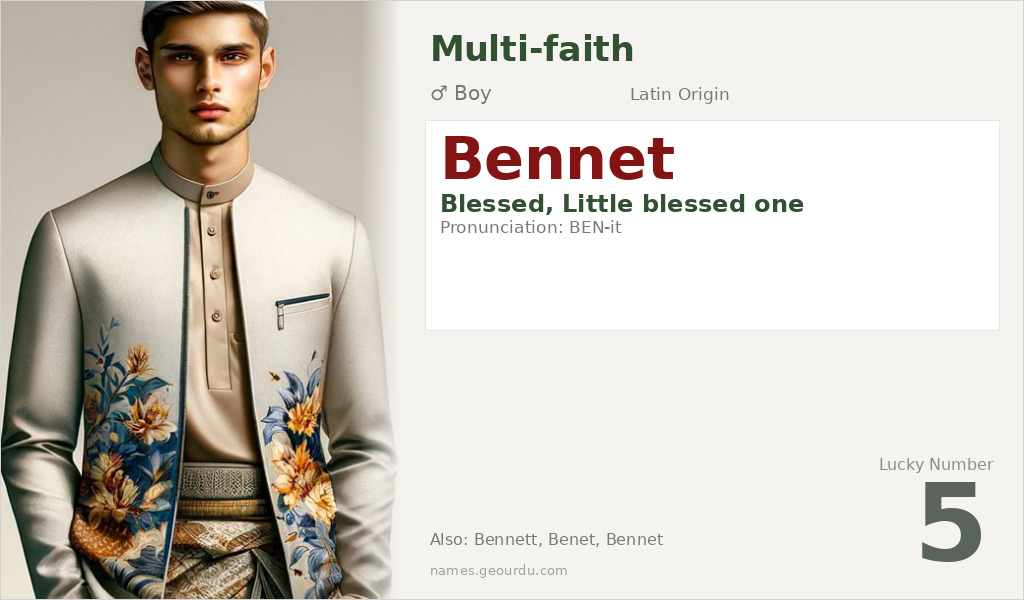
| 📛 Name | Bennet |
| 💎 Meaning | Blessed, Little blessed one |
| 👤 Gender | Boy |
| 🕌 Religion | Multi-faith |
| 🌍 Origin | Latin |
| 🗣 Pronunciation | BEN-it |
| ✍️ Urdu | بینٹ |
| ✍️ Arabic | بينيت |
| 🔢 Numerology | 5 |
| ✨ Spellings | Bennett, Benet, Bennet, Benedict |
Origin & Cultural Significance
Bennet has its origins in medieval England as a vernacular form of the Latin name Benedict. The name spread throughout Europe following the influence of Saint Benedict and the Benedictine monastic order he founded in the 6th century. During the Middle Ages, ‘Bennet’ became particularly common in England, often used as both a given name and surname. While the name has strong historical connections to Christian monastic tradition, it has since transcended religious boundaries and is now used by people of various faiths and cultural backgrounds. The name experienced revivals during the Victorian era and again in recent decades as parents seek classic names with historical depth.
Personality Traits
Those named Bennet are often perceived as adaptable and intellectually curious individuals who thrive on variety and new experiences. They typically possess natural social skills and a quick wit that makes them engaging companions. With their freedom-loving nature and enthusiasm for life’s adventures, Bennets often approach challenges with creativity and resilience. These personality associations, while not scientifically determined, reflect common cultural perceptions of the name’s bearers across different societies.
Similar Names
If you like Bennet, consider: Benedict, Benjamin, Benton, Bernard, Bennett
Famous People Named Bennet
- Bennet Omalu — Nigerian-American neuropathologist who discovered chronic traumatic encephalopathy in football players
- Bennet Wong — Canadian psychiatrist and co-founder of the Haven Institute for personal growth
Frequently Asked Questions About Bennet
What does Bennet mean?
Bennet means 'blessed' or 'little blessed one.' It originates from the Latin name Benedictus, which comes from 'benedicere' meaning 'to speak well of' or 'to bless.'
Is Bennet a boy or girl name?
Bennet is traditionally a masculine name, though some variations like Bennett are occasionally used for girls. Historically and in most cultures today, it remains primarily a boy's name.
What is the origin of Bennet?
Bennet originates from medieval England as a vernacular form of the Latin name Benedict. It has roots in Latin through 'Benedictus' and gained popularity through Saint Benedict of Nursia and the Benedictine monastic tradition.





