
Table of Contents
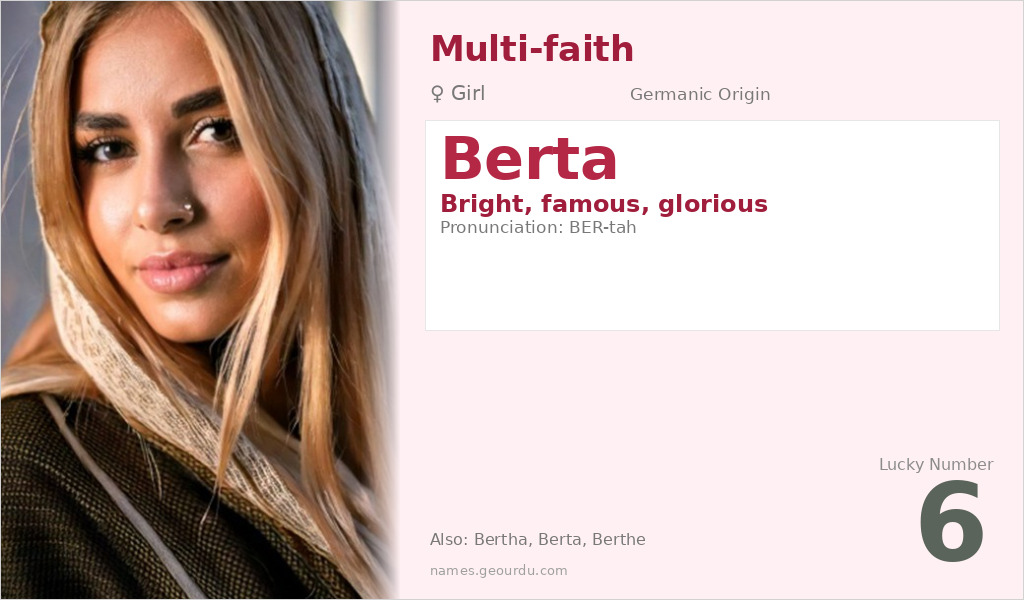
Berta is a classic Germanic name with a rich history spanning over a millennium. Meaning ‘bright, famous, and glorious,’ this name has been borne by queens, saints, and pioneering women throughout European history. While particularly popular in German-speaking countries, Berta has found usage across multiple cultures and faiths. Its enduring appeal lies in its strong, positive meaning and historical significance.
Meaning of Berta
The name Berta originates from Old High German, combining the elements ‘beraht’ meaning ‘bright, shining, famous’ and ‘heri’ meaning ‘army, warrior.’ This gives the name the comprehensive meaning of ‘bright army’ or ‘famous warrior,’ though in practice it’s understood as ‘bright, famous, glorious.’ The ‘bright’ component refers to both physical radiance and intellectual brilliance, while the ‘famous’ aspect speaks to renown and distinction. This etymology connects Berta to other Germanic names like Albert (noble + bright), Robert (fame + bright), and Herbert (army + bright). The name has been consistently used since the early Middle Ages, maintaining its core meaning throughout linguistic evolution.
| 📛 Name | Berta |
| 💎 Meaning | Bright, famous, glorious |
| 👤 Gender | Girl |
| 🕌 Religion | Multi-faith |
| 🌍 Origin | Germanic |
| 🗣 Pronunciation | BER-tah |
| ✍️ Urdu | برتھا |
| ✍️ Arabic | بيرتا |
| 🔢 Numerology | 6 |
| ✨ Spellings | Bertha, Berta, Berthe, Berta, Berte |
Origin & Cultural Significance
Berta has deep roots in Germanic culture, predating widespread Christianization in Europe. The name first appears in historical records with figures like Bertha of the Franks (6th century) and became particularly prominent through Saint Bertha of Kent, who played a crucial role in bringing Christianity to Anglo-Saxon England. Throughout the Middle Ages, the name was popular among European nobility, including Bertha of Swabia (Holy Roman Empress) and Bertha of Holland. The name spread across Europe through migration and royal marriages, with variations appearing in French (Berthe), Italian (Berta), Spanish (Berta), and other European languages. While often associated with Christianity due to several saintly bearers, the name itself has pagan Germanic origins and is used by people of various faiths today.
Personality Traits
Those named Berta often embody the qualities suggested by their name’s meaning. The ‘bright’ aspect manifests as intelligence, creativity, and clarity of thought, while the ‘famous’ component relates to leadership qualities and the ability to make a meaningful impact. Historically, women named Berta have been pioneers and influencers, from medieval queens to modern activists and innovators. This legacy contributes to the perception of Bertas as strong, independent individuals with both intellectual depth and practical capability.
Similar Names
If you like Berta, consider: Alberta, Roberta, Bertina, Bertilde, Bertrada
Famous People Named Berta
- Bertha von Suttner — Austrian pacifist and first woman Nobel Peace Prize laureate (1905)
- Bertha Benz — German automotive pioneer, first person to drive an automobile over a long distance
Frequently Asked Questions About Berta
What does Berta mean?
Berta means 'bright, famous, glorious' and originates from Old High German, combining 'beraht' (bright/famous) and 'heri' (army).
Is Berta a boy or girl name?
Berta is exclusively a feminine name, being the feminine form of Germanic names like Berthold and Bertram. It has been used for girls and women for over a thousand years.
What is the origin of Berta?
Berta has Germanic origins, specifically from Old High German. It predates Christianity in Europe and was popular among Germanic tribes before spreading throughout medieval Europe through royal and noble families.





