
Table of Contents
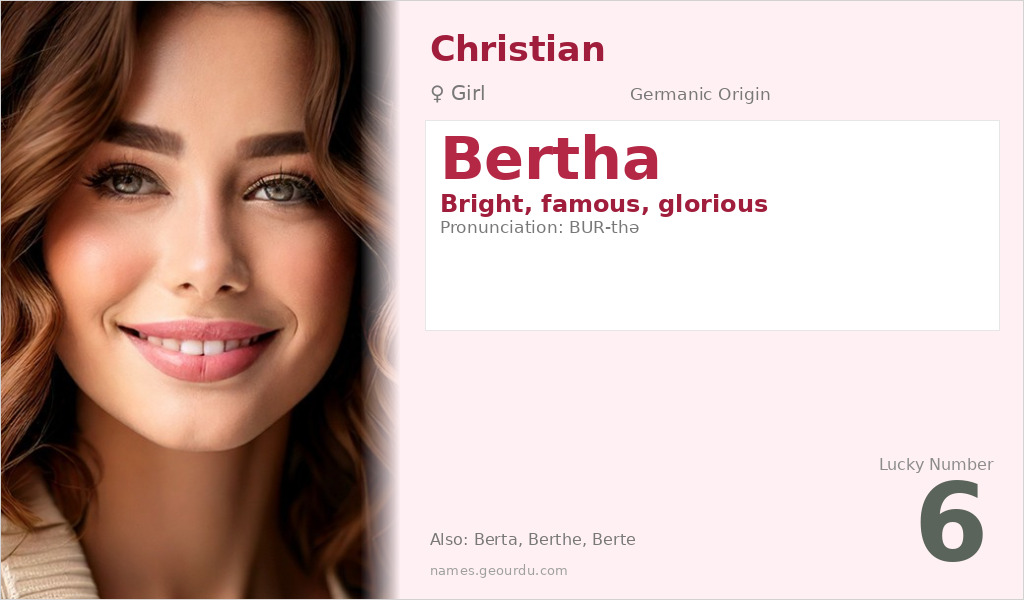
Bertha is a classic Germanic name with deep historical roots and Christian significance. Meaning ‘bright, famous, glorious,’ this name has been borne by saints, queens, and pioneers throughout European history. From its Old High German origins to its modern usage, Bertha carries a legacy of strength and illumination. Discover the rich etymology and cultural journey of this enduring name.
Meaning of Bertha
The name Bertha originates from the Old High German elements ‘beraht’ meaning ‘bright, famous, glorious’ and ‘heri’ meaning ‘army,’ giving it the combined meaning of ‘bright army’ or ‘glorious warrior.’ This etymology places it within the large family of Germanic names containing the ‘beraht’ element, which appears in numerous European names like Albert, Robert, and Herbert. The ‘bright’ connotation refers not just to physical light but to intellectual brilliance and moral excellence. Through linguistic evolution, the name spread across Germanic languages with cognates in Old English as ‘Beorht’ and in Old Norse as ‘Bjartr,’ all maintaining the core meaning of brightness and renown.
| 📛 Name | Bertha |
| 💎 Meaning | Bright, famous, glorious |
| 👤 Gender | Girl |
| 🕌 Religion | Christian |
| 🌍 Origin | Germanic |
| 🗣 Pronunciation | BUR-thə |
| ✍️ Urdu | برتھا |
| ✍️ Arabic | بيرتا |
| 🔢 Numerology | 6 |
| ✨ Spellings | Berta, Berthe, Berte, Berta |
Origin & Cultural Significance
Bertha emerged in early medieval Europe as a Germanic name that gained particular prominence through Christianization. The most significant historical bearer was Saint Bertha of Kent (539-c.612), a Frankish princess who married King Æthelberht of Kent and played a crucial role in introducing Christianity to Anglo-Saxon England by inviting Augustine of Canterbury to establish his mission. This Christian association made the name popular among European nobility throughout the Middle Ages. The name experienced revivals in the 19th century during the Romantic era’s interest in medieval names and again in the early 20th century before declining in usage in recent decades.
Personality Traits
Those named Bertha are often perceived as grounded individuals with strong traditional values and practical intelligence. They typically exhibit reliability and organizational skills, making them effective in leadership roles. The name’s meaning of ‘bright’ suggests intellectual curiosity and clarity of thought, while its historical association with Saint Bertha implies spiritual depth and moral strength.
Similar Names
If you like Bertha, consider: Alberta, Roberta, Bertram, Bertille, Bertina
Famous People Named Bertha
- Saint Bertha of Kent — Frankish princess and Queen of Kent who helped establish Christianity in Anglo-Saxon England
- Bertha Benz — German automotive pioneer who completed the first long-distance automobile journey in 1888
Frequently Asked Questions About Bertha
What does Bertha mean?
Bertha means 'bright, famous, glorious' and comes from the Old High German elements 'beraht' (bright) and 'heri' (army).
Is Bertha a boy or girl name?
Bertha is exclusively a feminine name with historical usage as a girl's name across European cultures, though its root elements appear in masculine names like Albert and Robert.
What is the origin of Bertha?
Bertha originates from Germanic languages, specifically Old High German, and gained prominence through Saint Bertha of Kent in early medieval Christian history.





