
Table of Contents
Bettina is an elegant feminine name with deep biblical roots that has charmed parents across Europe and beyond. As a diminutive of the classic Elizabeth, it carries the profound meaning ‘God is my oath’ while offering a distinctive, melodic sound. This name bridges ancient Hebrew tradition with European linguistic evolution, creating a timeless choice for girls. From German Romantic salons to modern creative circles, Bettina has maintained its appeal across centuries.
Meaning of Bettina
Bettina’s meaning traces directly to its source name Elizabeth, which originates from the Hebrew Elisheva (אֱלִישֶׁבַע). This Hebrew name combines ‘El’ (אֵל), meaning ‘God,’ and ‘sheva’ (שֶׁבַע), meaning ‘oath’ or ‘seven’—the latter number representing completeness and covenant in biblical tradition. The full meaning ‘God is my oath’ or ‘God’s promise’ reflects a solemn commitment to divine faith. Through Greek adaptation as Elisabet and Latin as Elisabeth, the name entered European languages. Bettina specifically emerged as an Italian and German affectionate form (like -ina diminutives in Romance languages), eventually becoming established as an independent given name while retaining its core semantic connection to divine promise.
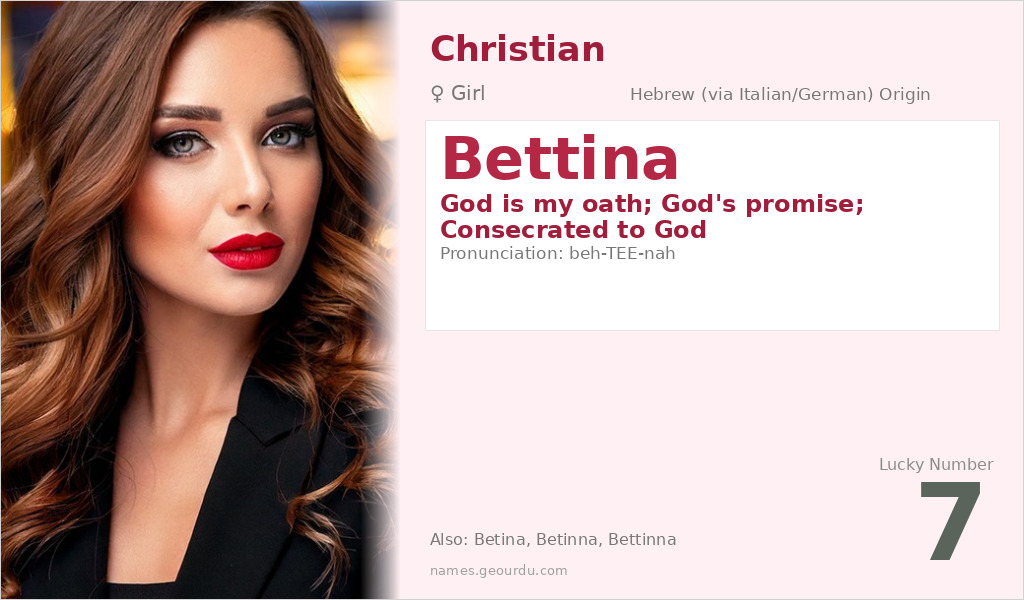
| 📛 Name | Bettina |
| 💎 Meaning | God is my oath; God's promise; Consecrated to God |
| 👤 Gender | Girl |
| 🕌 Religion | Christian |
| 🌍 Origin | Hebrew (via Italian/German) |
| 🗣 Pronunciation | beh-TEE-nah |
| ✍️ Urdu | بیٹینا |
| ✍️ Arabic | بيتينا |
| 🔢 Numerology | 7 |
| ✨ Spellings | Betina, Betinna, Bettinna |
Origin & Cultural Significance
Bettina originated as a diminutive form of Elizabeth/Elisabetta in Italian and German-speaking regions during the late medieval or Renaissance period. The name gained particular prominence in German culture through figures like Bettina von Arnim (1785-1859), a central personality in German Romanticism who corresponded with Goethe and championed social causes. In Italy, Bettina developed alongside other -ina diminutives (e.g., Carolina, Albertina) as affectionate forms that eventually gained standalone status. While fundamentally Christian in origin due to its connection to Elizabeth (mother of John the Baptist in the New Testament), the name has been adopted across various cultural contexts without exclusive religious association. Its usage spread through European aristocracy and literary circles before becoming more widely popular in the 20th century.
Personality Traits
Those named Bettina are often perceived as possessing a blend of intellectual depth and creative sensitivity. Drawing from the name’s etymological connection to solemn promises and divine commitment, they may exhibit strong principles and loyalty in relationships. The name’s European elegance suggests refinement and cultural appreciation, while its diminutive origin hints at approachability and warmth. Many Bettinas navigate life with thoughtful introspection balanced by expressive communication.
Similar Names
If you like Bettina, consider: Elizabeth, Elisabetta, Bettine, Betty, Beth, Elisa, Isabella, Bianca, Beatrice, Benedetta
Famous People Named Bettina
- Bettina von Arnim — 19th century German writer and prominent figure in Romantic literature
- Bettina Rheims — Contemporary French photographer known for celebrity portraits and artistic nudes
Frequently Asked Questions About Bettina
What does Bettina mean?
Bettina means 'God is my oath' or 'God's promise.' It derives from the Hebrew name Elizabeth (Elisheva), combining 'El' (God) and 'sheva' (oath).
Is Bettina a boy or girl name?
Bettina is exclusively a feminine name. It developed as a diminutive form of Elizabeth/Elisabetta and has never been used traditionally for boys.
What is the origin of Bettina?
Bettina originated as an Italian and German diminutive of Elizabeth. While its ultimate origin is Hebrew (via Greek and Latin), the specific form Bettina emerged in European languages during the medieval/Renaissance period.





