Table of Contents
Bhaavitha is a beautiful and meaningful name of Sanskrit origin that carries deep emotional resonance. Primarily used in Hindu communities, particularly in India and Nepal, this name reflects qualities of sensitivity and inner feeling. With its roots in ancient Indian language and philosophy, Bhaavitha offers both cultural richness and personal significance for parents seeking a name with emotional depth.
Meaning of Bhaavitha
Bhaavitha derives from the Sanskrit word ‘bhāva’ (भाव), which fundamentally means ‘feeling, emotion, sentiment, or state of being.’ The suffix ‘-itha’ transforms it into an adjective meaning ‘one who is filled with feelings’ or ’emotional being.’ In Sanskrit grammar, ‘bhāvita’ appears as a past participle meaning ‘perfected, cultivated, or emotionally developed,’ with the feminine form ‘bhāvitā’ specifically denoting a woman characterized by emotional depth. This linguistic construction appears in classical Sanskrit texts like the Natya Shastra (treatise on performing arts) where ‘bhāva’ refers to emotional states, and in philosophical works discussing emotional cultivation. The name thus carries connotations of emotional awareness, sensitivity, and inner richness rather than any connection to deities.
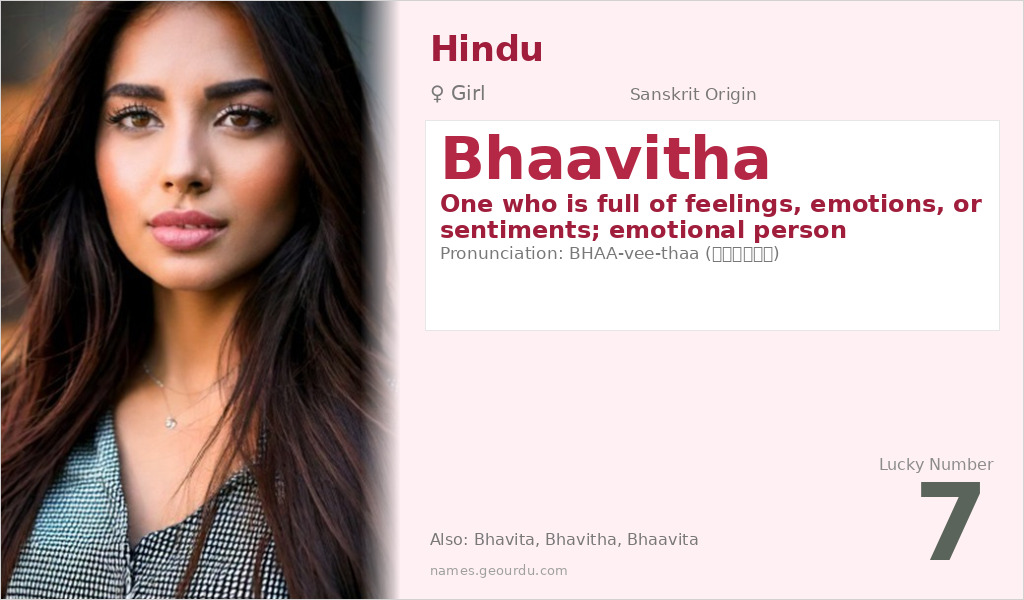
| 📛 Name | Bhaavitha |
| 💎 Meaning | One who is full of feelings, emotions, or sentiments; emotional person |
| 👤 Gender | Girl |
| 🕌 Religion | Hindu |
| 🌍 Origin | Sanskrit |
| 🗣 Pronunciation | BHAA-vee-thaa (भाविता) |
| ✍️ Urdu | بھاوِتھا |
| ✍️ Arabic | بهافيثا |
| 🔢 Numerology | 7 |
| ✨ Spellings | Bhavita, Bhavitha, Bhaavita, भाविता |
Origin & Cultural Significance
Bhaavitha originates from Sanskrit, the classical language of ancient India that has influenced numerous modern South Asian languages including Hindi, Marathi, Gujarati, and Bengali. As a Sanskrit-derived name, it belongs to the Indo-European language family and shares linguistic roots with other ancient languages like Greek and Latin. The name appears in Hindu cultural contexts, particularly among communities that value Sanskrit names for their philosophical and aesthetic qualities. While not among the most common Sanskrit names, Bhaavitha maintains presence in modern Indian naming practices, especially in regions with strong Sanskrit traditions like Maharashtra, Karnataka, and parts of North India. Its usage reflects the enduring influence of Sanskrit’s rich vocabulary for human emotions and inner states.
Personality Traits
Those named Bhaavitha are often associated with emotional intelligence and depth of feeling. They may exhibit strong intuitive abilities and sensitivity to both their own emotions and those of people around them. This emotional awareness can translate into artistic expression, empathetic relationships, and thoughtful decision-making. While sometimes perceived as reserved or introspective, individuals with this name typically possess rich inner lives and genuine compassion.
Similar Names
If you like Bhaavitha, consider: Bhavana, Bhavya, Bhaavya, Bhavini, Bhavita
Famous People Named Bhaavitha
- Bhavitha (Indian actress) — South Indian film actress known for roles in Telugu and Tamil cinema
- Bhavitha (singer) — Indian playback singer in regional film industries
Frequently Asked Questions About Bhaavitha
What does Bhaavitha mean?
Bhaavitha means 'one who is full of feelings or emotions' in Sanskrit. It comes from the root word 'bhāva' meaning emotion or sentiment, with the suffix indicating a person characterized by these qualities.
Is Bhaavitha a boy or girl name?
Bhaavitha is primarily a girl's name in Sanskrit and Hindu naming traditions. The feminine form 'bhāvitā' is grammatically feminine, and the name is almost exclusively given to girls in cultural practice, contrary to some incorrect listings that label it as masculine.
What is the origin of Bhaavitha?
Bhaavitha originates from Sanskrit, the classical language of ancient India. It is derived from the Sanskrit word 'bhāva' (emotion/feeling) and belongs to the Indo-European language family, specifically the Indo-Aryan branch that includes many modern South Asian languages.