Table of Contents
Bhagavathi is a profoundly spiritual name with roots in ancient Sanskrit tradition. Meaning ‘Goddess’ or ‘Divine Mother’, this name carries the essence of feminine divinity and supreme power. Popular among Hindu communities, particularly in South India, Bhagavathi represents both religious devotion and cultural heritage. Choosing this name connects a child to centuries of goddess worship and spiritual tradition.
Meaning of Bhagavathi
Bhagavathi originates from the Sanskrit word ‘Bhagavatī’ (भगवती), which is the feminine form of ‘Bhagavān’ meaning ‘the fortunate one’ or ‘the divine one’. The root ‘bhaga’ signifies fortune, prosperity, dignity, and divine majesty. In Hindu theology, Bhagavathi specifically denotes the Goddess as the supreme feminine principle, encompassing all goddess forms including Durga, Lakshmi, Saraswati, and Kali. The name appears in numerous sacred texts, most notably in the Devi Mahatmya (part of the Markandeya Purana), where the Goddess is praised as Bhagavati. This linguistic construction follows the common Sanskrit pattern where ‘-vatī’ or ‘-vatī’ forms feminine derivatives, making Bhagavathi literally mean ‘she who possesses bhaga’ or ‘the blessed feminine divine’.
| 📛 Name | Bhagavathi |
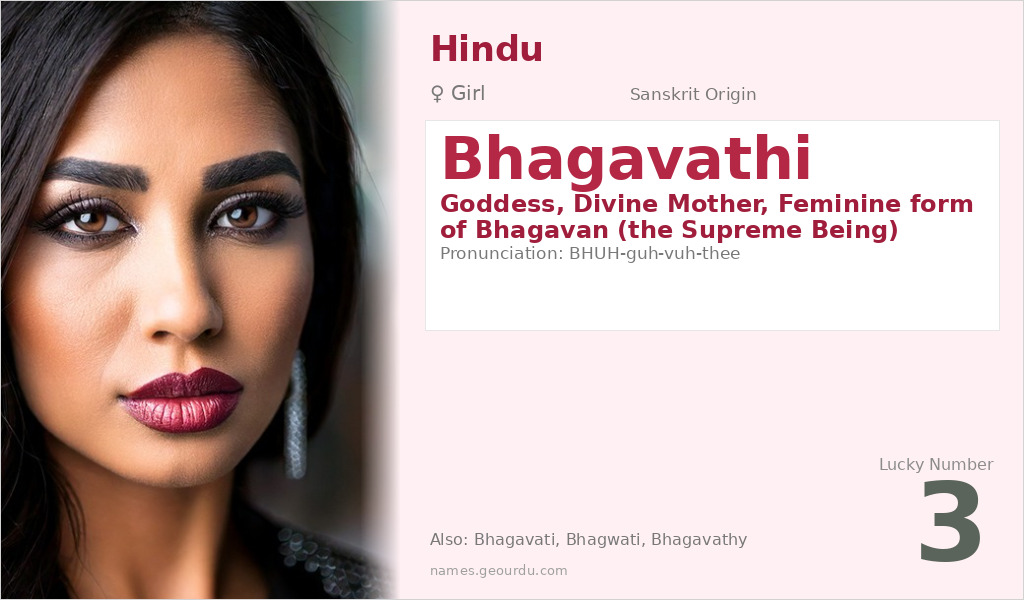
| 💎 Meaning | Goddess, Divine Mother, Feminine form of Bhagavan (the Supreme Being) |
| 👤 Gender | Girl |
| 🕌 Religion | Hindu |
| 🌍 Origin | Sanskrit |
| 🗣 Pronunciation | BHUH-guh-vuh-thee |
| ✍️ Urdu | بھگوتھی |
| ✍️ Arabic | بهاغافاثي |
| 🔢 Numerology | 3 |
| ✨ Spellings | Bhagavati, Bhagwati, Bhagavathy, Bhagavathi |
Origin & Cultural Significance
Bhagavathi has its origins in ancient Sanskrit literature and Hindu religious tradition dating back over two millennia. The name gained particular prominence in South Indian Hindu practice, especially in Kerala, Tamil Nadu, and Karnataka, where Bhagavathi temples are widespread and the goddess is worshipped in various forms. In Kerala, Bhagavathi worship is central to the famous Theyyam ritual performances and temple festivals. The name reflects the Shakta tradition’s emphasis on the feminine divine as the supreme reality. While primarily Hindu, the concept of Bhagavathi has influenced some Buddhist and Jain traditions in India, though the name itself remains predominantly Hindu in usage.
Personality Traits
Those named Bhagavathi are often perceived as having a strong spiritual presence and maternal qualities. They tend to be protective, nurturing, and possess natural authority that commands respect. With their connection to the divine feminine, they may exhibit creativity, intuition, and emotional depth. Their personality often blends strength with compassion, making them both leaders and caregivers in their communities.
Similar Names
If you like Bhagavathi, consider: Bhagya, Bhagirathi, Bhagyalakshmi, Bhagavati, Devi
Famous People Named Bhagavathi
- Bhagavathi Amma — Renowned Indian actress in Malayalam cinema
- Bhagavathi Perumal — Temple deity in South Indian Hindu tradition
Frequently Asked Questions About Bhagavathi
What does Bhagavathi mean?
Bhagavathi means 'Goddess' or 'Divine Mother' in Sanskrit. It is the feminine form of Bhagavan, referring to the supreme feminine divine principle in Hinduism.
Is Bhagavathi a boy or girl name?
Bhagavathi is exclusively a girl's name as it is the feminine form of Bhagavan and specifically denotes the Goddess in Hindu tradition.
What is the origin of Bhagavathi?
Bhagavathi originates from Sanskrit and Hindu religious tradition, with particular cultural significance in South Indian states like Kerala, Tamil Nadu, and Karnataka where Bhagavathi worship is prevalent.