
Table of Contents
Bhoolokanathan is a distinctive Sanskrit name for boys that carries profound meaning rooted in Hindu cosmology. Literally translating to ‘Lord of the Earth’ or ‘Ruler of the World’, this name embodies authority over the terrestrial realm. While not extremely common, it holds cultural significance in certain Hindu communities, particularly in South India. This guide explores the name’s etymology, origin, and cultural context in detail.
Meaning of Bhoolokanathan
Bhoolokanathan is a compound Sanskrit name with clear etymological components. The first part, ‘Bhooloka’, derives from the Sanskrit words ‘bhu’ (भू) meaning ‘to be, exist, become’ and ‘loka’ (लोक) meaning ‘world, realm, sphere’. In Hindu cosmology, Bhooloka specifically refers to the earthly plane, one of the seven lokas that constitute the universe. The suffix ‘nathan’ (नाथन्) comes from the Sanskrit root ‘nāth’ meaning ‘lord, master, protector, ruler’. Thus, the complete name Bhoolokanathan literally means ‘Lord of the Earth’ or ‘Ruler of the World’, suggesting divine or royal authority over the terrestrial domain. This construction follows common Sanskrit naming patterns where ‘nathan’ is appended to various elements to create theophoric names.
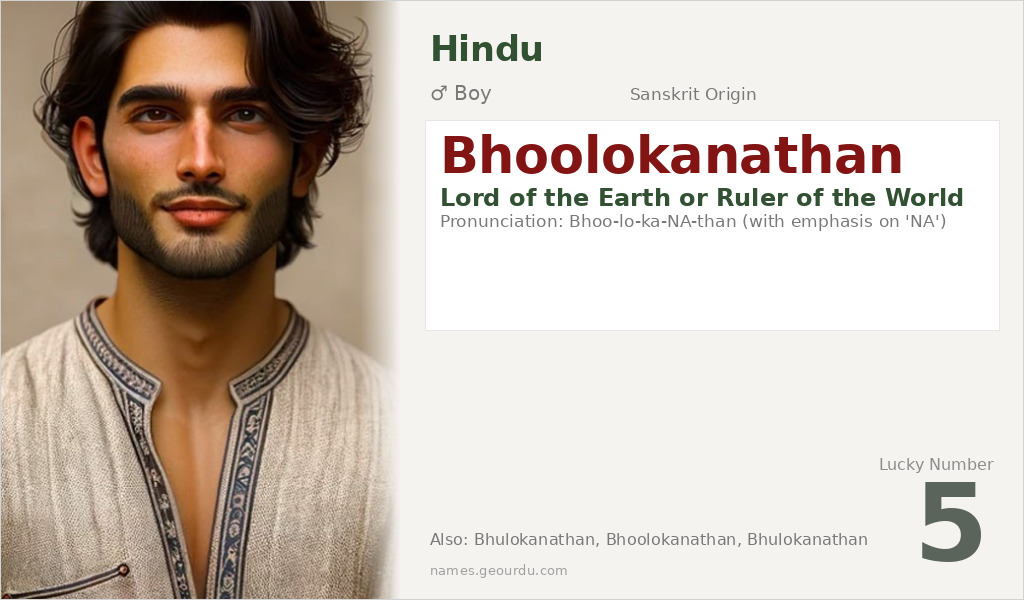
| 📛 Name | Bhoolokanathan |
| 💎 Meaning | Lord of the Earth or Ruler of the World |
| 👤 Gender | Boy |
| 🕌 Religion | Hindu |
| 🌍 Origin | Sanskrit |
| 🗣 Pronunciation | Bhoo-lo-ka-NA-than (with emphasis on 'NA') |
| ✍️ Urdu | بھولوکاناتھن (transliteration, not native Urdu) |
| ✍️ Arabic | بوهولوكاناثان (transliteration, not native Arabic) |
| 🔢 Numerology | 5 |
| ✨ Spellings | Bhulokanathan, Bhoolokanathan, Bhulokanathan |
Origin & Cultural Significance
Bhoolokanathan originates from classical Sanskrit, the ancient liturgical language of Hinduism. The name is deeply rooted in Hindu religious and philosophical traditions, particularly concepts from Puranic cosmology that describe multiple realms of existence. While the exact historical usage is not extensively documented, names with the ‘-nathan’ suffix (meaning ‘lord’) are common in South Indian Hindu naming traditions, especially in Tamil and Malayalam-speaking communities. The name reflects the Hindu worldview that recognizes divine sovereignty over all aspects of creation, including the earthly realm. It is primarily used within Hindu families, particularly those with cultural connections to South India, though it remains relatively rare compared to more common Sanskrit-derived names.
Personality Traits
While personality traits associated with names are largely cultural interpretations rather than deterministic, names like Bhoolokanathan often carry symbolic expectations. The name’s meaning suggests someone who is grounded, responsible, and authoritative—qualities associated with earthly stewardship. Such individuals might be perceived as natural leaders with a protective instinct and strong connection to practical matters. The name’s cosmological roots may also imply a person with depth of character and awareness of their place in the larger order of things.
Similar Names
If you like Bhoolokanathan, consider: Bhuvanath, Bhoomipati, Prithviraj, Vasudhaadhipa, Dharaniishvara
Famous People Named Bhoolokanathan
- No widely documented famous contemporary individuals with this name found in verified sources
- The name appears in some regional Hindu communities in South India, particularly Tamil Nadu and Kerala, but without notable public figures
Frequently Asked Questions About Bhoolokanathan
What does Bhoolokanathan mean?
Bhoolokanathan means 'Lord of the Earth' or 'Ruler of the World'. It is a Sanskrit compound name from 'Bhooloka' (earth/world) + 'nathan' (lord/ruler).
Is Bhoolokanathan a boy or girl name?
Bhoolokanathan is exclusively a boy's name in Hindu naming tradition. The '-nathan' suffix is typically masculine in Sanskrit-derived names.
What is the origin of Bhoolokanathan?
Bhoolokanathan originates from Sanskrit, the classical language of Hinduism. It is particularly used in Hindu communities, with some prevalence in South Indian regions like Tamil Nadu and Kerala.





