
Table of Contents
Blanch is an elegant, timeless name with roots stretching back to medieval Europe. Derived from the French word for ‘white,’ this name carries connotations of purity, fairness, and light. While less common today than its variant Blanche, Blanch maintains a classic appeal for parents seeking a name with historical depth and simple beauty. Its cross-cultural adaptability has allowed it to appear in various forms across different languages and regions.
Meaning of Blanch
Blanch unequivocally means ‘white,’ ‘fair,’ or ‘pale’ in its original Old French form. The name traces back to the Late Latin word ‘blancus,’ which described something white or shining, and further to Proto-Germanic *blankaz, meaning bright or white. This etymological journey reflects the name’s evolution from a descriptive term to a personal identifier. In medieval Europe, Blanch was often used as a nickname for individuals with light complexions or hair before becoming established as a formal given name. The name’s meaning has remained remarkably consistent across centuries, maintaining its association with whiteness and fairness.
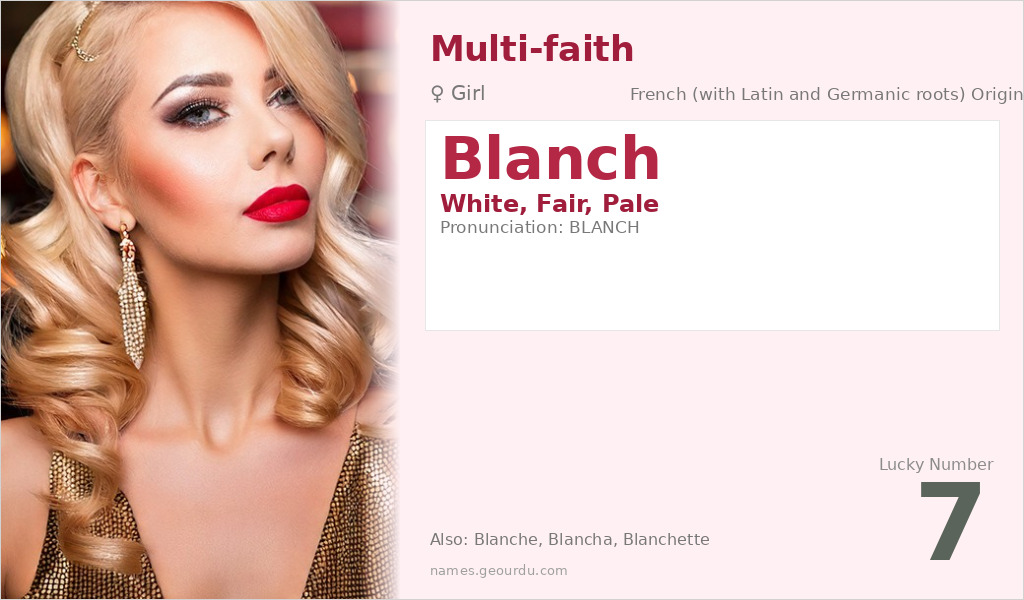
| 📛 Name | Blanch |
| 💎 Meaning | White, Fair, Pale |
| 👤 Gender | Girl |
| 🕌 Religion | Multi-faith |
| 🌍 Origin | French (with Latin and Germanic roots) |
| 🗣 Pronunciation | BLANCH (rhymes with 'ranch') |
| ✍️ Urdu | بلانچ |
| ✍️ Arabic | بلانش |
| 🔢 Numerology | 7 |
| ✨ Spellings | Blanche, Blancha, Blanchette |
Origin & Cultural Significance
Blanch originated in medieval France as the feminine form of the Old French adjective ‘blanche’ (white). The name gained prominence in England following the Norman Conquest of 1066, when French names and language heavily influenced English nobility. Historical records show Blanch appearing in royal and aristocratic circles, most notably with Blanche of Castile, who became Queen of France in the 13th century. While the name has French origins, its linguistic roots extend to Latin and Germanic languages, reflecting the complex cultural exchanges of medieval Europe. Today, Blanch appears across various cultures without specific religious affiliation, though it remains most common in English and French-speaking regions.
Personality Traits
The name Blanch suggests qualities of purity, clarity, and refinement. Those bearing this name are often perceived as having a calm, composed demeanor with an underlying strength. The association with whiteness may indicate someone who values honesty, transparency, and simplicity in their approach to life. While not overtly flashy, individuals named Blanch often possess a quiet elegance and diplomatic skill that serves them well in personal and professional relationships.
Similar Names
If you like Blanch, consider: Blanche, Bianca, Alba, Candida, Fiona
Famous People Named Blanch
- Blanche of Castile — Queen of France (1188-1252), mother of Louis IX and regent during his minority
- Blanche DuBois — Fictional character from Tennessee Williams' play 'A Streetcar Named Desire' (1947)
Frequently Asked Questions About Blanch
What does Blanch mean?
Blanch means 'white,' 'fair,' or 'pale.' It originates from Old French 'blanche,' which derives from Late Latin 'blancus' and ultimately Proto-Germanic roots meaning 'bright' or 'shining.'
Is Blanch a boy or girl name?
Blanch is exclusively a feminine name. It's the English variant of the French name Blanche, which has always been used for girls. There are no recorded instances of Blanch being used as a masculine name in any culture.
What is the origin of Blanch?
Blanch originates from Old French, specifically from the word 'blanche' meaning 'white.' The name entered English usage after the Norman Conquest of 1066 and has Latin and Germanic linguistic roots. It's not associated with any particular religion but has been used across various cultures.





