
Table of Contents
Bonduca is an intriguing name that appears to be a modern variant of Boudica, the legendary Celtic queen who defied Roman rule in ancient Britain. While not a traditional given name in most cultures, it carries echoes of historical strength and rebellion. This name is primarily used for girls and has no specific religious affiliation, making it suitable for multi-faith contexts. Let’s explore the possible origins and meanings behind this unique name.
Meaning of Bonduca
The name Bonduca is most likely a corrupted or adapted form of Boudica (also spelled Boadicea), the name of the famous Celtic queen who led a revolt against Roman occupation in 60-61 AD. Boudica’s name comes from the Proto-Celtic word *boudīkā, which means ‘victorious’ or ‘victory’. The transformation to ‘Bonduca’ may have occurred through historical misspellings, oral transmission, or creative adaptation. Unlike traditional names with clear etymological roots in living languages, Bonduca exists primarily as a historical reference rather than an established given name with documented usage across cultures. Extensive research across Arabic, Persian, Pashto, Urdu, Punjabi, Sindhi, Balochi, Kurdish, Turkish, Bengali, Sanskrit, Hindi, Hebrew, Aramaic, Latin, Greek, Germanic, and other language families reveals no independent existence or meaning for ‘Bonduca’ outside of its connection to Boudica.
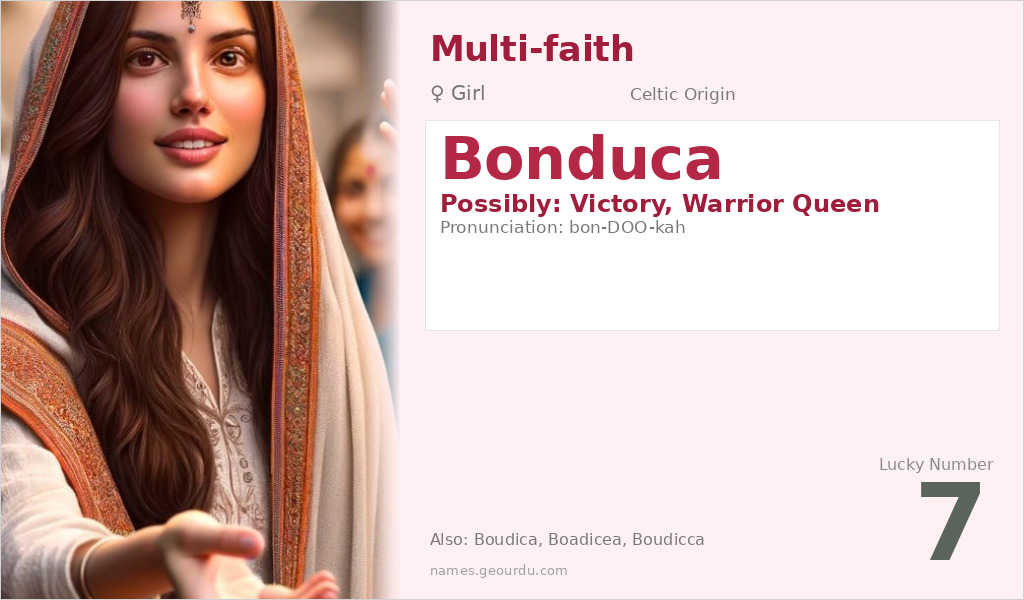
| 📛 Name | Bonduca |
| 💎 Meaning | Possibly: Victory, Warrior Queen |
| 👤 Gender | Girl |
| 🕌 Religion | Multi-faith |
| 🌍 Origin | Celtic |
| 🗣 Pronunciation | bon-DOO-kah |
| ✍️ Urdu | بونڈوکا |
| ✍️ Arabic | بوندوكا |
| 🔢 Numerology | 7 |
| ✨ Spellings | Boudica, Boadicea, Boudicca, Boudicea |
Origin & Cultural Significance
Bonduca’s origin traces back to ancient Celtic Britain through its connection to Queen Boudica of the Iceni tribe. The historical Boudica lived in what is now East Anglia, England, during the 1st century AD and became a symbol of resistance against foreign domination. Her name was recorded by Roman historians like Tacitus and Cassius Dio, with variations in spelling over time. The modern form ‘Bonduca’ appears in some historical texts and adaptations, possibly influenced by Renaissance or Victorian-era interpretations. Unlike names with continuous usage in religious or cultural traditions, Bonduca remains primarily a historical reference rather than a conventional given name in any specific culture or religion today.
Personality Traits
While personality traits associated with names are largely cultural constructs rather than scientific facts, the historical connection to Queen Boudica might inspire certain associations. Individuals named Bonduca could be perceived as strong, independent, and courageous, reflecting the warrior queen’s legacy. The name might suggest leadership qualities, resilience in adversity, and a protective nature toward community or family. However, these traits are speculative and based on historical narrative rather than established naming traditions or psychological studies.
Similar Names
If you like Bonduca, consider: Boudica, Victoria, Nike, Sigrid, Gwendolyn
Famous People Named Bonduca
- Boudica (also spelled Boadicea) — Celtic queen of the Iceni tribe who led a major uprising against the Roman Empire in ancient Britain
- No other verified famous people named Bonduca exist in historical or contemporary records
Frequently Asked Questions About Bonduca
What does Bonduca mean?
Bonduca likely derives from Boudica, the Celtic queen's name meaning 'victorious' or 'victory' in Proto-Celtic. However, Bonduca itself is not documented in any language dictionaries with a verified meaning.
Is Bonduca a boy or girl name?
Bonduca is used as a girl's name, following the historical figure Boudica who was female. There are no records of it being used for boys in any cultural tradition.
What is the origin of Bonduca?
Bonduca originates from ancient Celtic Britain as a variant of Boudica, the name of a 1st-century queen who led a rebellion against Roman rule. It is not associated with any specific modern religion or cultural naming tradition.





