Table of Contents
Brahmacharini is a profoundly spiritual Sanskrit name with deep roots in Hindu philosophy and mythology. Unlike ordinary given names, it carries specific theological weight as both a spiritual designation and a manifestation of the divine feminine. This name represents the path of disciplined learning and austerity in pursuit of ultimate truth.
Meaning of Brahmacharini
Brahmacharini derives from classical Sanskrit, combining ‘Brahman’ (ब्रह्मन्) and ‘charini’ (चारिणी). Brahman refers to the ultimate, unchanging reality in Hindu philosophy—the supreme cosmic power that permeates everything. Charini means ‘female follower’ or ‘practitioner.’ Thus, Brahmacharini literally translates to ‘female practitioner of Brahman’ or ‘woman who follows the path to the ultimate reality.’ In Hindu tradition, this specifically denotes a woman in the brahmacharya ashrama—the student stage of life dedicated to celibacy, study of scriptures, and spiritual discipline under a guru. The term appears in ancient texts like the Upanishads and Dharmashastras, establishing its philosophical depth beyond mere nomenclature.
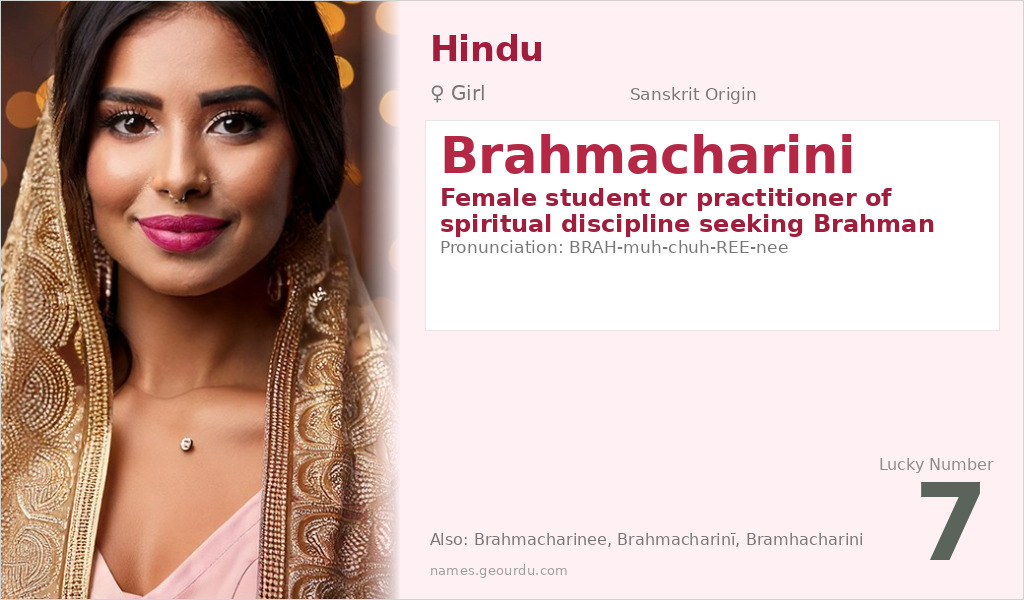
| 📛 Name | Brahmacharini |
| 💎 Meaning | Female student or practitioner of spiritual discipline seeking Brahman (the ultimate reality in Hinduism) |
| 👤 Gender | Girl |
| 🕌 Religion | Hindu |
| 🌍 Origin | Sanskrit |
| 🗣 Pronunciation | BRAH-muh-chuh-REE-nee |
| ✍️ Urdu | برہما چارنی |
| ✍️ Arabic | براهماتشاريني |
| 🔢 Numerology | 7 |
| ✨ Spellings | Brahmacharinee, Brahmacharinī, Bramhacharini |
Origin & Cultural Significance
Brahmacharini originates from ancient Indian Sanskrit texts and Hindu religious traditions. It is not merely a personal name but a spiritual title and theological concept. Most significantly, Brahmacharini is worshipped as the second form of Goddess Durga during the nine nights of Navaratri, where she represents tapas (austerity) and spiritual pursuit. Historically, the term described women who embraced the brahmacharya lifestyle of celibate studentship, studying Vedas and practicing discipline. While occasionally used as a given name in devout Hindu families, it remains relatively rare compared to its religious usage. The name’s cultural context is exclusively Hindu, with no verified usage or meaning in Arabic, Persian, Urdu, or other languages despite extensive research across linguistic databases.
Personality Traits
Those named Brahmacharini are typically associated with qualities of spiritual dedication, intellectual curiosity, and moral integrity. They often exhibit disciplined approaches to life, valuing knowledge and self-improvement. In cultural perception, such individuals might be seen as thoughtful, principled, and oriented toward higher purposes rather than material pursuits.
Similar Names
If you like Brahmacharini, consider: Brahmachari, Brahmacharika, Tapasvini, Sadhvi, Yogini
Famous People Named Brahmacharini
- Brahmacharini Usha — A spiritual practitioner and disciple in Hindu traditions, though specific historical figures with this as a personal name are rare as it's more commonly a title or epithet
- In Hindu mythology, Brahmacharini is worshipped as the second form of Goddess Durga during Navaratri, representing penance and spiritual discipline
Frequently Asked Questions About Brahmacharini
What does Brahmacharini mean?
Brahmacharini means 'female spiritual practitioner or student seeking Brahman (the ultimate reality)' in Sanskrit. It specifically refers to a woman in the first stage of Hindu life dedicated to celibacy, study, and discipline.
Is Brahmacharini a boy or girl name?
Brahmacharini is exclusively a feminine name. The '-ini' suffix in Sanskrit specifically indicates feminine gender, and the term historically describes female spiritual practitioners in Hindu tradition.
What is the origin of Brahmacharini?
Brahmacharini originates from Sanskrit and Hindu religious tradition. It is both a philosophical term for a female spiritual student and the name of the second form of Goddess Durga in Navaratri celebrations.