
Table of Contents
Brajendra is a beautiful and meaningful Sanskrit name that carries deep cultural and spiritual significance in Hindu tradition. Derived from the sacred region of Braj associated with Lord Krishna’s childhood, this name evokes images of divine pastoral beauty and leadership. As a compound name meaning ‘Lord of Braj’, it connects the bearer to one of Hinduism’s most beloved spiritual landscapes. Parents choosing this name often seek to imbue their child with qualities of protection, leadership, and spiritual connection.
Meaning of Brajendra
Brajendra is a classical Sanskrit compound name with clear etymological roots. The first component ‘Braj’ (also spelled Vraj) refers to the pastoral region in northern India where Lord Krishna spent his childhood, literally meaning ‘cow pasture’ or ‘settlement’. The second component ‘Indra’ is a common Sanskrit suffix meaning ‘lord’, ‘ruler’, or ‘king’, derived from the name of the Vedic deity Indra. When combined, Brajendra literally translates to ‘Lord of Braj’ or ‘Ruler of Braj’, specifically referring to Krishna’s dominion over this sacred region. This naming pattern follows traditional Sanskrit morphology where ‘Indra’ serves as a honorific suffix indicating mastery or leadership. The name’s meaning is well-documented in Sanskrit literature and Hindu religious texts, making it a name with both linguistic precision and spiritual depth.
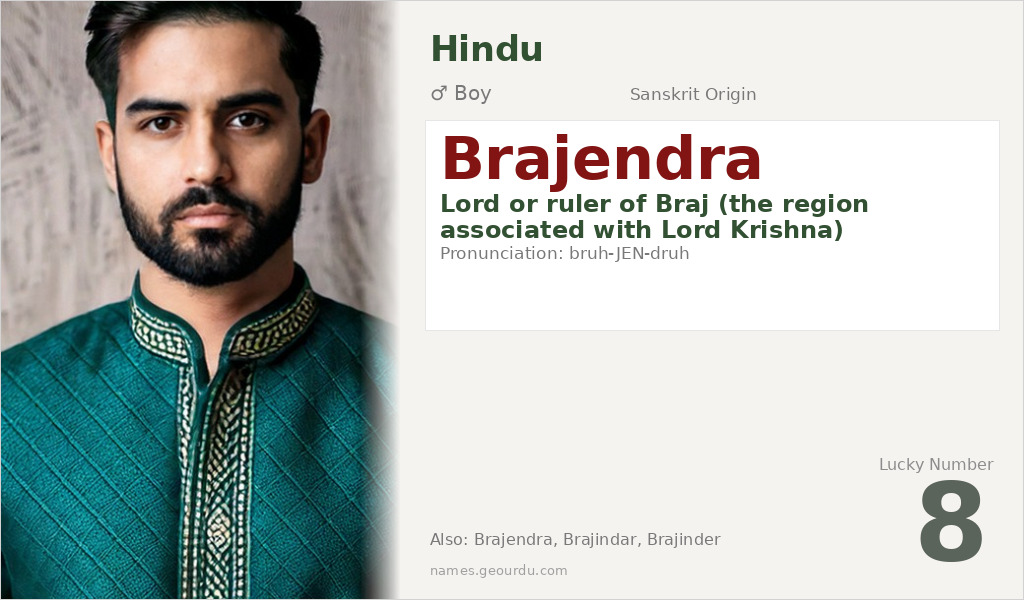
| 📛 Name | Brajendra |
| 💎 Meaning | Lord or ruler of Braj (the region associated with Lord Krishna) |
| 👤 Gender | Boy |
| 🕌 Religion | Hindu |
| 🌍 Origin | Sanskrit |
| 🗣 Pronunciation | bruh-JEN-druh |
| ✍️ Urdu | برجیندر |
| ✍️ Arabic | براجيندرا |
| 🔢 Numerology | 8 |
| ✨ Spellings | Brajendra, Brajindar, Brajinder, Vrajendra |
Origin & Cultural Significance
Brajendra originates from classical Sanskrit, the ancient liturgical language of Hinduism. Its cultural context is deeply rooted in the Braj region (modern-day Mathura district in Uttar Pradesh, India), which holds immense significance in Hindu mythology as the childhood home of Lord Krishna. The name emerged from the devotional (bhakti) traditions that flourished in this region, particularly during the medieval period when Krishna worship became widespread. As a compound name, it follows the traditional Sanskrit practice of creating meaningful names through word combination, similar to other names ending in ‘-endra’ like Rajendra (king of kings) or Mahendra (great lord). While primarily used in Hindu communities, the name has spread through the Indian diaspora and appears in various regions where Sanskrit-derived names are appreciated for their spiritual and linguistic heritage.
Personality Traits
Those named Brajendra are often perceived as having a balanced personality that combines leadership qualities with spiritual sensitivity. The name’s association with the Braj region suggests someone who is nurturing, protective, and connected to nature, much like the pastoral landscape it references. The ‘Indra’ component implies natural authority and organizational ability, while the ‘Braj’ element adds creativity, devotion, and emotional depth. This combination typically results in individuals who are both practical and philosophical, capable of leading while maintaining strong ethical and spiritual foundations.
Similar Names
If you like Brajendra, consider: Krishna, Govinda, Gopal, Madhav, Shyam
Famous People Named Brajendra
- Brajendra Nath Seal — Indian philosopher and social reformer (1864-1938)
- Brajendra Kumar Sanyal — Indian classical vocalist of the Agra gharana
Frequently Asked Questions About Brajendra
What does Brajendra mean?
Brajendra means 'Lord of Braj' or 'Ruler of Braj' in Sanskrit, specifically referring to the sacred region associated with Lord Krishna's childhood in Hindu tradition.
Is Brajendra a boy or girl name?
Brajendra is exclusively a boy's name in Hindu naming tradition, following the grammatical gender patterns of Sanskrit where '-endra' endings are masculine.
What is the origin of Brajendra?
Brajendra originates from classical Sanskrit, combining 'Braj' (the pastoral region of Krishna's childhood) and 'Indra' (meaning lord or ruler), creating a name deeply rooted in Hindu cultural and religious context.





