
Table of Contents
Brita is a charming Scandinavian name with deep Celtic roots that has traveled across centuries and cultures. While most familiar in Nordic countries, this name carries the powerful meaning of ‘exalted one’ from its ancient origins. With its soft sound and noble meaning, Brita offers both traditional heritage and contemporary appeal for parents seeking a name with historical depth.
Meaning of Brita
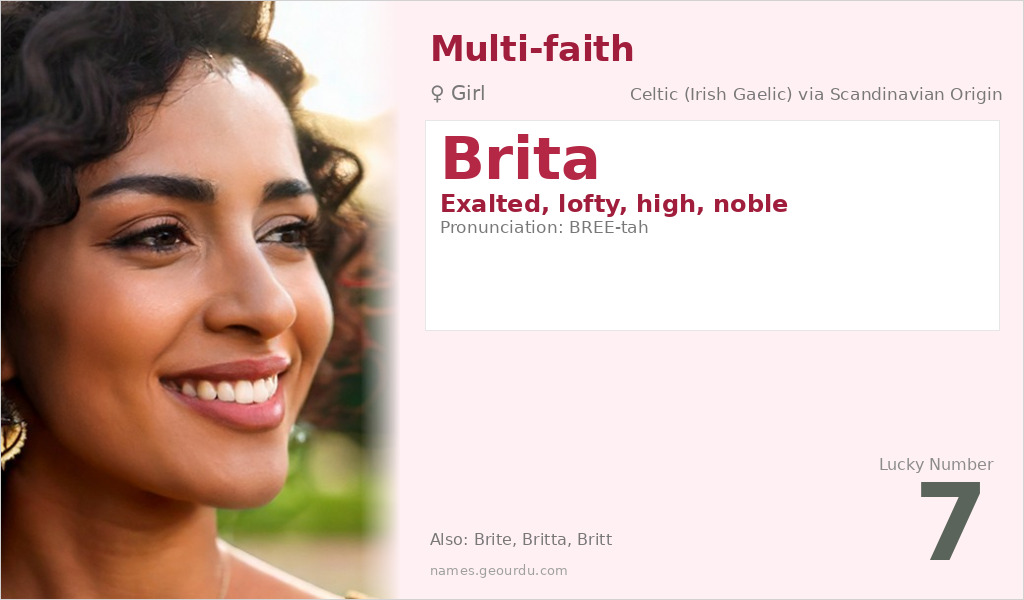
The name Brita derives from the Scandinavian diminutive of Birgitta, which is the Swedish form of Bridget. Its ultimate origin traces back to the Irish Gaelic name Brighid, composed of the elements ‘brígh’ meaning ‘power, strength, virtue’ and the suffix ‘-id’ indicating a person. In Celtic mythology, Brighid was a triple goddess of poetry, healing, and smithcraft, whose name meant ‘the exalted one’. When Christianity spread to Ireland, the goddess was transformed into Saint Bridget of Kildare, one of Ireland’s patron saints. The diminutive form Brita emerged in Scandinavian countries as a familiar, affectionate version of the formal Birgitta, maintaining the core meaning of nobility and exaltation.
| 📛 Name | Brita |
| 💎 Meaning | Exalted, lofty, high, noble |
| 👤 Gender | Girl |
| 🕌 Religion | Multi-faith |
| 🌍 Origin | Celtic (Irish Gaelic) via Scandinavian |
| 🗣 Pronunciation | BREE-tah |
| ✍️ Urdu | بریٹا |
| ✍️ Arabic | بريتا |
| 🔢 Numerology | 7 |
| ✨ Spellings | Brite, Britta, Britt, Bridget, Birgitta |
Origin & Cultural Significance
Brita originated as a Scandinavian diminutive form that gained popularity throughout Sweden, Norway, Denmark, and Finland. The name entered Scandinavian culture through the Christianization of the region and the veneration of Saint Bridget (Birgitta in Swedish). Saint Bridget of Sweden (1303-1373) was a mystic and founder of the Bridgettine Order, further popularizing the name throughout Scandinavia. While the name has Christian associations through Saint Bridget, its roots are firmly planted in pre-Christian Celtic culture, making it a name that bridges pagan and Christian traditions. Today, Brita remains particularly popular in Sweden and Finland, where it maintains its traditional charm while feeling fresh and accessible.
Personality Traits
Those named Brita often embody the noble qualities suggested by their name’s meaning. They tend to approach life with dignity and purpose, valuing integrity and authenticity in their relationships and endeavors. The name’s Scandinavian origins may reflect in practical, grounded personalities with a touch of mystical intuition inherited from its Celtic roots. Britas are frequently described as resilient individuals who carry themselves with quiet confidence and inner strength.
Similar Names
If you like Brita, consider: Bridget, Birgitta, Brigid, Britta, Brittany
Famous People Named Brita
- Brita Borg — Swedish singer and actress known as 'Sweden's Doris Day'
- Brita Koivunen — Finnish singer who won the 1956 Eurovision Song Contest
Frequently Asked Questions About Brita
What does Brita mean?
Brita means 'exalted', 'lofty', 'high', or 'noble'. It originates from the Celtic Irish Gaelic name Brighid via Scandinavian diminutive forms.
Is Brita a boy or girl name?
Brita is exclusively a girl's name. It developed as a feminine diminutive in Scandinavian countries and has never been used traditionally for boys.
What is the origin of Brita?
Brita has Celtic origins via Scandinavian adaptation. It comes from the Irish Gaelic Brighid, meaning 'exalted one', which became Bridget in English, Birgitta in Swedish, and the diminutive Brita in Scandinavian languages.





