
Table of Contents
Bryon is a distinctive masculine name with roots stretching back to ancient Celtic and Greek civilizations. While often confused with the more common Brian, Bryon carries its own unique linguistic heritage and historical significance. This name has maintained a quiet presence across English-speaking countries for centuries, appealing to parents seeking a classic yet uncommon choice. Understanding Bryon’s true origins reveals a fascinating journey from ancient topographical terms to modern personal nomenclature.
Meaning of Bryon
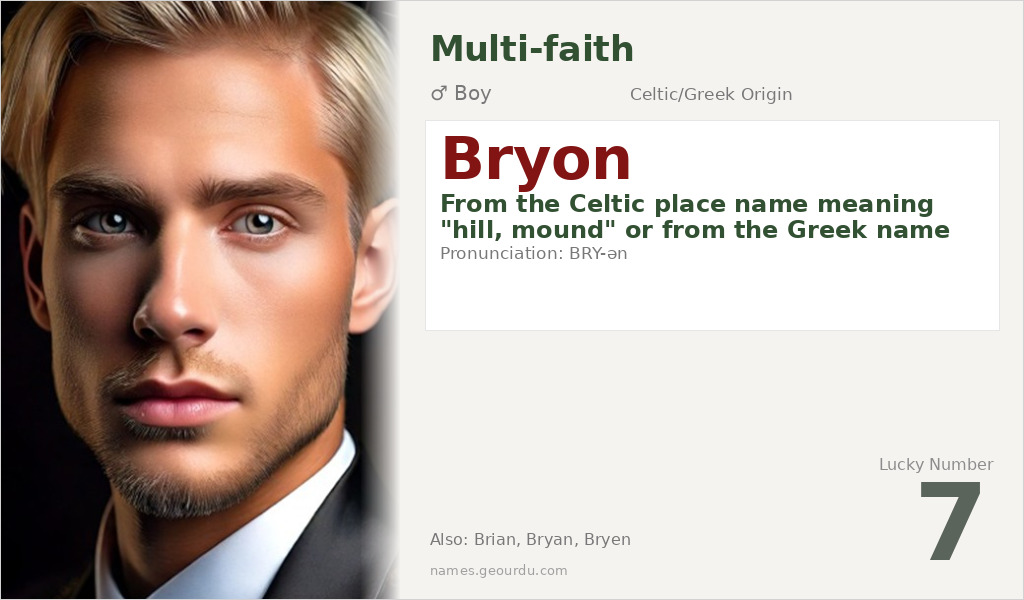
The name Bryon has two well-documented meanings from different linguistic traditions. From the Celtic languages, it derives from the Old Celtic word “briga,” meaning “high place,” “hill,” or “mound,” which was used to describe elevated geographical features. This evolved into Bryon as both a place name and personal name in medieval Britain. Simultaneously, Bryon originates from the Ancient Greek word “βρύον” (bryon), meaning “moss,” which was used as a given name in Hellenistic culture. These dual origins reflect how names can travel across cultures while maintaining distinct meanings. The Celtic meaning emphasizes strength and elevation, while the Greek meaning connects to nature and growth.
| 📛 Name | Bryon |
| 💎 Meaning | From the Celtic place name meaning "hill, mound" or from the Greek name Βρύων (Bryon) meaning "moss" |
| 👤 Gender | Boy |
| 🕌 Religion | Multi-faith |
| 🌍 Origin | Celtic/Greek |
| 🗣 Pronunciation | BRY-ən |
| ✍️ Urdu | برائیون |
| ✍️ Arabic | بريون |
| 🔢 Numerology | 7 |
| ✨ Spellings | Brian, Bryan, Bryen, Briant, Bryant |
Origin & Cultural Significance
Bryon’s origins trace to two ancient civilizations: the Celtic peoples of Western Europe and the Greek world of the Mediterranean. The Celtic version emerged as a topographical surname in medieval England and Ireland, describing someone who lived near or on a hill. The Greek version appears in historical records from the Hellenistic period onward. The name gained popularity in English-speaking countries during the 20th century, particularly in the United States and United Kingdom, often as a variant spelling of Brian. Unlike many names tied to specific religious traditions, Bryon has been used across multiple faiths and cultures without strong religious associations.
Personality Traits
Those named Bryon are often perceived as thoughtful, grounded individuals with a connection to both nature and intellect. The name’s meanings—”hill” and “moss”—suggest stability, growth, and resilience. Many Bryons exhibit a balance between practical sensibility and philosophical depth, making them reliable friends and insightful thinkers. Their personality often reflects the name’s dual heritage: the Celtic strength and elevation combined with the Greek naturalism and subtlety.
Similar Names
If you like Bryon, consider: Brian, Bryan, Bryant, Brendan, Bryson
Famous People Named Bryon
- Bryon Russell — American former professional basketball player who played 13 seasons in the NBA
- Bryon Wilfert — Canadian politician who served as a Member of Parliament from 1997 to 2011
Frequently Asked Questions About Bryon
What does Bryon mean?
Bryon has two verified meanings: from Celtic languages it means "hill" or "mound," and from Ancient Greek it means "moss." Both origins are well-documented in etymological sources.
Is Bryon a boy or girl name?
Bryon is exclusively a masculine name. Historical records and contemporary usage consistently show it as a boy's name across English-speaking cultures.
What is the origin of Bryon?
Bryon originates from both Celtic and Greek languages. The Celtic version comes from Old Celtic "briga" meaning "high place," while the Greek version comes from "βρύον" (bryon) meaning "moss."





