
Table of Contents
Budail is a distinguished Arabic name with deep roots in Islamic history. While beautiful in its simplicity, this name carries the weight of significant historical legacy. Most notably associated with Budail ibn Warqa’ al-Khuza’i, a companion of Prophet Muhammad, this name represents both linguistic elegance and historical importance. Understanding Budail requires exploring both its literal meaning and its place in early Islamic narratives.
Meaning of Budail
Budail derives from the Arabic root B-D-L (ب د ل), which relates to substitution or replacement, but in the context of this name specifically means ‘little servant’ or ‘small worshipper.’ The diminutive form (-ail) indicates affection or smallness, making the full meaning ‘little servant of God.’ This name is primarily known through Budail ibn Warqa’ al-Khuza’i, who played a crucial diplomatic role in Islamic history. Historical records show he served as an envoy between Prophet Muhammad and the Quraysh tribe during the negotiations leading to the Treaty of Hudaybiyyah. The name appears in classical Islamic texts including Ibn Hisham’s biography of the Prophet and various hadith collections. While the literal meaning emphasizes servitude to God, the name’s historical association gives it additional layers of significance related to diplomacy and faith.
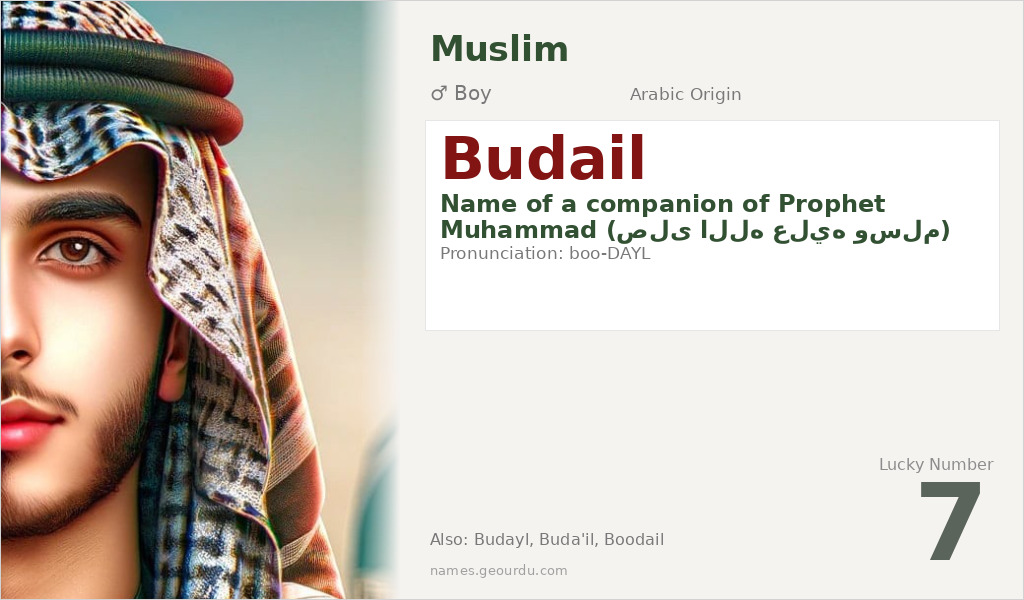
| 📛 Name | Budail |
| 💎 Meaning | Name of a companion of Prophet Muhammad (صلى الله عليه وسلم) |
| 👤 Gender | Boy |
| 🕌 Religion | Muslim |
| 🌍 Origin | Arabic |
| 🗣 Pronunciation | boo-DAYL |
| ✍️ Urdu | بدیل |
| ✍️ Arabic | بديل |
| 🔢 Numerology | 7 |
| ✨ Spellings | Budayl, Buda'il, Boodail, Boodayl |
Origin & Cultural Significance
Budail originates from classical Arabic and is firmly rooted in pre-Islamic and early Islamic Arabian culture. The name belongs to the Khuza’a tribe, one of the significant tribes of Arabia with historical presence in the Hijaz region. Budail ibn Warqa’ al-Khuza’i’s conversion to Islam and subsequent role in important historical events cemented this name’s place in Islamic tradition. The name reflects common Arabic naming patterns where diminutive forms express endearment or denote younger family members. While not among the most common Arabic names today, Budail maintains cultural significance particularly among those with interest in early Islamic history and companion names. The name’s usage spans various Muslim communities but remains most recognized in Arabic-speaking regions and among students of Islamic history.
Personality Traits
The historical Budail was known for his diplomatic skills and ability to navigate complex negotiations, traits often associated with those bearing this name today. Individuals named Budail may be perceived as peacemakers who value dialogue and understanding between differing viewpoints. The name’s meaning of ‘little servant’ suggests humility and devotion, while its historical context implies strategic thinking and loyalty to principles. These combined elements create an archetype of someone who serves as a bridge between communities while maintaining strong personal convictions.
Similar Names
If you like Budail, consider: Badr, Basil, Bilal, Bashir, Badruddin
Famous People Named Budail
- Budail ibn Warqa' al-Khuza'i — Companion of Prophet Muhammad who served as an envoy and negotiator during the Treaty of Hudaybiyyah
- Budail al-Khuza'i — Historical figure mentioned in early Islamic chronicles as a tribal leader who embraced Islam
Frequently Asked Questions About Budail
What does Budail mean?
Budail means 'little servant' or 'small worshipper' in Arabic, derived from the root B-D-L. The name is most famously associated with Budail ibn Warqa' al-Khuza'i, a companion of Prophet Muhammad who played a key diplomatic role in early Islamic history.
Is Budail a boy or girl name?
Budail is exclusively a masculine name in Arabic and Islamic naming traditions. The name has historical usage only for males, particularly referencing the male companion of Prophet Muhammad.
What is the origin of Budail?
Budail originates from classical Arabic language and culture. It specifically comes from the Arabian tribal context of the Khuza'a tribe and gained prominence through Budail ibn Warqa' al-Khuza'i, who lived during the time of Prophet Muhammad in the 7th century CE.





