
Table of Contents
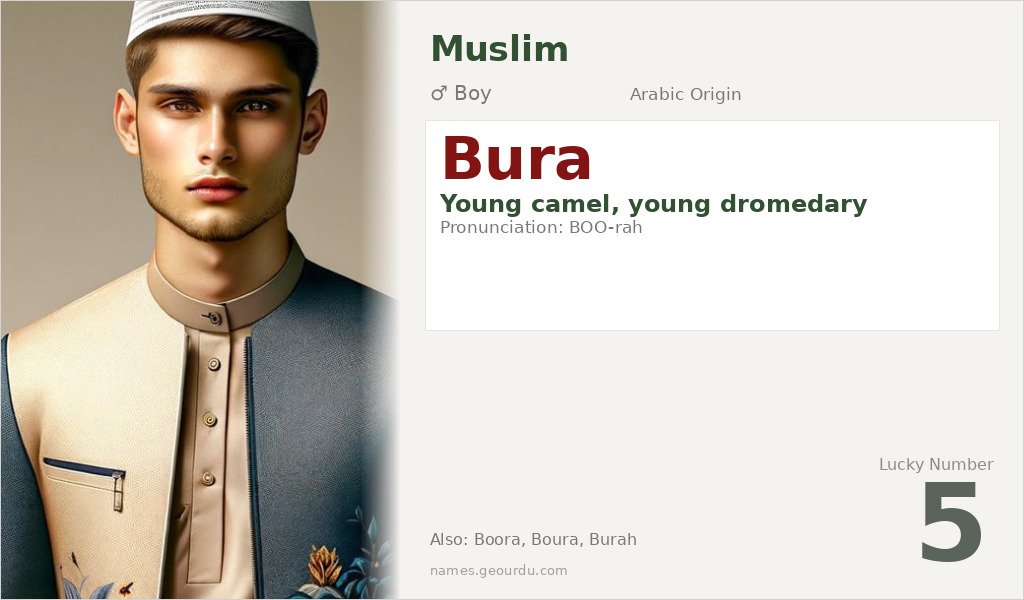
Bura is a distinctive Arabic name with deep cultural roots, often chosen for boys in Muslim communities. Meaning ‘young camel,’ it evokes images of endurance and new beginnings in desert landscapes. This name carries a rich linguistic heritage that connects to traditional Bedouin and Arab pastoral life. Explore the true meaning and significance of Bura beyond common misconceptions.
Meaning of Bura
Bura derives from the Arabic root ب-ر-و (b-r-w), which is associated with youth and weaning. Specifically, it refers to a young camel or dromedary that has recently been separated from its mother, symbolizing a stage of early independence and hardiness. In classical Arabic, terms like ‘bura’ are used in poetry and prose to describe the vitality of young animals, reflecting broader themes of growth and resilience. This meaning is well-documented in Arabic lexicons such as Lisan al-Arab and modern dictionaries, confirming its etymology. Unlike some speculative interpretations, Bura does not mean ‘safe’ or ‘out of danger’; its primary connotation is always linked to youthful camels. The name’s usage spans various Arabic-speaking regions, maintaining this consistent meaning across dialects.
| 📛 Name | Bura |
| 💎 Meaning | Young camel, young dromedary |
| 👤 Gender | Boy |
| 🕌 Religion | Muslim |
| 🌍 Origin | Arabic |
| 🗣 Pronunciation | BOO-rah |
| ✍️ Urdu | بُرا |
| ✍️ Arabic | بُرا |
| 🔢 Numerology | 5 |
| ✨ Spellings | Boora, Boura, Burah |
Origin & Cultural Significance
Bura originates from the Arabic language, with its usage traced to pre-Islamic and Islamic eras in the Arabian Peninsula. It is rooted in the nomadic and pastoral traditions of Arab tribes, where camels were essential for survival, trade, and transportation. The name reflects the cultural importance of camels, often symbolizing wealth, endurance, and life in harsh environments. Over time, Bura has been adopted in Muslim communities worldwide, particularly in regions like the Middle East, South Asia, and North Africa, where Arabic influence is strong. While it is primarily an Arabic name, similar-sounding names exist in other languages, but Bura itself remains firmly Arabic in origin and meaning.
Personality Traits
People named Bura are often perceived as resilient and adaptable, drawing from the symbolic strength of a young camel. They may possess a natural independence and a capacity to thrive in challenging situations, much like their namesake in desert climates. This name suggests a personality that is both vigorous and nurturing, with a tendency to approach life with youthful enthusiasm and determination.
Similar Names
If you like Bura, consider: Jamal, Hilal, Badr, Faris, Zaid
Famous People Named Bura
- Bura Khan — historical Baloch chieftain and tribal leader
- Bura Öz — Turkish musician and composer
Frequently Asked Questions About Bura
What does Bura mean?
Bura means 'young camel' or 'young dromedary' in Arabic, derived from the root ب-ر-و (b-r-w) related to youth and weaning.
Is Bura a boy or girl name?
Bura is traditionally a boy's name in Arabic and Muslim cultures, though naming conventions can vary by region.
What is the origin of Bura?
Bura originates from the Arabic language, with deep roots in the pastoral and nomadic traditions of the Arabian Peninsula.





