
Table of Contents
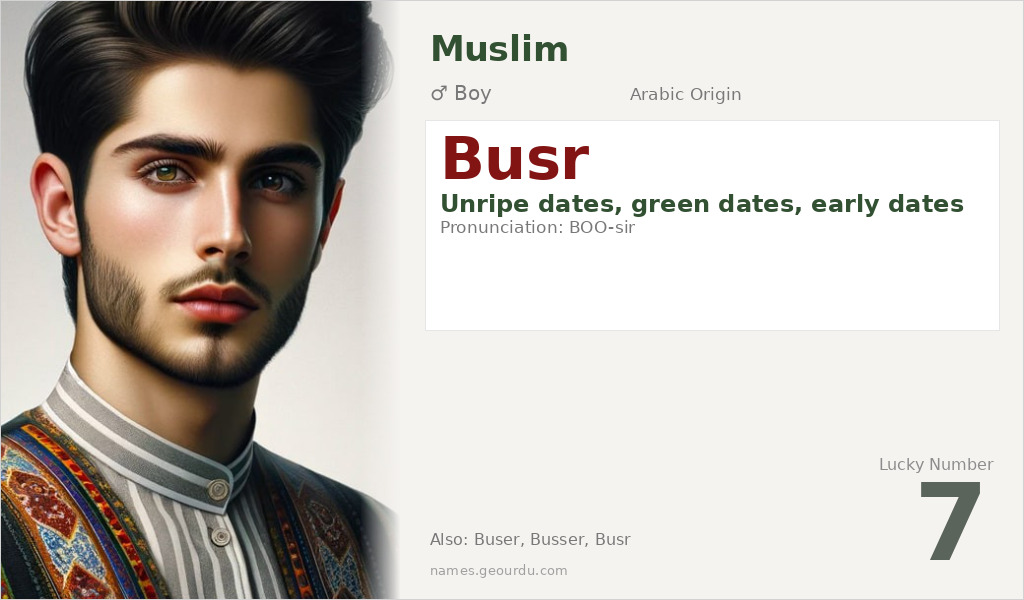
Busr is a distinctive Arabic name with deep cultural and linguistic roots in the Arab world. Meaning ‘unripe dates’ or ‘green dates,’ this name carries the symbolism of freshness, new beginnings, and natural bounty. While less common than some Arabic names today, Busr has historical significance and appears in early Islamic records. Its connection to the date palm—a tree of immense importance in desert cultures—gives it particular resonance in Middle Eastern naming traditions.
Meaning of Busr
Busr (بسر) is an Arabic term with a very specific meaning: it refers to dates that are still unripe, typically green or yellow in color before they mature into the brown dates familiar to most people. The word comes from the Arabic root ب-س-ر (b-s-r), which conveys concepts of early stages, beginnings, and immaturity. In traditional Arab societies, busr represented the first edible stage of the date’s development, valued for its crisp texture and tart flavor that contrasts with the sweetness of ripe dates. This linguistic specificity makes Busr an example of how Arabic names often derive from precise natural phenomena. The term appears consistently in classical Arabic literature, including pre-Islamic poetry and early Islamic texts, maintaining its exact meaning across centuries.
| 📛 Name | Busr |
| 💎 Meaning | Unripe dates, green dates, early dates |
| 👤 Gender | Boy |
| 🕌 Religion | Muslim |
| 🌍 Origin | Arabic |
| 🗣 Pronunciation | BOO-sir |
| ✍️ Urdu | بسر |
| ✍️ Arabic | بسر |
| 🔢 Numerology | 7 |
| ✨ Spellings | Buser, Busser, Busr |
Origin & Cultural Significance
Busr originates from Classical Arabic and is deeply embedded in the cultural context of the Arabian Peninsula and surrounding regions. The name reflects the central importance of date palms in desert societies, where dates provided essential nutrition and the palm tree offered shade, building materials, and economic value. As a personal name, Busr appears in early Islamic history, most notably with Busr ibn Abi Artat, a military commander during the First Fitna (civil war) in the 7th century. The name’s usage reflects the Arab tradition of naming children after natural elements, agricultural products, or stages of growth. While primarily used in Arabic-speaking Muslim communities, the name’s straightforward meaning and pleasant sound have occasionally led to usage in other Muslim cultures familiar with Arabic terminology.
Personality Traits
Those named Busr are often associated with qualities of freshness, potential, and natural vitality. Like the unripe dates their name represents, they may embody the promise of growth and development, showing resilience in challenging environments. Their personality might reflect the symbolic transition from crisp tartness to mature sweetness, suggesting someone who develops depth and wisdom over time. The connection to agriculture and natural cycles may indicate a grounded, practical nature with appreciation for traditional values and sustainable growth.
Similar Names
If you like Busr, consider: Basr, Bashir, Basil, Bassam, Baraa
Famous People Named Busr
- Busr ibn Abi Artat — Early Islamic military commander who fought in the Battle of Siffin (657 CE) on the side of Mu'awiya I
- Busr al-Hilali — Noted Arab poet from the pre-Islamic era whose works are preserved in classical Arabic anthologies
Frequently Asked Questions About Busr
What does Busr mean?
Busr means 'unripe dates' or 'green dates' in Arabic. It specifically refers to dates that are still in their early, crisp stage before ripening fully.
Is Busr a boy or girl name?
Busr is traditionally a masculine name in Arabic naming conventions. It follows the pattern of many Arabic names derived from concrete nouns that are typically given to boys.
What is the origin of Busr?
Busr originates from Classical Arabic language and culture. It comes from the Arabic root ب-س-ر (b-s-r) and reflects the importance of date palms in traditional Arab societies.





