
Table of Contents
Buz is an ancient name with deep roots in Semitic languages and cultures. While often associated with Muslim communities today, its origins trace back to Hebrew scripture and pre-Islamic Arabia. This name carries the straightforward meaning of ‘goat’ or ‘he-goat,’ reflecting the pastoral traditions of its earliest bearers. Understanding Buz requires looking beyond modern associations to its historical and linguistic foundations.
Meaning of Buz
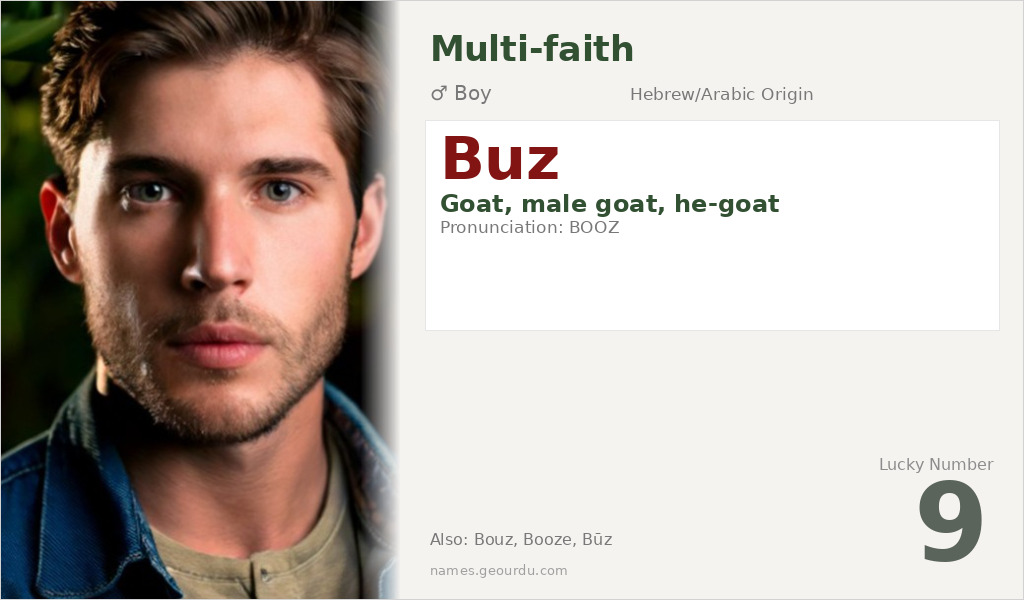
The name Buz unequivocally means ‘goat’ or ‘male goat’ in both Hebrew (בּוּז) and Arabic (بُوز). In Hebrew, it appears in the Old Testament as a personal name (Genesis 22:21) and geographical reference (Job 32:2). The Arabic form maintains the same zoological meaning, with بُوز specifically denoting a he-goat. This meaning is well-documented in classical dictionaries like Lane’s Arabic-English Lexicon and Brown-Driver-Briggs Hebrew Lexicon. The name reflects the common practice in Semitic cultures of using animal names for people, often symbolizing desirable traits like strength, fertility, or independence. There is no linguistic connection to ‘ice cream’—that appears to be a modern misinterpretation or fabrication.
| 📛 Name | Buz |
| 💎 Meaning | Goat, male goat, he-goat |
| 👤 Gender | Boy |
| 🕌 Religion | Multi-faith |
| 🌍 Origin | Hebrew/Arabic |
| 🗣 Pronunciation | BOOZ |
| ✍️ Urdu | بوز |
| ✍️ Arabic | بُوز |
| 🔢 Numerology | 9 |
| ✨ Spellings | Bouz, Booze, Būz |
Origin & Cultural Significance
Buz originates from the Semitic language family, with its earliest attested usage in Hebrew Biblical texts dating to approximately the first millennium BCE. It was borne by Buz, son of Nahor and nephew of Abraham, indicating its use among early Northwest Semitic peoples. The name also appears in pre-Islamic Arabian contexts, with Buz ibn Qays recorded among the Tamim tribe. While adopted by some Muslim communities, particularly in Arabic-speaking regions, it is not exclusively Islamic—it predates Islam and has Biblical Hebrew origins. The name’s persistence across millennia demonstrates the continuity of certain naming traditions in the Middle East.
Personality Traits
Names often carry symbolic associations, and Buz’s meaning as ‘goat’ suggests characteristics of resilience, independence, and practicality. Like goats that thrive in rugged terrain, individuals named Buz may exhibit adaptability and determination. They often approach life with a grounded, no-nonsense attitude, valuing stability and reliability. While these traits are cultural associations rather than deterministic, they reflect the qualities traditionally admired in pastoral societies where such names originated.
Similar Names
If you like Buz, consider: Baz, Bilal, Bashir, Badi, Baqir
Famous People Named Buz
- Buz ibn Qays — Pre-Islamic Arabian figure from the tribe of Tamim, mentioned in early Islamic historical sources
- Buz — Biblical figure, son of Nahor and Milcah, mentioned in Genesis 22:21 as Abraham's nephew
Frequently Asked Questions About Buz
What does Buz mean?
Buz means 'goat' or 'male goat' in both Hebrew and Arabic. It is an ancient Semitic name with Biblical and pre-Islamic usage.
Is Buz a boy or girl name?
Buz is exclusively a masculine name in all historical and contemporary usage, reflecting its meaning as 'he-goat.'
What is the origin of Buz?
Buz originates from the Semitic language family, with earliest documented use in Hebrew Biblical texts and pre-Islamic Arabian culture.





