
Table of Contents
Cain is a name rich in history and meaning, spanning multiple cultures and languages. From its biblical origins to Celtic and Germanic roots, this name carries layers of significance that have evolved over millennia. Whether you’re drawn to its ancient heritage or its strong phonetic appeal, Cain offers a timeless choice for a baby boy. Explore the fascinating etymology and cultural contexts behind this enduring name.
Meaning of Cain
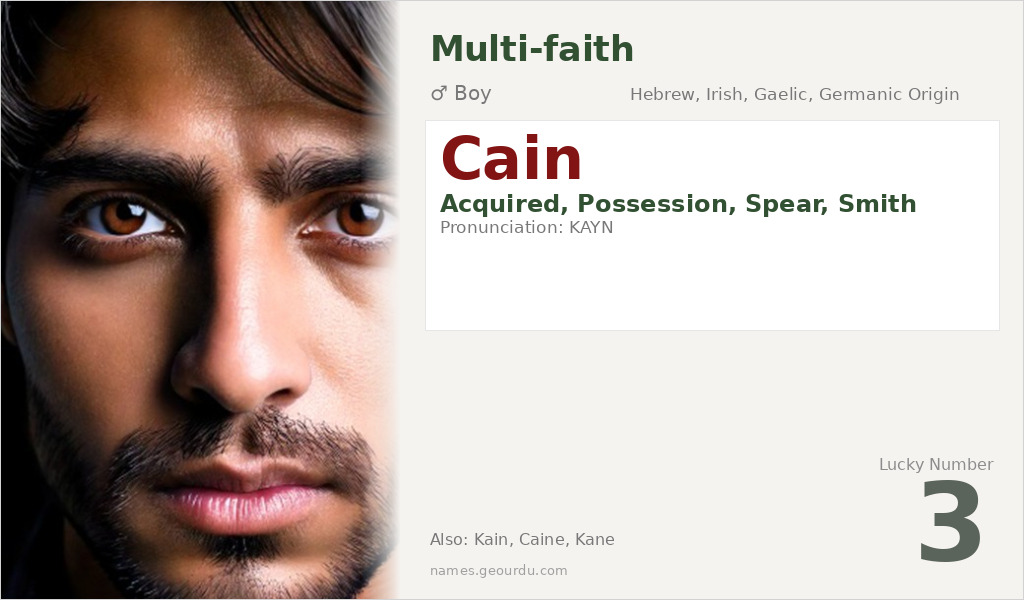
The name Cain primarily derives from the Hebrew word ‘Qayin’ (קַיִן), meaning ‘acquired’ or ‘possession,’ as Eve expresses in Genesis 4:1 upon his birth. This Hebrew root ‘qanah’ signifies to get, acquire, or create. In Irish and Gaelic, Cain (or Cian) translates to ‘ancient’ or ‘enduring,’ from Old Irish ‘cían.’ Additionally, in Old German, it relates to ‘kain-‘ meaning ‘to strike,’ associated with ‘spear’ or ‘smith,’ reflecting a warrior or craftsman connotation. These diverse meanings highlight the name’s linguistic depth across Semitic, Celtic, and Germanic traditions.
| 📛 Name | Cain |
| 💎 Meaning | Acquired, Possession, Spear, Smith |
| 👤 Gender | Boy |
| 🕌 Religion | Multi-faith |
| 🌍 Origin | Hebrew, Irish, Gaelic, Germanic |
| 🗣 Pronunciation | KAYN |
| ✍️ Urdu | قابیل |
| ✍️ Arabic | قابيل |
| 🔢 Numerology | 3 |
| ✨ Spellings | Kain, Caine, Kane, Kayn, Cayn |
Origin & Cultural Significance
Cain’s origins are multifaceted, with its most famous usage in the Hebrew Bible as the first son of Adam and Eve, a figure also mentioned in the Quran as Qabil. Beyond Abrahamic texts, the name appears in Irish mythology as Cian, father of the hero Lugh, and in Germanic languages as a term linked to metalworking or weaponry. This cross-cultural presence shows how Cain has been adapted in Jewish, Christian, Islamic, and European pagan contexts. Historically, it has been used in various forms across Europe and the Middle East, evolving in spelling and pronunciation over time.
Personality Traits
Those named Cain often embody traits of determination and independence, influenced by the name’s associations with acquisition and strength. They may be perceived as natural leaders or innovators, capable of forging their own paths. The name’s varied roots suggest a personality that is both reflective of ancient wisdom and adaptable to modern challenges, with an underlying intensity that drives achievement.
Similar Names
If you like Cain, consider: Abel, Seth, Enoch, Cian, Kane
Famous People Named Cain
- Cain Velasquez — American mixed martial artist and former UFC Heavyweight Champion
- Cain Dingle — fictional character from the British TV series 'Emmerdale'
Frequently Asked Questions About Cain
What does Cain mean?
Cain means 'acquired' or 'possession' in Hebrew, from the root 'qanah.' In Irish/Gaelic, it means 'ancient,' and in Germanic, it relates to 'spear' or 'smith.'
Is Cain a boy or girl name?
Cain is traditionally a boy's name, used for males in biblical, Celtic, and Germanic contexts, with no common feminine variants.
What is the origin of Cain?
Cain originates from Hebrew (as Qayin), with additional roots in Irish/Gaelic (as Cian) and Old German, making it a multi-cultural name.





