
Table of Contents
Catharine is a timeless feminine name with deep historical roots and enduring popularity across cultures. Derived from the Greek word for ‘pure’, this elegant name has been borne by saints, royalty, and influential figures throughout history. Its classic spelling variation maintains the traditional charm while offering a distinctive alternative to the more common ‘Catherine’. With its strong Christian associations and cross-cultural appeal, Catharine continues to be a meaningful choice for parents worldwide.
Meaning of Catharine
The name Catharine originates from the Greek Αἰκατερίνη (Aikaterinē), most commonly derived from καθαρός (katharos) meaning ‘pure’ or ‘clear’. This etymology reflects the name’s association with purity and clarity of character. Some linguistic scholars propose alternative origins, including possible connections to the Greek goddess Hecate or the term ‘ἑκάτερος’ (hekateros) meaning ‘each of the two’. Through Latin adaptation as ‘Catharina’, the name spread throughout Europe during the Middle Ages, particularly through veneration of Saint Catherine of Alexandria, whose martyrdom in the 4th century cemented the name’s Christian significance. The spelling ‘Catharine’ represents one of several English variations that developed from these classical roots.
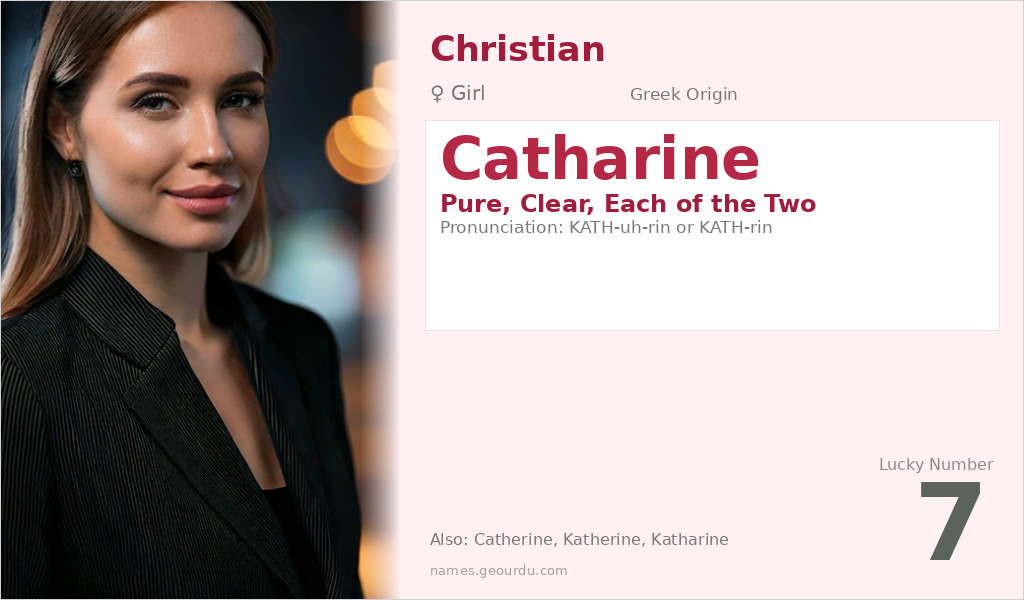
| 📛 Name | Catharine |
| 💎 Meaning | Pure, Clear, Each of the Two |
| 👤 Gender | Girl |
| 🕌 Religion | Christian |
| 🌍 Origin | Greek |
| 🗣 Pronunciation | KATH-uh-rin or KATH-rin |
| ✍️ Urdu | کیتھرین |
| ✍️ Arabic | كاثرين |
| 🔢 Numerology | 7 |
| ✨ Spellings | Catherine, Katherine, Katharine, Kathryn, Cathryn, Katarina, Ekaterina, Katrina |
Origin & Cultural Significance
Catharine has its origins in ancient Greece, where the name Αἰκατερίνη first appeared. The name gained prominence in Christian tradition through Saint Catherine of Alexandria, an early Christian martyr whose story became widely known in medieval Europe. During the Crusades, devotion to Saint Catherine spread throughout Western Europe, making the name particularly popular in France, England, and Italy. The name arrived in England through the Norman Conquest and became established in royal circles, with notable bearers including Catherine of Aragon, first wife of Henry VIII. The spelling ‘Catharine’ emerged as a distinct English variant, maintaining the classical connection while developing its own identity separate from the more common ‘Catherine’.
Personality Traits
Those named Catharine are often associated with qualities of intelligence, integrity, and strength of character. They tend to approach life with clarity of purpose and moral conviction, reflecting the name’s meaning of ‘pure’. Catharines are frequently seen as natural leaders who combine analytical thinking with compassionate understanding. Their traditional yet distinctive name often correlates with individuals who value both heritage and individuality, balancing respect for tradition with personal authenticity.
Similar Names
If you like Catharine, consider: Catherine, Katherine, Kathleen, Caitlin, Katrina, Katarina, Ekaterina, Catalina, Katya, Katerina
Famous People Named Catharine
- Catherine the Great — Empress of Russia from 1762 to 1796
- Catherine, Princess of Wales — Member of the British royal family
- Catherine Zeta-Jones — Welsh actress
- Saint Catherine of Siena — 14th-century Italian mystic and Doctor of the Church
- Catherine O'Hara — Canadian-American actress and comedian
Frequently Asked Questions About Catharine
What does Catharine mean?
Catharine means 'Pure' or 'Clear', derived from the Greek word καθαρός (katharos). Some sources also suggest possible meanings related to 'each of the two' from Greek ἑκάτερος (hekateros).
Is Catharine a boy or girl name?
Catharine is exclusively a feminine name. It has been used for girls and women throughout its history, with no significant masculine usage in any culture.
What is the origin of Catharine?
Catharine originates from ancient Greek, specifically from the name Αἰκατερίνη (Aikaterinē). It spread through Latin as 'Catharina' and became popular throughout Europe via Christian tradition, particularly through veneration of Saint Catherine of Alexandria.





