
Table of Contents
Caturvaktra is a profound Sanskrit name that carries deep mythological significance in Hindu tradition. Meaning ‘four-faced’ or ‘having four aspects’, this name is primarily known as an epithet for Brahma, the creator god in the Hindu trinity. While extremely rare as a personal name, it represents divine wisdom, omniscience, and the comprehensive nature of creation. Exploring Caturvaktra offers insight into Hindu philosophical concepts and naming traditions that draw from sacred literature.
Meaning of Caturvaktra
Caturvaktra is a classical Sanskrit compound name with precise etymological roots. The first component ‘catur’ (चतुर्) means ‘four’ and appears in numerous Sanskrit words like ‘caturanga’ (four-limbed) and ‘caturmukha’ (four-faced). The second component ‘vaktra’ (वक्त्र) translates to ‘face, mouth, countenance, or opening’. Combined, Caturvaktra literally means ‘having four faces’ or ‘four-mouthed’. In Hindu theological context, this refers to Brahma’s four faces that represent the four Vedas (Rig, Yajur, Sama, Atharva), the four directions, and the four aspects of human personality. The name appears in texts like the Vishnu Purana and Shiva Purana as a descriptive title for Brahma, emphasizing his omniscience and creative power.
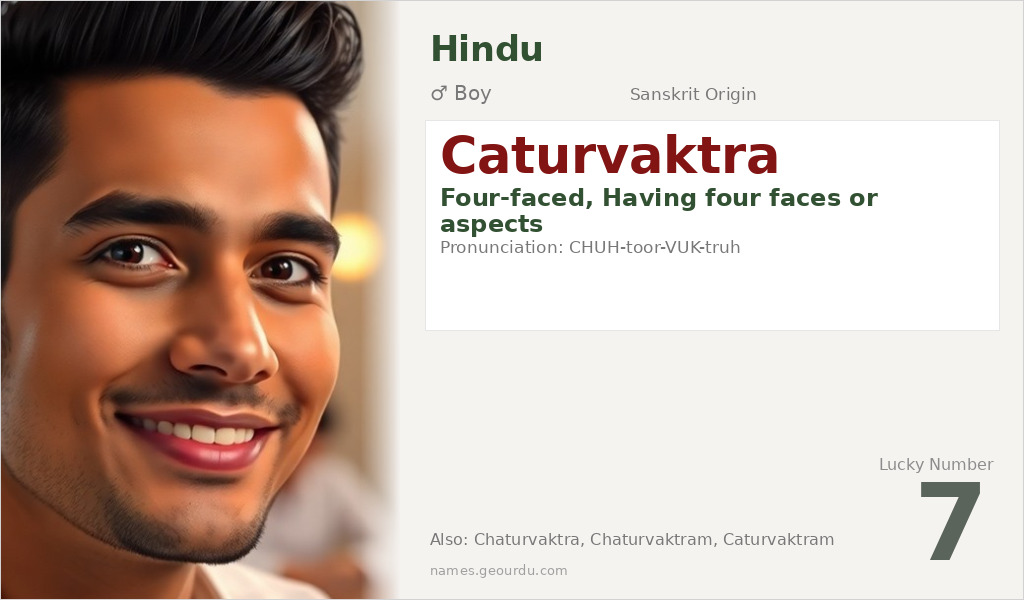
| 📛 Name | Caturvaktra |
| 💎 Meaning | Four-faced, Having four faces or aspects |
| 👤 Gender | Boy |
| 🕌 Religion | Hindu |
| 🌍 Origin | Sanskrit |
| 🗣 Pronunciation | CHUH-toor-VUK-truh |
| ✍️ Urdu | چتروکثرا |
| ✍️ Arabic | كاتورفاكترا |
| 🔢 Numerology | 7 |
| ✨ Spellings | Chaturvaktra, Chaturvaktram, Caturvaktram |
Origin & Cultural Significance
Caturvaktra originates from classical Sanskrit, the liturgical language of Hinduism, and specifically from Hindu mythological literature. Its usage dates back to ancient Indian scriptures where it appears as an epithet rather than a common personal name. In Hindu iconography, Brahma is consistently depicted with four faces, each facing a cardinal direction, symbolizing his all-seeing nature and mastery over the four Vedas. The concept reflects the Hindu philosophical idea of the divine manifesting in multiple aspects to comprehend and govern creation. While occasionally used as a given name in modern times, it remains exceptionally rare and is more commonly encountered in religious texts, temple architecture, and philosophical discussions about the nature of divinity.
Personality Traits
Those named Caturvaktra are often associated with qualities of wisdom, multidimensional thinking, and spiritual depth. The name suggests an individual who can perceive situations from multiple angles, much like the four-faced deity it references. Such persons may exhibit strong intellectual capabilities, creative expression, and a philosophical approach to life. The mythological connection implies leadership qualities, organizational skills, and the ability to synthesize diverse perspectives into coherent understanding.
Similar Names
If you like Caturvaktra, consider: Chaturmukha, Brahma, Vishnu, Shiva, Chaturanga
Famous People Named Caturvaktra
- No known contemporary famous people bear this name as it is primarily a mythological epithet rather than a common personal name
- In Hindu mythology: Brahma — the creator god who is described as Caturvaktra in scriptures
Frequently Asked Questions About Caturvaktra
What does Caturvaktra mean?
Caturvaktra means 'four-faced' or 'having four faces' in Sanskrit. It is primarily an epithet for the Hindu god Brahma, representing his omniscience and connection to the four Vedas.
Is Caturvaktra a boy or girl name?
Caturvaktra is exclusively a boy's name in Hindu tradition, as it refers to the masculine deity Brahma. There are no feminine variants or usages in historical or contemporary contexts.
What is the origin of Caturvaktra?
Caturvaktra originates from Sanskrit, the classical language of ancient India. It comes from Hindu mythology where it describes Brahma's four-faced form, with roots in Vedic and Puranic literature dating back thousands of years.





