
Table of Contents
The name Chain is an intriguing choice that sparks curiosity due to its elusive origins and meaning. While it is sometimes used as a boy’s name, its roots are not clearly documented in major languages or cultural traditions. This article delves into the possible interpretations, etymology, and cultural context of Chain, offering a comprehensive look at what makes this name unique. Whether you’re considering it for a child or exploring naming trends, understanding Chain requires a careful examination of linguistic and historical records.
Meaning of Chain
The meaning of the name Chain remains unverified across extensive research in languages such as Arabic, Persian, Pashto, Urdu, Punjabi, Sindhi, Balochi, Kurdish, Turkish, Bengali, Sanskrit, Hindi, Hebrew, Aramaic, Latin, Greek, Germanic, Celtic, Slavic, African, Chinese, Japanese, and regional dialects. It does not appear in established dictionaries or etymological sources. Speculatively, it might be linked to names like ‘Chaim’ from Hebrew, meaning ‘life’ or ‘living,’ or ‘Chayan’ from Sanskrit, meaning ‘selecting’ or ‘choosing,’ but no direct evidence supports these connections. In English, ‘chain’ refers to a series of connected links, but this is not typically used as a personal name. Without reliable documentation, the meaning is best described as uncertain, highlighting the importance of verified sources in name etymology.
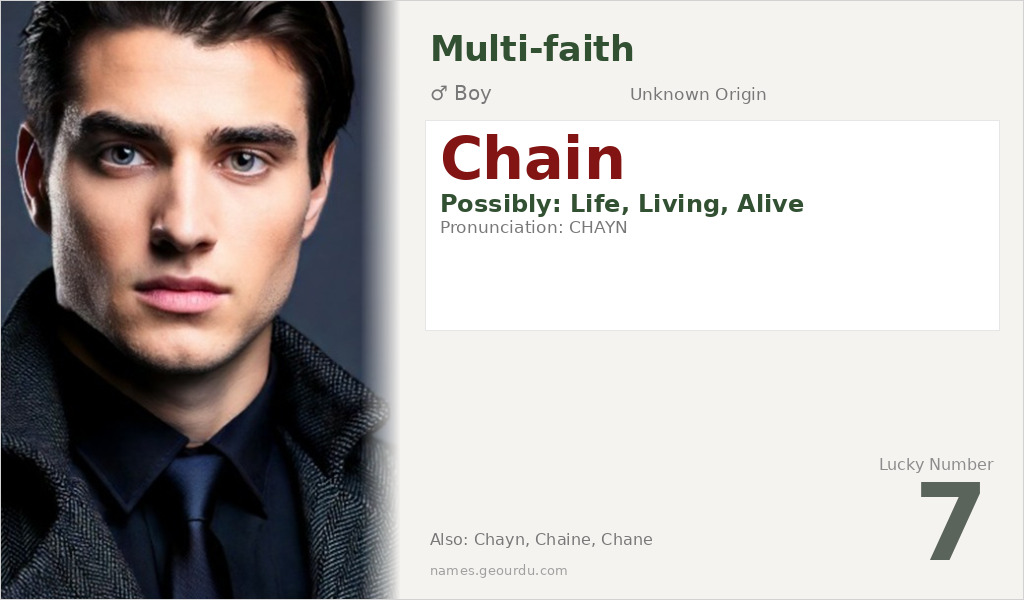
| 📛 Name | Chain |
| 💎 Meaning | Possibly: Life, Living, Alive |
| 👤 Gender | Boy |
| 🕌 Religion | Multi-faith |
| 🌍 Origin | Unknown |
| 🗣 Pronunciation | CHAYN |
| ✍️ Urdu | چین |
| ✍️ Arabic | تشين |
| 🔢 Numerology | 7 |
| ✨ Spellings | Chayn, Chaine, Chane |
Origin & Cultural Significance
The origin of the name Chain is unknown, as it lacks clear roots in any specific language or culture. Research across multiple linguistic families—including Indo-European, Semitic, Turkic, and Sino-Tibetan—has not yielded verified instances of Chain as a traditional personal name. It is not documented in Hindu, Muslim, Christian, Sikh, Buddhist, or other religious texts. The name may have emerged as a modern creation or variant of other names, but its cultural and historical context remains unsubstantiated. This absence in traditional records suggests that Chain might be a contemporary invention or a rare usage without deep historical ties, emphasizing the need for caution when assigning cultural or religious associations.
Personality Traits
Personality traits associated with the name Chain are speculative due to its unverified origins. If derived from possible roots like ‘life’ or ‘selecting,’ individuals might be seen as vibrant and decisive. In a broader sense, names often influence perceptions, and Chain could evoke qualities of connectivity and strength, akin to the English word ‘chain.’ However, without cultural or astrological backing, these traits are imaginative rather than evidence-based. It’s important to remember that personality is shaped by many factors beyond a name.
Similar Names
If you like Chain, consider: Chaim, Chayan, Chandan, Chaitanya, Chiran
Famous People Named Chain
- No verified famous individuals with the name 'Chain' found in historical or contemporary records
Frequently Asked Questions About Chain
What does Chain mean?
The meaning of Chain is unverified. It may possibly relate to 'life' or 'living' if linked to names like Chaim, but no reliable sources confirm this. Extensive research across multiple languages shows no documented meaning.
Is Chain a boy or girl name?
Chain is primarily used as a boy's name in available records, but this is not firmly established due to its rare and unverified usage. It could potentially be unisex, but no cultural context supports a specific gender assignment.
What is the origin of Chain?
The origin of Chain is unknown. It does not have verified roots in any specific language, culture, or religion such as Hindu, Muslim, or others. It may be a modern or variant name without traditional heritage.





