
Table of Contents
Chakravarty is a powerful name with deep roots in ancient Indian civilization, carrying connotations of sovereignty and righteous leadership. Derived from the Sanskrit term for a universal monarch, this name evokes images of chariot wheels rolling unimpeded across vast domains. While more commonly encountered as a surname among certain Hindu communities, it occasionally serves as a given name symbolizing authority and dharma. Its linguistic heritage connects it to philosophical concepts of ideal governance found in Hindu, Buddhist, and Jain traditions.
Meaning of Chakravarty
Chakravarty originates from the Sanskrit compound ‘chakravartin’ (चक्रवर्तिन्), combining ‘chakra’ (wheel, discus, or cycle) and ‘vartin’ (one who turns or causes to revolve). In Vedic and classical Indian literature, a chakravartin was an emperor whose dominion extended as far as his chariot could travel without hindrance, symbolizing both temporal power and spiritual authority. The wheel specifically represents the dharma-chakra (wheel of law), which the ideal ruler turns to maintain cosmic and social order. This concept appears in texts like the Mahabharata, Buddhist sutras, and Jain agamas, where chakravartins are described as possessing seven treasures and ruling with justice. The name thus conveys not merely kingship but enlightened sovereignty that upholds righteousness across diverse territories.
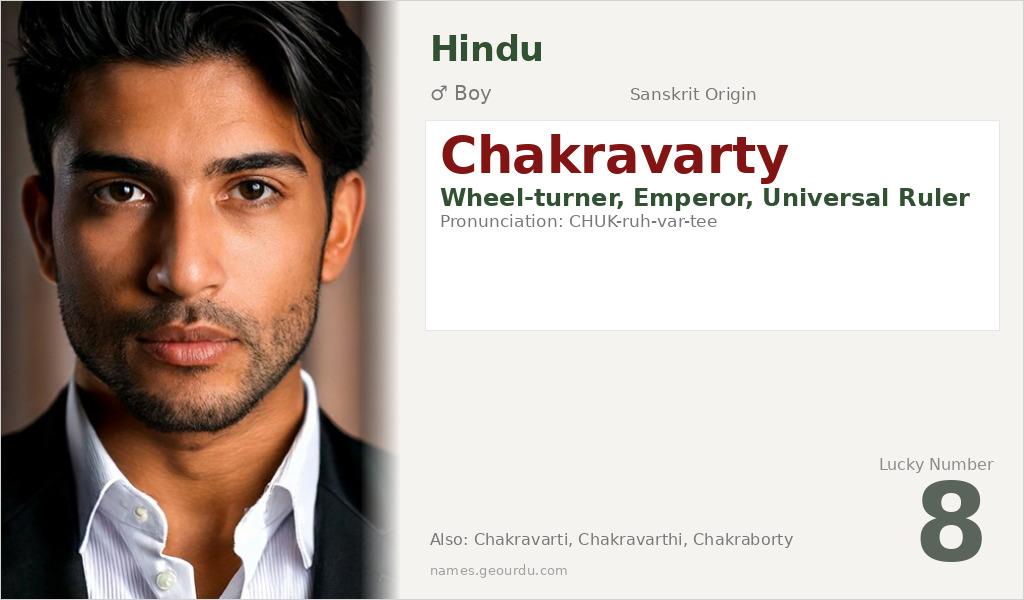
| 📛 Name | Chakravarty |
| 💎 Meaning | Wheel-turner, Emperor, Universal Ruler |
| 👤 Gender | Boy |
| 🕌 Religion | Hindu |
| 🌍 Origin | Sanskrit |
| 🗣 Pronunciation | CHUK-ruh-var-tee |
| ✍️ Urdu | چکرورتی |
| ✍️ Arabic | تشاكرافارتي |
| 🔢 Numerology | 8 |
| ✨ Spellings | Chakravarti, Chakravarthi, Chakraborty, Chakrabarti |
Origin & Cultural Significance
The name Chakravarty emerges from ancient Indian political and religious terminology, particularly within Sanskritic traditions dating back over two millennia. It was originally a title for legendary emperors like Bharata and Ashoka in Hindu and Buddhist narratives, later evolving into a surname among Brahmin and other communities, especially in Bengal and South India. Unlike many personal names, Chakravarty functions primarily as an honorific or family name rather than a common given name, though it is occasionally used as such in modern times. Its cultural significance spans multiple Indian religions, reflecting shared ideals of righteous rule. The variant spellings—Chakravarti, Chakravarthi, Chakraborty—demonstrate regional linguistic adaptations across different Indian languages and scripts.
Personality Traits
Those named Chakravarty are often associated with leadership qualities, strategic thinking, and a strong moral compass. The name’s imperial connotations suggest someone who is ambitious yet principled, capable of guiding others with wisdom and fairness. Such individuals may exhibit natural organizational skills and a tendency to take responsibility in group settings, inspired by the name’s historical connection to dharma-driven governance.
Similar Names
If you like Chakravarty, consider: Chakradhar, Chakrapani, Samrat, Maharaj, Rajendra
Famous People Named Chakravarty
- Subrahmanyan Chandrasekhar — Nobel Prize-winning astrophysicist whose surname 'Chandrasekhar' is sometimes Anglicized from similar roots
- M. S. Swaminathan — Indian geneticist and administrator known as 'Chakravarthy' in agricultural science circles
Frequently Asked Questions About Chakravarty
What does Chakravarty mean?
Chakravarty means 'wheel-turner' or 'universal ruler' in Sanskrit, referring to an ideal emperor who maintains dharma across vast territories.
Is Chakravarty a boy or girl name?
Chakravarty is exclusively a boy's name in Hindu naming traditions, derived from masculine Sanskrit terminology for rulers.
What is the origin of Chakravarty?
Chakravarty originates from Sanskrit, specifically from the compound 'chakravartin' used in ancient Indian Hindu, Buddhist, and Jain texts to denote a righteous universal monarch.





