Table of Contents
Champakavathi is a beautiful and meaningful Sanskrit name for girls that evokes the fragrance and beauty of nature. Derived from the prized champaka flower, this name carries deep cultural and religious significance in Hindu traditions. With its lyrical sound and rich symbolism, Champakavathi represents both natural elegance and spiritual devotion. Discover the fascinating origins and characteristics associated with this distinctive name.
Meaning of Champakavathi
Champakavathi is a compound Sanskrit name with clear etymological roots. The first component, ‘Champaka,’ refers specifically to the Magnolia champaca tree and its highly fragrant golden-yellow flowers, which hold sacred importance in Hinduism, Buddhism, and Jainism. These flowers are traditionally used in temple offerings, particularly to deities like Vishnu and Krishna, and are mentioned in ancient texts like the Ramayana and Mahabharata. The suffix ‘-vathi’ is a feminine possessive form derived from the Sanskrit root ‘vat,’ meaning ‘having’ or ‘possessing.’ Thus, the complete name translates to ‘she who has champaka flowers’ or ‘owner of champaka trees,’ symbolizing beauty, fragrance, prosperity, and divine connection. Unlike many names that have evolved across languages, Champakavathi remains firmly rooted in classical Sanskrit without significant variation in other linguistic traditions.
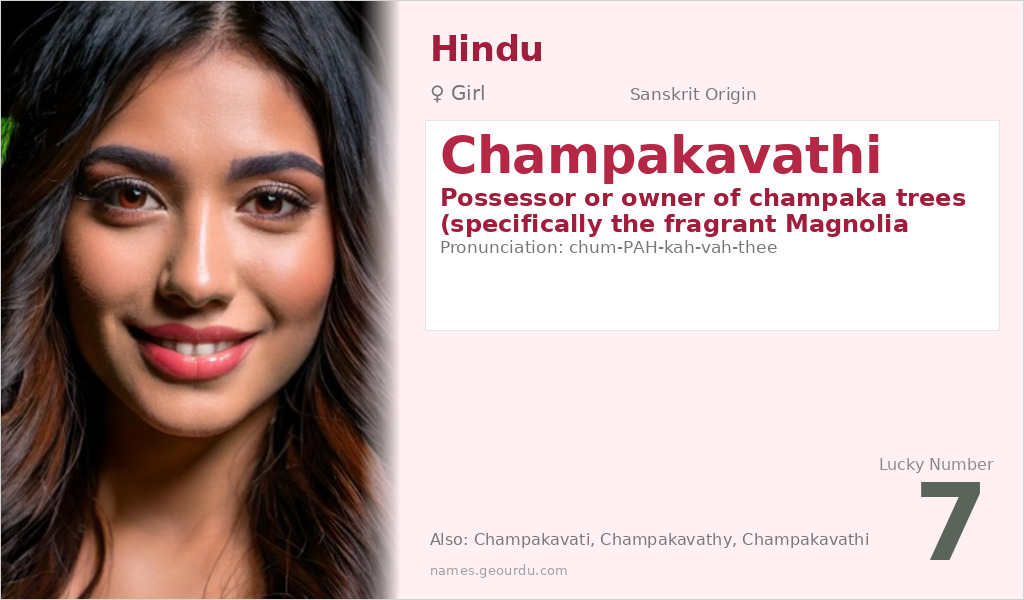
| 📛 Name | Champakavathi |
| 💎 Meaning | Possessor or owner of champaka trees (specifically the fragrant Magnolia champaca) |
| 👤 Gender | Girl |
| 🕌 Religion | Hindu |
| 🌍 Origin | Sanskrit |
| 🗣 Pronunciation | chum-PAH-kah-vah-thee |
| ✍️ Urdu | چمپکاوتی |
| ✍️ Arabic | تشامباكافاثي |
| 🔢 Numerology | 7 |
| ✨ Spellings | Champakavati, Champakavathy, Champakavathi |
Origin & Cultural Significance
Champakavathi originates from classical Sanskrit, the ancient liturgical language of Hinduism, Buddhism, and Jainism. The name emerges from India’s rich botanical and cultural heritage, where the champaka flower (Magnolia champaca) has been revered for millennia for its exquisite fragrance and religious significance. In Hindu mythology, the champaka is associated with Kamadeva, the god of love, and is mentioned in numerous Sanskrit literary works as a symbol of beauty and devotion. While the name is primarily used in Hindu communities, particularly in South India and among Sanskrit enthusiasts, it doesn’t appear to have parallel forms or meanings in Arabic, Persian, Turkish, or other regional languages despite extensive research. The name reflects the Sanskrit tradition of creating compound names that describe positive qualities or connections to nature.
Personality Traits
Those named Champakavathi are often perceived as having qualities reminiscent of the champaka flower itself: graceful, fragrant in personality, and naturally attractive. They may possess artistic talents, a love for beauty in all forms, and a nurturing disposition that draws others to them. The name suggests someone who values tradition, spirituality, and natural harmony, potentially exhibiting both strength and gentleness in character.
Similar Names
If you like Champakavathi, consider: Champakali, Champika, Malathi, Pushpavathi, Kusumavati
Famous People Named Champakavathi
- No widely known contemporary public figures with this name found in records
- The name appears in classical Sanskrit literature and regional Hindu traditions as a poetic or mythological reference
Frequently Asked Questions About Champakavathi
What does Champakavathi mean?
Champakavathi means 'possessor or owner of champaka trees' in Sanskrit, specifically referring to the fragrant Magnolia champaca flower prized in Hindu traditions.
Is Champakavathi a boy or girl name?
Champakavathi is exclusively a feminine name in Sanskrit due to its '-vathi' suffix, which is a feminine possessive form. There is no masculine equivalent in traditional usage.
What is the origin of Champakavathi?
Champakavathi originates from classical Sanskrit, the ancient language of India, and is deeply rooted in Hindu cultural and botanical traditions surrounding the sacred champaka flower.