
Table of Contents
Chandrakanth is a beautiful and traditional Sanskrit name for boys, deeply rooted in Hindu culture and mythology. Combining ‘Chandra’ (moon) and ‘Kanth’ (throat or crest), it evokes imagery of the moon’s luminous beauty and preciousness. This name has been cherished for centuries in Indian communities, symbolizing serenity, creativity, and divine connection. Explore the rich etymology and cultural significance of Chandrakanth in this detailed guide.
Meaning of Chandrakanth
Chandrakanth is derived from Sanskrit, an ancient Indo-Aryan language with a rich literary and religious heritage. The first component, ‘Chandra’ (चन्द्र), directly translates to ‘moon’ and is a common element in Indian names, associated with lunar deities like Chandra, the Hindu god of the moon. The second component, ‘Kanth’ (कण्ठ), means ‘throat, neck, or crest’, and in poetic contexts, it implies something valuable or jewel-like, akin to a necklace (‘kantha’). Thus, Chandrakanth literally means ‘moon’s throat’ but is poetically interpreted as ‘moonstone’—a gem believed to be formed from moonbeams—or ‘moon’s crest’, referring to the brightest part of the moon. This name highlights the aesthetic and metaphorical use of language in Sanskrit, where natural elements are often personified or adorned with symbolic meanings.
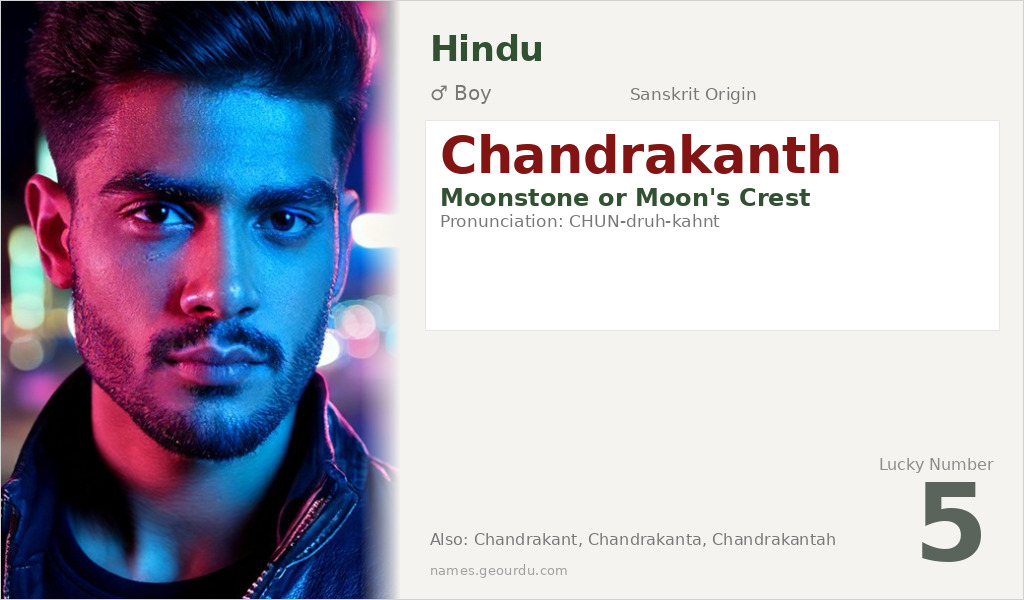
| 📛 Name | Chandrakanth |
| 💎 Meaning | Moonstone or Moon's Crest |
| 👤 Gender | Boy |
| 🕌 Religion | Hindu |
| 🌍 Origin | Sanskrit |
| 🗣 Pronunciation | CHUN-druh-kahnt |
| ✍️ Urdu | چندرکانتھ |
| ✍️ Arabic | تشاندراكانث |
| 🔢 Numerology | 5 |
| ✨ Spellings | Chandrakant, Chandrakanta, Chandrakantah |
Origin & Cultural Significance
Chandrakanth originates from Sanskrit, the classical language of ancient India, and is predominantly used within Hindu communities. It appears in Hindu scriptures and poetry, where the moon is revered as a symbol of calmness, beauty, and cyclical renewal. The name is common in India, Nepal, and among the Hindu diaspora, reflecting the enduring influence of Sanskrit on Indian naming traditions. Historically, names like Chandrakanth were chosen to invoke divine qualities or natural elements, aligning with Hindu beliefs in astrology and spirituality. Its usage persists today, often given to boys born under auspicious lunar phases or to honor cultural heritage.
Personality Traits
People named Chandrakanth are often perceived as gentle, imaginative, and introspective, mirroring the moon’s tranquil and reflective nature. They may excel in creative fields such as art, writing, or music, drawing inspiration from their intuitive and emotional depth. Their calm demeanor and loyalty make them valued friends and family members, often serving as peacemakers in conflicts.
Similar Names
If you like Chandrakanth, consider: Chandrashekhar, Chandraprakash, Chandramohan, Kanth, Chandrika
Famous People Named Chandrakanth
- Chandrakant Borde — Indian cricketer and former national selector
- Chandrakant Bakshi — Indian author and columnist in Gujarati literature
Frequently Asked Questions About Chandrakanth
What does Chandrakanth mean?
Chandrakanth means 'moonstone' or 'moon's crest' in Sanskrit, derived from 'Chandra' (moon) and 'Kanth' (throat/crest).
Is Chandrakanth a boy or girl name?
Chandrakanth is traditionally a boy's name in Hindu culture, though variations like Chandrakanta can be feminine.
What is the origin of Chandrakanth?
Chandrakanth originates from Sanskrit, an ancient Indian language, and is primarily used in Hindu communities.





