Table of Contents
Chandramani is a beautiful and poetic Sanskrit name for girls, evoking the serene beauty of the moon adorned with jewels. Rooted in ancient Hindu tradition, this name carries deep cultural and spiritual significance, symbolizing purity, radiance, and celestial grace. Often chosen for its lyrical quality and auspicious connotations, Chandramani connects the bearer to lunar deities and natural elegance. In this guide, we explore its rich etymology, historical usage, and modern appeal.
Meaning of Chandramani
Chandramani derives from the Sanskrit words ‘Chandra’ (moon) and ‘Mani’ (jewel), forming a compound that literally translates to ‘jewel of the moon’ or ‘moonstone.’ In Sanskrit linguistics, it is a tatpurusha compound, where ‘Chandra’ modifies ‘Mani’ to indicate possession or association. This name is deeply embedded in Hindu mythology and literature, often used to describe the moon’s luminous beauty or as an epithet for goddesses like Chandraghanta, a form of Durga. The term ‘Chandramani’ also refers to the moonstone gem in Ayurveda and gemology, believed to have calming properties. Its usage spans classical texts, poetry, and modern naming practices, maintaining its original meaning without significant alteration across centuries.
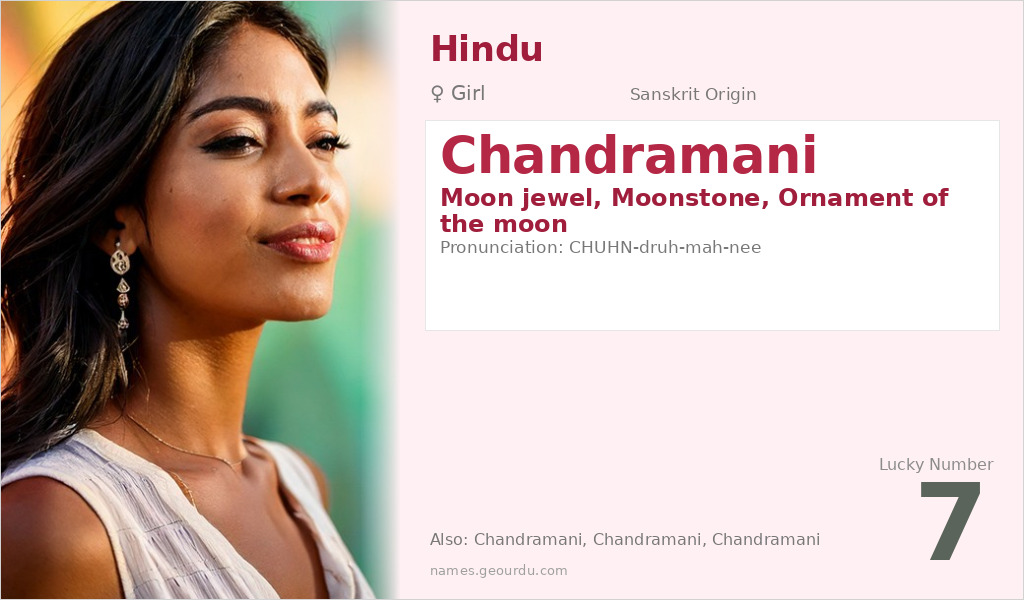
| 📛 Name | Chandramani |
| 💎 Meaning | Moon jewel, Moonstone, Ornament of the moon |
| 👤 Gender | Girl |
| 🕌 Religion | Hindu |
| 🌍 Origin | Sanskrit |
| 🗣 Pronunciation | CHUHN-druh-mah-nee |
| ✍️ Urdu | چندرمانی |
| ✍️ Arabic | تشاندراماني |
| 🔢 Numerology | 7 |
| ✨ Spellings | Chandramani, Chandramani, Chandramani |
Origin & Cultural Significance
Chandramani originates from Sanskrit, the ancient liturgical language of Hinduism, with its earliest documented uses found in Vedic and post-Vedic Sanskrit literature. It is predominantly used within Hindu communities in India, Nepal, and the diaspora, reflecting the cultural importance of lunar symbolism in South Asian traditions. The name is associated with the moon god Chandra in Hindu mythology, who represents mind, emotions, and fertility. Historically, it has been used for girls in royal and artistic families, symbolizing elegance and divine connection. While it remains most common in Sanskrit-derived languages like Hindi, it has not been adopted into Arabic, Persian, or other regional languages with verified independent meanings, confirming its specific Hindu-Sanskrit origin.
Personality Traits
Those named Chandramani are often seen as gentle, imaginative, and spiritually inclined, with a natural affinity for arts and introspection. Their lunar namesake suggests a personality that is reflective, empathetic, and adaptable to changing circumstances. They may exhibit a quiet strength and a nurturing demeanor, inspiring others with their creativity and inner peace. This name imbues a sense of timeless beauty and emotional depth, shaping individuals who value harmony and aesthetic expression.
Similar Names
If you like Chandramani, consider: Chandrika, Chandrani, Indumati, Tarani, Shashi
Famous People Named Chandramani
- Chandramani — Indian classical dancer and choreographer known for Bharatanatyam performances
- Chandramani Singh — Historical figure, Maharani of Jaipur in the 18th century
Frequently Asked Questions About Chandramani
What does Chandramani mean?
Chandramani means 'moon jewel' or 'moonstone' in Sanskrit, derived from 'Chandra' (moon) and 'Mani' (jewel).
Is Chandramani a boy or girl name?
Chandramani is traditionally a girl's name in Hindu culture, though it is rarely used for boys; its feminine association is strong in Sanskrit naming conventions.
What is the origin of Chandramani?
Chandramani originates from Sanskrit, an ancient Indian language, and is used primarily in Hindu communities, with no verified meanings in Arabic, Persian, or other languages.