Table of Contents
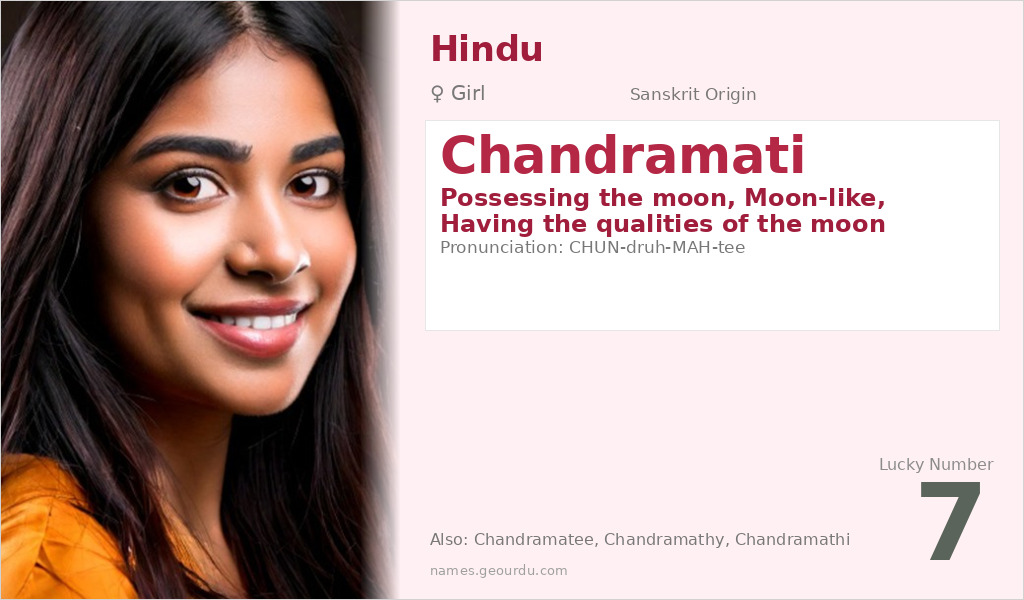
Chandramati is a beautiful Sanskrit name for girls that literally means ‘possessing the moon’ or ‘moon-like’. Rooted in ancient Indian tradition, this name carries the luminous qualities associated with the celestial moon – beauty, serenity, and gentle radiance. As a compound name from classical Sanskrit, Chandramati represents more than just physical beauty; it embodies the intellectual and spiritual qualities symbolized by the moon in Hindu cosmology. This name continues to be cherished in Hindu families seeking names with deep cultural resonance and poetic meaning.
Meaning of Chandramati
Chandramati is a Sanskrit compound name with precise linguistic construction. The first component ‘Chandra’ (चन्द्र) refers to the moon, one of the most important celestial bodies in Hindu tradition, associated with beauty, coolness, and the mind. The second component ‘Mati’ (मति) comes from the Sanskrit root ‘man’ meaning ‘to think’ or ‘to have’, and in this context functions as a suffix indicating possession or quality. When combined, Chandramati literally means ‘one who has the moon’ or ‘moon-possessing’. This differs from simpler moon-related names as it emphasizes ownership of lunar qualities rather than mere comparison. In Vedic and classical Sanskrit literature, such compound names were carefully constructed to convey specific attributes, with ‘-mati’ being a common suffix in feminine names denoting possession of desirable characteristics.
| 📛 Name | Chandramati |
| 💎 Meaning | Possessing the moon, Moon-like, Having the qualities of the moon |
| 👤 Gender | Girl |
| 🕌 Religion | Hindu |
| 🌍 Origin | Sanskrit |
| 🗣 Pronunciation | CHUN-druh-MAH-tee |
| ✍️ Urdu | چندر متی |
| ✍️ Arabic | تشاندراماتي |
| 🔢 Numerology | 7 |
| ✨ Spellings | Chandramatee, Chandramathy, Chandramathi |
Origin & Cultural Significance
Chandramati originates from classical Sanskrit, the liturgical language of Hinduism that has influenced naming traditions across South Asia for millennia. The name appears in ancient Indian texts and folklore, most notably associated with Queen Chandramati, the devoted wife of the legendary King Harishchandra whose story is told in the Markandeya Purana and other scriptures. This royal association gives the name historical depth and cultural significance. As a Sanskrit name, Chandramati follows the sophisticated morphological patterns of classical Indian onomastics, where compound names were created to express specific virtues and qualities. The name’s lunar symbolism connects it to Hindu cosmology where the moon (Chandra) is not just a celestial body but also a deity and a symbol of the mind, emotions, and the cyclical nature of time.
Personality Traits
Those named Chandramati are often associated with lunar characteristics – calmness, intuition, and reflective wisdom. Like the moon’s phases, they may display adaptability and emotional depth, with a natural ability to navigate life’s cycles with grace. Their presence tends to be soothing and magnetic, drawing people toward their composed and thoughtful nature. The intellectual component of ‘mati’ suggests they possess not just beauty but also mental acuity and perceptiveness.
Similar Names
If you like Chandramati, consider: Chandrika, Chandrani, Chandrabhaga, Chandramukhi, Chandralekha
Famous People Named Chandramati
- Chandramati – Legendary queen in Hindu mythology, wife of King Harishchandra known for her devotion and virtue
- Chandramati – Character in ancient Indian literature and folk traditions, often representing ideal womanhood
Frequently Asked Questions About Chandramati
What does Chandramati mean?
Chandramati literally means 'possessing the moon' or 'moon-like' in Sanskrit, derived from 'Chandra' (moon) and 'Mati' (having/possessing).
Is Chandramati a boy or girl name?
Chandramati is exclusively a feminine name in Hindu naming tradition, following Sanskrit grammatical gender rules where '-mati' endings typically indicate feminine names.
What is the origin of Chandramati?
Chandramati originates from classical Sanskrit, the ancient language of Hindu scriptures, and has been used in Indian culture for centuries, notably appearing in Puranic literature as the name of a legendary queen.