
Table of Contents
Chetanananda is a profound Sanskrit name that carries centuries of spiritual wisdom within its syllables. Primarily used for boys in Hindu families, this name beautifully combines two essential concepts from Indian philosophy: consciousness and bliss. It represents the ideal state of being that spiritual seekers aspire to achieve through self-realization. Today, it remains a meaningful choice for parents seeking a name with deep philosophical resonance.
Meaning of Chetanananda
Chetanananda is a compound Sanskrit name with precise linguistic roots. The first component, ‘Chetana’ (चेतन), derives from the Sanskrit root ‘cit’ meaning ‘to perceive’ or ‘to be conscious’, referring to the essential awareness that characterizes living beings. The second component, ‘Ananda’ (आनन्द), comes from the root ‘nand’ meaning ‘to rejoice’ or ‘to be happy’, representing spiritual joy rather than temporary pleasure. Together, they form ‘Chetanananda’ meaning ‘bliss of consciousness’ or ‘joy of the soul’. This concept is central to Hindu philosophy, particularly in Advaita Vedanta where it describes the state of realizing one’s true nature as pure consciousness experiencing eternal bliss. The name appears in various Hindu texts and spiritual traditions as both a personal name and a philosophical concept.
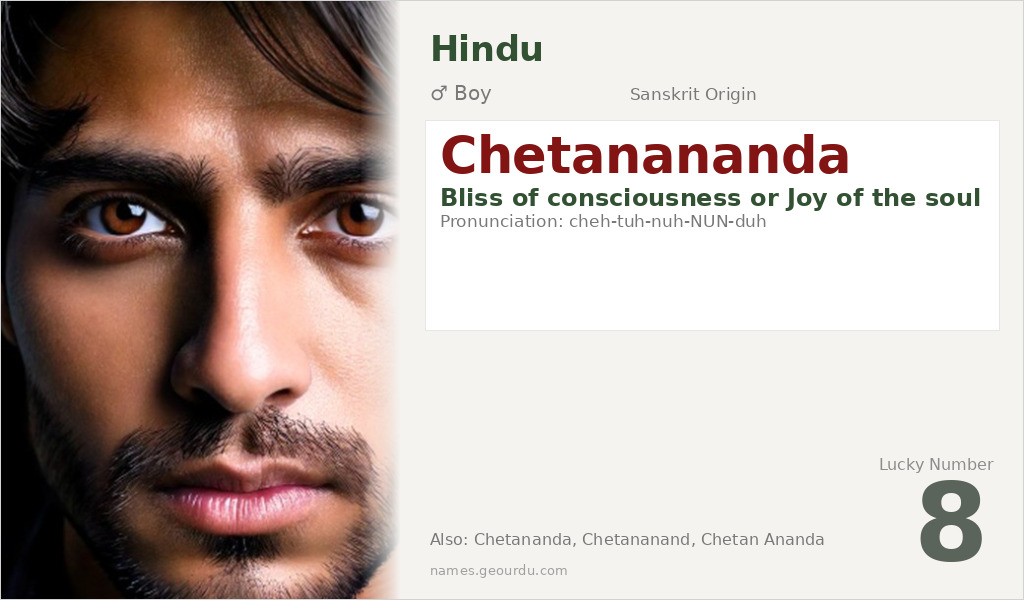
| 📛 Name | Chetanananda |
| 💎 Meaning | Bliss of consciousness or Joy of the soul |
| 👤 Gender | Boy |
| 🕌 Religion | Hindu |
| 🌍 Origin | Sanskrit |
| 🗣 Pronunciation | cheh-tuh-nuh-NUN-duh |
| ✍️ Urdu | چیتن آنند |
| ✍️ Arabic | تشيتاناناندا |
| 🔢 Numerology | 8 |
| ✨ Spellings | Chetananda, Chetananand, Chetan Ananda |
Origin & Cultural Significance
Chetanananda originates from classical Sanskrit, the ancient liturgical language of Hinduism that has influenced numerous South Asian languages. As a compound name, it follows the common Sanskrit naming pattern of combining two meaningful elements to create a spiritually significant name. Historically, such names were often given to spiritual leaders, scholars, and children in Brahmin and other Hindu communities. The name reflects core concepts from Upanishadic philosophy where ‘Chetana’ represents the individual soul (jivatman) and ‘Ananda’ represents the bliss of realizing unity with the universal soul (paramatman). While primarily used in Hindu communities across India, Nepal, and the diaspora, the philosophical concepts it embodies have influenced spiritual traditions worldwide through the spread of Hindu philosophy and yoga.
Personality Traits
The name Chetanananda suggests a personality oriented toward spiritual growth and inner peace. Those bearing this name are often seen as contemplative individuals who value wisdom over worldly success. They may exhibit natural empathy and a calm presence that helps others feel at ease. The combination of consciousness and bliss in their name implies someone who finds genuine happiness through understanding and awareness rather than external circumstances.
Similar Names
If you like Chetanananda, consider: Chidananda, Chaitanya, Anand, Chetan, Chandrananda, Satchidananda, Bodhananda, Prajnananda, Vedananda, Yogananda
Famous People Named Chetanananda
- Swami Chetanananda — American Hindu spiritual teacher and author, disciple of Swami Rudrananda
- Chetanananda Saraswati — Hindu spiritual leader and scholar associated with Advaita Vedanta tradition
Frequently Asked Questions About Chetanananda
What does Chetanananda mean?
Chetanananda means 'bliss of consciousness' or 'joy of the soul' in Sanskrit. It combines 'Chetana' (consciousness) and 'Ananda' (bliss) to represent a state of spiritual happiness achieved through self-awareness.
Is Chetanananda a boy or girl name?
Chetanananda is traditionally a masculine name in Hindu naming conventions. While Sanskrit names can sometimes be adapted, this particular compound name is overwhelmingly used for boys in cultural practice.
What is the origin of Chetanananda?
Chetanananda originates from Sanskrit, the classical language of ancient India. It is a compound name formed from two Sanskrit words that are central to Hindu philosophical traditions, particularly Vedanta and Yoga.





