
Table of Contents
Cyril is a distinguished name with deep roots in Christian history and Greek language. Meaning ‘lordly’ or ‘masterful,’ this name has been borne by influential saints and scholars throughout centuries. From early Church Fathers to modern leaders, Cyril carries a legacy of intellectual and spiritual significance. Its timeless appeal continues across cultures, particularly in Christian communities worldwide.
Meaning of Cyril
The name Cyril originates from the Greek Κύριλλος (Kyrillos), derived from κύριος (kyrios), meaning ‘lord,’ ‘master,’ or ‘ruler.’ This Greek term held significant religious weight in early Christianity, appearing in the New Testament as a title for God and Jesus Christ. The ‘-illos’ suffix is a diminutive, giving the name the sense of ‘little lord’ or ‘lordly one.’ Through Latin transmission as Cyrillus, the name spread throughout Christian Europe. Its meaning evolved to encompass qualities of nobility, authority, and spiritual leadership, reflecting the stature of its early saintly bearers.
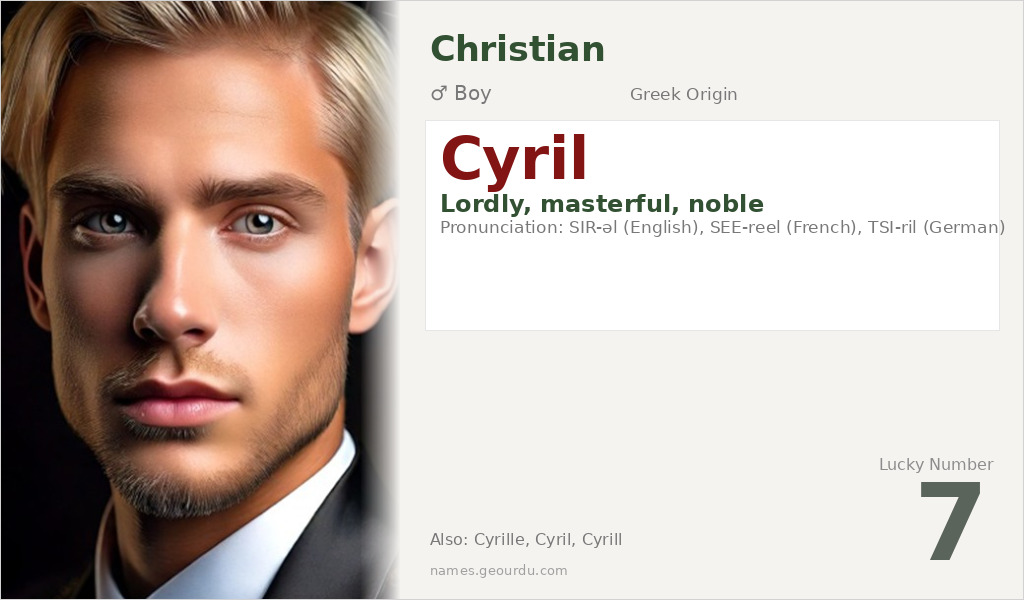
| 📛 Name | Cyril |
| 💎 Meaning | Lordly, masterful, noble |
| 👤 Gender | Boy |
| 🕌 Religion | Christian |
| 🌍 Origin | Greek |
| 🗣 Pronunciation | SIR-əl (English), SEE-reel (French), TSI-ril (German) |
| ✍️ Urdu | سیرل |
| ✍️ Arabic | كيريل |
| 🔢 Numerology | 7 |
| ✨ Spellings | Cyrille, Cyril, Cyrill, Kiril, Kirill, Cyrillus |
Origin & Cultural Significance
Cyril emerged in the early Christian era, first gaining prominence through Saint Cyril of Jerusalem and Saint Cyril of Alexandria in the 4th-5th centuries. The name’s most significant expansion occurred with Saints Cyril and Methodius in the 9th century, Byzantine Greek brothers who evangelized the Slavs and created the Glagolitic alphabet, precursor to Cyrillic script. This missionary work established Cyril as a popular name across Eastern Orthodox communities, particularly in Slavic countries where it appears as Kirill. The name entered Western Europe through Latin ecclesiastical channels and became established in various Christian traditions, maintaining consistent usage for over fifteen centuries.
Personality Traits
Those named Cyril often inherit associations with wisdom, spiritual depth, and intellectual pursuit. The name’s historical connection to scholarly saints suggests personality traits oriented toward learning, contemplation, and religious devotion. In modern contexts, Cyrils may be perceived as traditional yet thoughtful individuals, possibly exhibiting leadership qualities rooted in the name’s meaning of ‘lordly.’ The name carries an air of dignified intelligence that has remained consistent across cultures and time periods.
Similar Names
If you like Cyril, consider: Cyrus, Cyr, Kyrie, Kyros, Cyriliano
Famous People Named Cyril
- Saint Cyril of Alexandria — Early Church Father and Patriarch of Alexandria (376–444 AD)
- Saint Cyril — Co-creator of the Glagolitic alphabet and evangelizer of the Slavs (826–869 AD)
- Cyril Ramaphosa — President of South Africa (born 1952)
- Cyril Cusack — Irish actor (1910–1993)
Frequently Asked Questions About Cyril
What does Cyril mean?
Cyril means 'lordly,' 'masterful,' or 'noble' from the Greek word κύριος (kyrios) meaning 'lord' or 'master.'
Is Cyril a boy or girl name?
Cyril is traditionally and almost exclusively a masculine name, though the French feminine form Cyrille exists. All historical and cultural usage strongly associates it with male bearers.
What is the origin of Cyril?
Cyril originates from Greek (Κύριλλος) and was adopted into Latin as Cyrillus. It gained prominence through early Christian saints and spread throughout Christian communities, particularly in Eastern Orthodox traditions.





