
Table of Contents
Dafne is an elegant and timeless name with deep roots in Greek mythology and classical literature. Derived from the Greek word for ‘laurel tree,’ this name carries centuries of cultural heritage and symbolic meaning. While often associated with its more common spelling ‘Daphne,’ Dafne offers a distinctive variation that maintains the same rich history. This name has traveled across cultures while retaining its connection to nature, poetry, and ancient traditions.
Meaning of Dafne
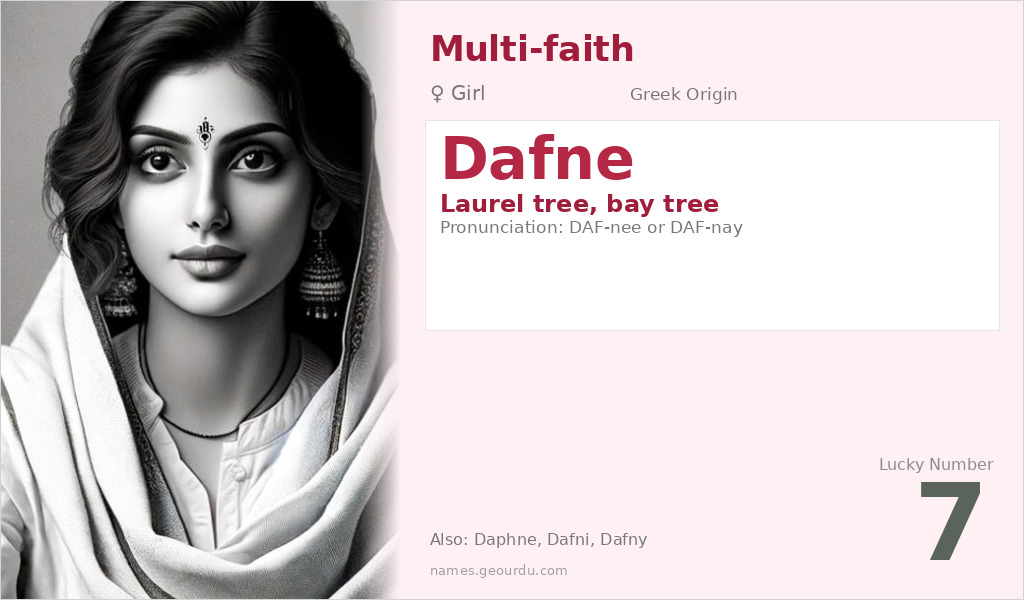
The name Dafne originates from the Greek word ‘daphnē’ (δάφνη), which specifically refers to the laurel tree or bay tree. In botanical terms, this is Laurus nobilis, an evergreen tree native to the Mediterranean region. The laurel held significant symbolic value in ancient Greece, representing victory, honor, and poetic achievement—winners of the Pythian Games received laurel wreaths, and poets were crowned with laurel leaves. The name’s mythological connection comes from the story of Daphne, a nymph who was transformed into a laurel tree to escape Apollo, making the name symbolize purity, protection, and natural beauty. This etymology is well-documented in classical Greek literature and linguistic sources.
| 📛 Name | Dafne |
| 💎 Meaning | Laurel tree, bay tree |
| 👤 Gender | Girl |
| 🕌 Religion | Multi-faith |
| 🌍 Origin | Greek |
| 🗣 Pronunciation | DAF-nee or DAF-nay |
| ✍️ Urdu | ڈافنی |
| ✍️ Arabic | دافني |
| 🔢 Numerology | 7 |
| ✨ Spellings | Daphne, Dafni, Dafny, Daphné |
Origin & Cultural Significance
Dafne has its origins in ancient Greek culture and mythology, dating back to at least the 8th century BCE when the Homeric Hymns and later Ovid’s ‘Metamorphoses’ (1st century CE) featured the nymph Daphne. The name spread through the Hellenistic world and was adopted into Latin as ‘Daphne,’ then into various European languages during the Renaissance when classical names were revived. While the name appears in some Christian contexts due to its presence in Greek-speaking communities, it is not inherently Christian and predates Christianity by many centuries. Today, Dafne is used internationally, with particular popularity in Spanish, Italian, and Portuguese-speaking countries as a variation of Daphne.
Personality Traits
People named Dafne are often perceived as creative, graceful, and connected to nature, reflecting their namesake’s botanical and mythological origins. They may exhibit artistic talents, intuitive thinking, and a preference for authenticity over convention. The laurel tree symbolism suggests qualities of resilience, victory, and enduring beauty, while the mythological story adds layers of transformation and protection. These associations contribute to a personality profile that values independence, creativity, and natural harmony.
Similar Names
If you like Dafne, consider: Daphne, Daphna, Laura, Laurel, Bay
Famous People Named Dafne
- Dafne Keen — British-Spanish actress known for 'Logan' and 'His Dark Materials'
- Dafne Fernández — Spanish actress and dancer
Frequently Asked Questions About Dafne
What does Dafne mean?
Dafne means 'laurel tree' or 'bay tree,' originating from the Greek word 'daphnē' (δάφνη). This refers specifically to the Laurus nobilis tree, which held symbolic importance in ancient Greece.
Is Dafne a boy or girl name?
Dafne is exclusively a girl's name. It has always been feminine in usage, stemming from the mythological female nymph Daphne in Greek mythology. There are no documented masculine versions or uses.
What is the origin of Dafne?
Dafne originates from ancient Greek language and mythology. It is the Greek form of the name Daphne, first appearing in classical Greek literature and later spreading through Latin and European languages during the Renaissance revival of classical names.





