
Table of Contents
Daisy is a charming and timeless name that evokes images of sunny meadows and simple beauty. Derived from the Old English term for ‘day’s eye’, this name has been beloved for centuries, first as a nickname and later as a formal given name. Its floral association makes it a popular choice for parents seeking a nature-inspired name. While often used in English-speaking countries, Daisy has gained recognition globally due to its pleasant sound and positive connotations.
Meaning of Daisy
The name Daisy comes directly from the Old English phrase ‘dæges ēage’, which translates to ‘day’s eye’. This poetic description refers to the daisy flower’s behavior of opening its petals at sunrise and closing them at sunset, much like an eye that greets the day. The term was used for the flower long before it became a personal name. In the Victorian era, when flower names became fashionable, Daisy transitioned from a nickname (often for Margaret, as daisies were called ‘Margaret’s flower’) to a standalone given name. Unlike many names with roots in languages like Arabic or Sanskrit, Daisy’s etymology is firmly planted in Germanic linguistic heritage, specifically Old English, with no significant variants in other major language families.
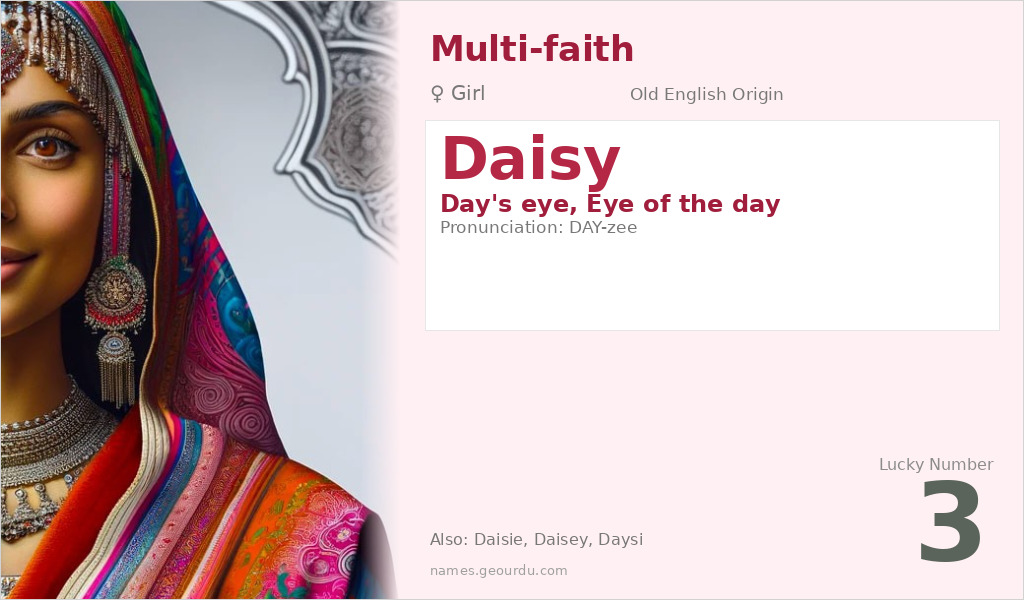
| 📛 Name | Daisy |
| 💎 Meaning | Day's eye, Eye of the day |
| 👤 Gender | Girl |
| 🕌 Religion | Multi-faith |
| 🌍 Origin | Old English |
| 🗣 Pronunciation | DAY-zee |
| ✍️ Urdu | ڈیزی |
| ✍️ Arabic | ديزي |
| 🔢 Numerology | 3 |
| ✨ Spellings | Daisie, Daisey, Daysi |
Origin & Cultural Significance
Daisy originated in England as a descriptive term for the common daisy flower (Bellis perennis). Its use as a given name began in the 19th century, coinciding with the Victorian fascination with floral and nature-inspired names. While the name is most common in English-speaking countries such as the United States, United Kingdom, and Australia, it has been adopted in various cultures worldwide due to globalization and the appeal of its sound and imagery. It is not tied to any specific religion or ethnic group, making it a multi-faith and multicultural name choice. Historically, it was sometimes used as a diminutive for Margaret, but it has long since established its own identity.
Personality Traits
People named Daisy are often associated with qualities of innocence, purity, and cheerfulness, mirroring the daisy flower’s symbolism in folklore and literature. They may be seen as optimistic individuals who bring light and joy to their surroundings. The name’s connection to nature can also suggest a grounded, practical personality with an appreciation for simplicity and beauty in everyday life.
Similar Names
If you like Daisy, consider: Rose, Lily, Violet, Iris, Poppy
Famous People Named Daisy
- Daisy Ridley — British actress known for Star Wars sequel trilogy
- Daisy Fuentes — Cuban-American model and television host
Frequently Asked Questions About Daisy
What does Daisy mean?
Daisy means 'day's eye' or 'eye of the day', originating from the Old English term 'dæges ēage', which describes the daisy flower opening at dawn.
Is Daisy a boy or girl name?
Daisy is almost exclusively a girl's name in modern usage, though historically it was used as a unisex nickname in rare cases. It is strongly feminine in contemporary contexts.
What is the origin of Daisy?
Daisy originates from Old English, specifically from the phrase 'dæges ēage' referring to the daisy flower. It became a given name in the Victorian era and is not tied to a specific religion or culture.





