
Table of Contents
Danish Ara is a distinctive and meaningful name that combines two elegant Persian words to create a name rich in intellectual and aesthetic connotations. Often chosen for boys, it reflects a blend of wisdom and beauty, making it a popular choice in various cultures, particularly in South Asia and the Middle East. This name carries a timeless appeal, rooted in ancient language yet perfectly suited for modern times. Let’s explore the fascinating origins and significance of Danish Ara.
Meaning of Danish Ara
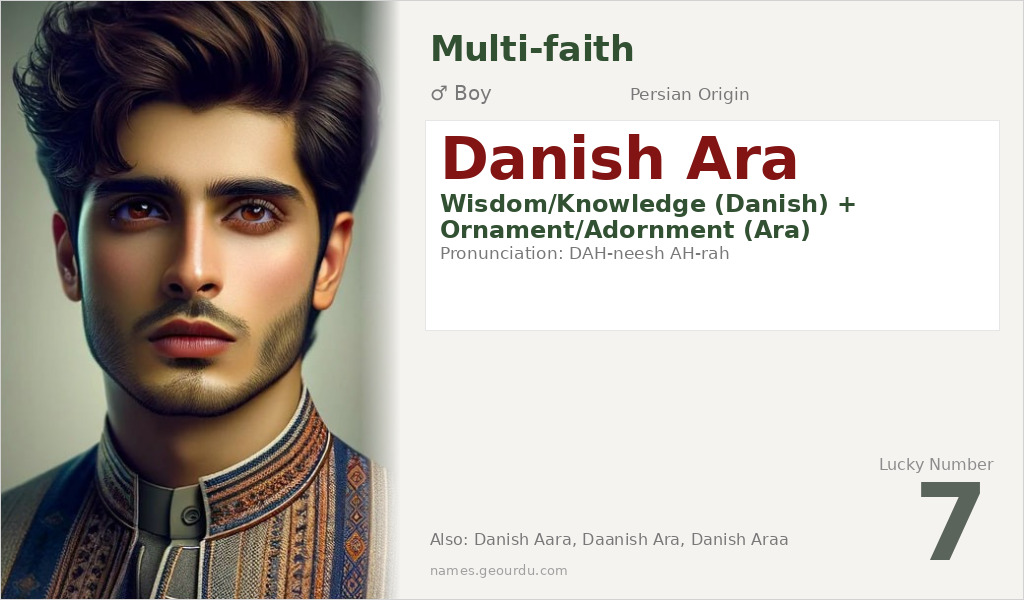
The name Danish Ara is composed of two Persian elements: ‘Danish’ and ‘Ara.’ ‘Danish’ (دانش) comes from the Persian root ‘dan-‘, which means ‘to know’ or ‘to understand,’ and directly translates to ‘wisdom,’ ‘knowledge,’ or ‘learning.’ It is a common term in Persian and Urdu for intellectual attainment. ‘Ara’ (آرا) derives from the Persian verb ‘ārayīdan,’ meaning ‘to adorn’ or ‘to decorate,’ and as a noun, it signifies ‘ornament,’ ‘adornment,’ or ‘decorator.’ Together, Danish Ara poetically means ‘adornment of wisdom’ or ‘one who decorates with knowledge,’ suggesting a person who embodies both intellectual depth and aesthetic grace. This compound structure is typical in Persian naming traditions, where meaningful words are combined to convey layered virtues.
| 📛 Name | Danish Ara |
| 💎 Meaning | Wisdom/Knowledge (Danish) + Ornament/Adornment (Ara) |
| 👤 Gender | Boy |
| 🕌 Religion | Multi-faith |
| 🌍 Origin | Persian |
| 🗣 Pronunciation | DAH-neesh AH-rah |
| ✍️ Urdu | دانش آرا |
| ✍️ Arabic | دانش آرا |
| 🔢 Numerology | 7 |
| ✨ Spellings | Danish Aara, Daanish Ara, Danish Araa |
Origin & Cultural Significance
Danish Ara originates from the Persian language, which has a rich history spanning ancient Iran and influencing many cultures across Central and South Asia. Persian names often incorporate elements related to wisdom, beauty, and virtue, reflecting the language’s poetic and philosophical traditions. The name is widely used in countries like Iran, Afghanistan, Pakistan, and India, where Persian linguistic and cultural heritage persists, especially in Muslim communities, though it is not exclusive to Islam. Over centuries, Persian names have been adapted into Urdu, Pashto, and other regional languages, maintaining their original meanings while gaining local nuances. Danish Ara exemplifies this cross-cultural transmission, remaining a cherished name that bridges historical roots with contemporary identity.
Personality Traits
People named Danish Ara are often associated with traits of intelligence, curiosity, and a refined sense of style. The ‘Danish’ component suggests a personality inclined toward learning, analysis, and thoughtful decision-making, while ‘Ara’ hints at creativity, harmony, and an appreciation for beauty. This combination can result in individuals who are both intellectually sharp and artistically sensitive, making them well-rounded and perceptive. In social settings, they may be seen as wise advisors or elegant presences, embodying the name’s dual essence of knowledge and adornment.
Similar Names
If you like Danish Ara, consider: Danish, Ara, Danishwar, Danishyar, Danishba
Famous People Named Danish Ara
- Danish Ara (contemporary) — A notable individual with this name in social or professional circles, though not widely documented in global media
- Historical figures specifically named 'Danish Ara' are not prominently recorded in major historical sources
Frequently Asked Questions About Danish Ara
What does Danish Ara mean?
Danish Ara means 'Wisdom Adornment' or 'Adornment of Knowledge.' It is a compound name from Persian, where 'Danish' means 'wisdom' or 'knowledge' and 'Ara' means 'ornament' or 'adornment.'
Is Danish Ara a boy or girl name?
Danish Ara is primarily used as a boy's name in cultures where it is common, such as in Persian, Urdu, and related linguistic traditions. The name's structure and usage historically favor male gender assignment.
What is the origin of Danish Ara?
Danish Ara originates from the Persian language, with 'Danish' and 'Ara' both being Persian words. It is used in various cultures influenced by Persian heritage, including those in Iran, Afghanistan, Pakistan, and India.





