
Table of Contents
Dashabahu is a powerful Sanskrit name that carries deep mythological significance in Hindu tradition. Meaning ‘ten-armed’ or ‘having ten arms,’ this name is most famously associated with Parashurama, the sixth avatar of Lord Vishnu. While not commonly used as a personal name in modern times, it remains an important epithet in Hindu scriptures. Understanding Dashabahu requires exploring its linguistic roots and mythological context rather than contemporary naming practices.
Meaning of Dashabahu
Dashabahu is a compound Sanskrit name with clear etymological roots. The first component ‘dasha’ (दश) directly translates to ‘ten,’ while ‘bahu’ (बाहु) means ‘arm’ or ‘limb.’ Together, they create the literal meaning ‘ten-armed.’ In Hindu mythology, this epithet specifically refers to Parashurama’s formidable form as described in various texts including the Mahabharata and Puranas. The ten arms symbolize extraordinary power, divine capability, and the ability to accomplish multiple tasks simultaneously. Unlike many Sanskrit names that have evolved into common personal names, Dashabahu remains primarily a descriptive epithet for mythological figures.
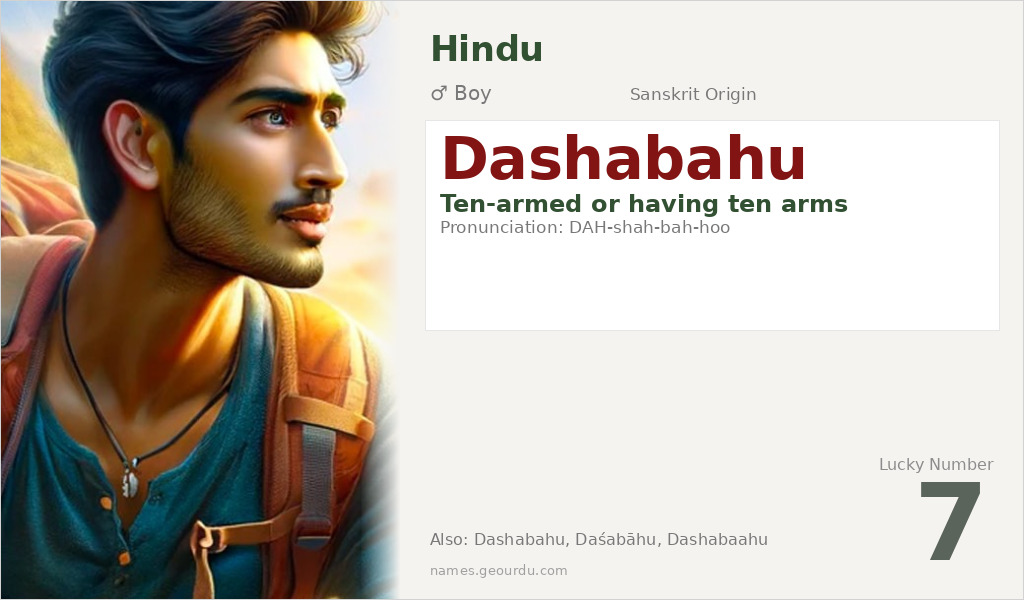
| 📛 Name | Dashabahu |
| 💎 Meaning | Ten-armed or having ten arms |
| 👤 Gender | Boy |
| 🕌 Religion | Hindu |
| 🌍 Origin | Sanskrit |
| 🗣 Pronunciation | DAH-shah-bah-hoo |
| ✍️ Urdu | دشاباہو |
| ✍️ Arabic | داشاباهو |
| 🔢 Numerology | 7 |
| ✨ Spellings | Dashabahu, Daśabāhu, Dashabaahu |
Origin & Cultural Significance
Dashabahu originates from classical Sanskrit, the ancient liturgical language of Hinduism. Its usage is deeply embedded in Hindu mythology rather than contemporary naming traditions. The name appears in scriptures describing Parashurama, the warrior-sage avatar of Vishnu known for eliminating corrupt Kshatriya rulers. In cultural context, the epithet represents divine intervention and extraordinary capability rather than being part of standard Hindu naming conventions. While Sanskrit names are widely used in Hindu communities, Dashabahu is exceptional as it’s preserved more as a mythological descriptor than a personal name given to children.
Personality Traits
While Dashabahu isn’t typically used as a personal name with associated personality traits in modern astrology, its mythological associations suggest certain characteristics. The connection to Parashurama implies strength, determination, and a sense of justice. Such individuals might be perceived as powerful protectors with strong convictions. The ten arms metaphorically suggest multitasking ability and comprehensive capability in various endeavors.
Similar Names
If you like Dashabahu, consider: Dasharatha, Dashanan, Bahubali, Chaturbhuja, Shadanan
Famous People Named Dashabahu
- Parashurama — Sixth avatar of Lord Vishnu in Hindu mythology, often described with the epithet Dashabahu in scriptures
- No modern notable figures with this as a personal name — primarily used as mythological epithet
Frequently Asked Questions About Dashabahu
What does Dashabahu mean?
Dashabahu means 'ten-armed' or 'having ten arms' in Sanskrit. It's a compound of 'dasha' (ten) and 'bahu' (arm).
Is Dashabahu a boy or girl name?
Dashabahu is exclusively a masculine name in Hindu tradition, associated with male mythological figures like Parashurama.
What is the origin of Dashabahu?
Dashabahu originates from Sanskrit, the classical language of Hinduism, and is primarily found in Hindu mythological texts as an epithet for Parashurama.





