Table of Contents
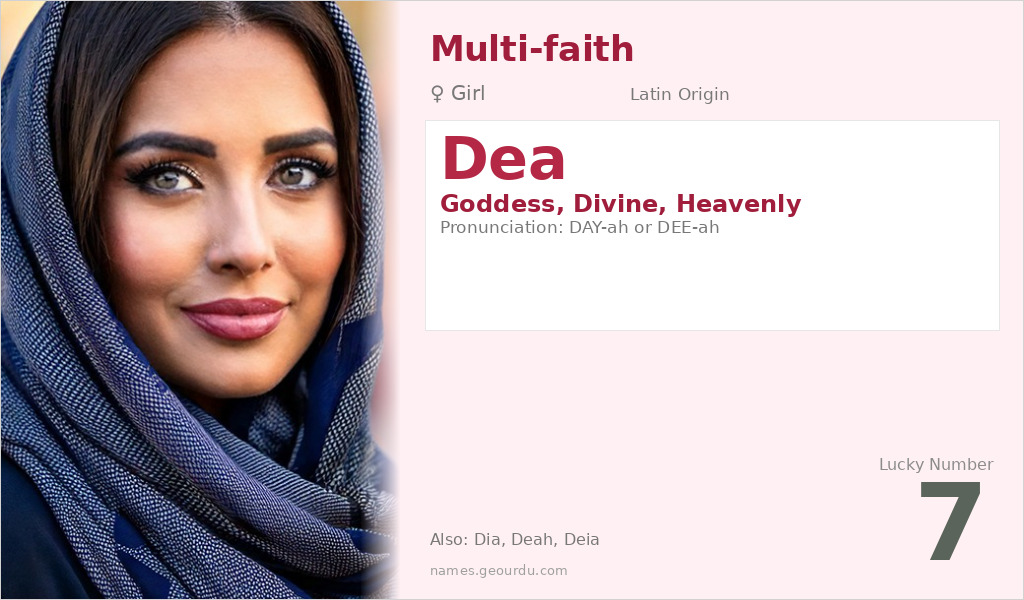
Dea is a beautiful, timeless name with deep roots in classical mythology and language. Meaning ‘goddess’ in Latin, it carries connotations of divinity, strength, and feminine power. While simple in form, Dea has been used across cultures and continues to appeal to parents seeking a name with historical weight and elegant simplicity. This guide explores the true origins, meanings, and cultural contexts of the name Dea.
Meaning of Dea
Dea originates from the Latin word ‘dea’, which directly translates to ‘goddess’ or ‘divine female being’. In ancient Roman religion, ‘Dea’ was used as a title or epithet for various goddesses, such as Dea Dia (a goddess of growth worshipped by the Arval Brethren) and Dea Tacita (the goddess of silence). The name entered broader European usage through Latin’s influence on literature, theology, and romance languages—Italian and Spanish both use ‘dea’ as the common word for goddess. Unlike many names that evolve through diminutives or compounds, Dea remains remarkably close to its original form, preserving its clear, powerful meaning across centuries.
| 📛 Name | Dea |
| 💎 Meaning | Goddess, Divine, Heavenly |
| 👤 Gender | Girl |
| 🕌 Religion | Multi-faith |
| 🌍 Origin | Latin |
| 🗣 Pronunciation | DAY-ah or DEE-ah |
| ✍️ Urdu | ڈیا |
| ✍️ Arabic | ديا |
| 🔢 Numerology | 7 |
| ✨ Spellings | Dia, Deah, Deia |
Origin & Cultural Significance
Dea’s origin is firmly rooted in Latin language and Roman culture, where it functioned both as a common noun and a divine title. As the Roman Empire expanded, Latin spread across Europe, carrying words like ‘dea’ into various languages. The name appears in medieval and Renaissance texts, often in poetic or religious contexts referencing classical mythology. While not tied to a single modern religion, Dea has been adopted by Christian, secular, and multi-faith families, particularly in Europe and the Americas. Its usage as a given name became more established in the 19th and 20th centuries, appealing to those drawn to classical or mythological names.
Personality Traits
People named Dea are often associated with grace, wisdom, and inner strength, reflecting the name’s divine meaning. They may exhibit natural creativity, a thoughtful demeanor, and a tendency toward spiritual or philosophical exploration. The name’s simplicity can also suggest clarity of purpose and a calm, centered personality, with an appreciation for beauty and tradition.
Similar Names
If you like Dea, consider: Diana, Deanna, Thea, Rhea, Gaia
Famous People Named Dea
- Dea Birkett — British writer and broadcaster known for travel writing
- Dea Loher — contemporary German playwright and author
Frequently Asked Questions About Dea
What does Dea mean?
Dea means 'goddess' or 'divine' and comes directly from the Latin word 'dea'. It is not related to meanings like 'valley'—those are incorrect attributions.
Is Dea a boy or girl name?
Dea is exclusively a girl's name, as it refers to a female deity in Latin and is grammatically feminine. There are no traditional masculine uses.
What is the origin of Dea?
Dea originates from Latin, the language of ancient Rome, where it was used as a term for goddesses in mythology and religion. It is not a Hindu, Arabic, or Persian name.