Table of Contents
Deiva is a beautiful and spiritually significant name for girls, deeply rooted in Hindu traditions. Derived from Sanskrit, it carries the powerful meaning of ‘Goddess’ or ‘divine being,’ connecting the bearer to celestial energy. This name is particularly popular in South Indian communities where Dravidian linguistic influences blend with Sanskrit heritage. Choosing Deiva reflects a desire to honor divine feminine qualities in a child.
Meaning of Deiva
Deiva originates from the Sanskrit word ‘deva’ (देव), which means ‘god’ or ‘divine being.’ The feminine form ‘devī’ (देवी) specifically denotes ‘goddess,’ and Deiva serves as a variant emphasizing this feminine divine aspect. In Dravidian languages like Tamil, ‘deiva’ or ‘teyvam’ similarly refers to deities or spiritual entities, showing cross-linguistic adoption. Historically, the term appears in Vedic scriptures dating back over 3,000 years, where devas were celestial beings associated with natural elements. This name thus embodies a rich tapestry of Indo-Aryan and Dravidian linguistic heritage, consistently maintaining its core meaning of divinity across millennia.
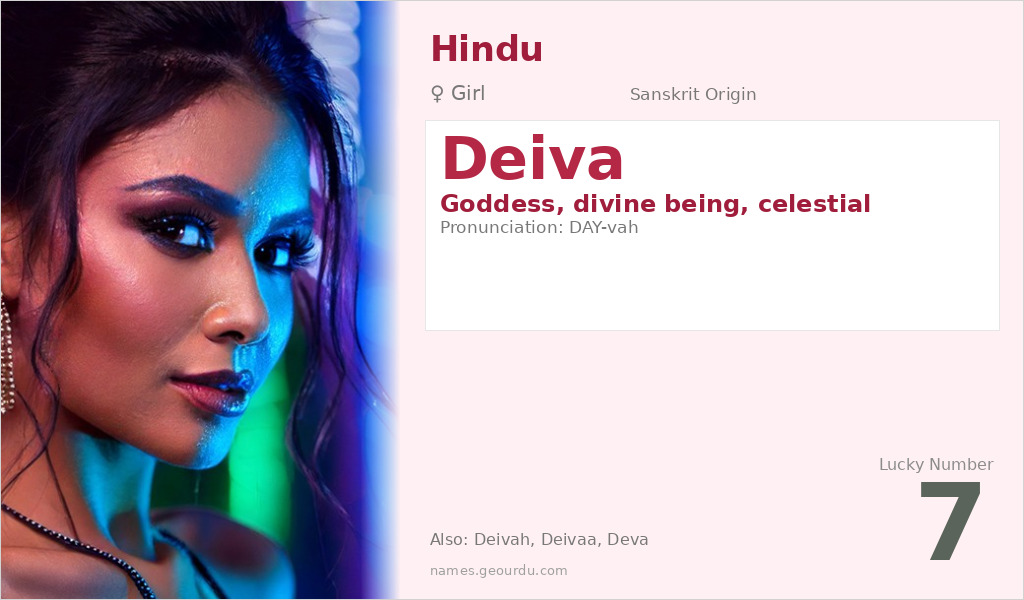
| 📛 Name | Deiva |
| 💎 Meaning | Goddess, divine being, celestial |
| 👤 Gender | Girl |
| 🕌 Religion | Hindu |
| 🌍 Origin | Sanskrit |
| 🗣 Pronunciation | DAY-vah |
| ✍️ Urdu | دیوا |
| ✍️ Arabic | ديفا |
| 🔢 Numerology | 7 |
| ✨ Spellings | Deivah, Deivaa, Deva, Devi |
Origin & Cultural Significance
Deiva has its primary origins in Sanskrit, the ancient liturgical language of Hinduism, and is widely used in Hindu communities across India, especially in Tamil Nadu, Kerala, and Karnataka. The name gained cultural prominence through Hindu mythology, where goddesses like Devi are central figures. It reflects the syncretism between Sanskrit and regional Dravidian languages, with ‘deiva’ appearing in Tamil devotional literature and temple inscriptions. Historically, names derived from ‘deva’ have been bestowed to invoke divine protection and blessings, making Deiva a traditional choice in Hindu naming ceremonies. Its usage persists in modern times, often symbolizing spiritual aspiration and cultural pride.
Personality Traits
Those named Deiva are often associated with grace, wisdom, and a strong spiritual inclination. They may exhibit nurturing traits, inspired by the maternal aspects of goddess figures in Hinduism. Their intuitive nature helps them connect deeply with others, while their name’s divine connotation can inspire confidence and leadership. Overall, Deiva suggests a personality balanced between compassion and strength.
Similar Names
If you like Deiva, consider: Devi, Divya, Devika, Devanshi, Devayani
Famous People Named Deiva
- Deiva Thirumagal — 2011 Indian Tamil-language drama film featuring a character named Deiva
- Deiva Zivarattinam — Tamil scholar and writer known for works on Saivism
Frequently Asked Questions About Deiva
What does Deiva mean?
Deiva means 'Goddess' or 'divine being,' originating from the Sanskrit word 'deva' (god) and its feminine form 'devī' (goddess).
Is Deiva a boy or girl name?
Deiva is primarily a girl's name in Hindu culture, derived from feminine Sanskrit forms, though 'Deva' can be masculine in some contexts.
What is the origin of Deiva?
Deiva originates from Sanskrit, with strong usage in Hindu traditions and Dravidian languages like Tamil, where it denotes divine or celestial beings.