Table of Contents
Devakiri is a beautiful and meaningful Sanskrit name for girls that carries profound spiritual significance. Meaning ‘Goddess of the divine mountain’ or ‘divine peak’, this name evokes imagery of sacred landscapes and feminine divinity. While not extremely common, it represents a thoughtful choice for parents seeking a name with traditional roots and poetic resonance. Let’s explore the rich linguistic and cultural dimensions of this distinctive name.
Meaning of Devakiri
Devakiri derives from classical Sanskrit, combining ‘Deva’ (देव), meaning ‘god’ or ‘divine’, with ‘Kiri’ (किरि), meaning ‘mountain’ or ‘peak’. This compound construction creates a name that literally translates to ‘divine mountain’ or more poetically as ‘goddess of the peak’. In Sanskrit literature, mountains are often personified as divine entities, particularly in Puranic texts where they serve as abodes of gods and sites of spiritual significance. The name follows established Sanskrit morphological patterns where ‘Deva-‘ as a prefix indicates celestial or godly qualities. While not among the most common Sanskrit names, its components are well-documented in ancient texts, giving it authentic linguistic heritage.
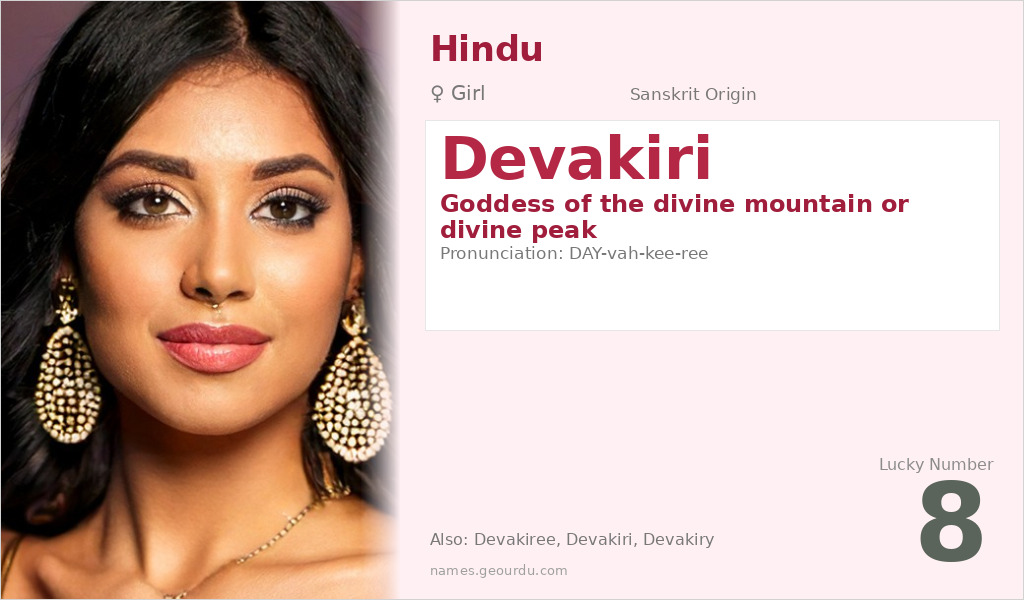
| 📛 Name | Devakiri |
| 💎 Meaning | Goddess of the divine mountain or divine peak |
| 👤 Gender | Girl |
| 🕌 Religion | Hindu |
| 🌍 Origin | Sanskrit |
| 🗣 Pronunciation | DAY-vah-kee-ree |
| ✍️ Urdu | دیواکیری |
| ✍️ Arabic | ديفاكيري |
| 🔢 Numerology | 8 |
| ✨ Spellings | Devakiree, Devakiri, Devakiry |
Origin & Cultural Significance
Devakiri originates from Sanskrit, the classical language of ancient India that has influenced naming traditions across South Asia for millennia. As a Hindu name, it reflects the tradition of naming children after divine concepts, natural phenomena with spiritual significance, or attributes of deities. The mountain imagery connects to Hindu cosmology where mountains like Meru, Kailash, and Govardhan hold sacred status as dwelling places of gods and sites of pilgrimage. While the exact name Devakiri doesn’t appear prominently in major Hindu scriptures, its components are thoroughly Sanskritic, and similar compound names with ‘Deva-‘ prefixes are well-established in Hindu naming conventions. The name represents the enduring practice of creating meaningful names from Sanskrit roots that convey spiritual values and natural beauty.
Personality Traits
Those named Devakiri are often associated with qualities of strength, stability, and spiritual depth—characteristics metaphorically linked to mountains. They may exhibit a grounded nature combined with lofty aspirations, balancing practicality with idealism. The divine element in their name suggests a personality inclined toward ethical living and possibly artistic or contemplative pursuits. Like the enduring mountains they’re named for, they might demonstrate resilience in facing life’s challenges while maintaining inner peace.
Similar Names
If you like Devakiri, consider: Devaki, Devika, Devanshi, Kirti, Devapriya
Famous People Named Devakiri
- No widely known contemporary figures with this name found in public records
- The name appears occasionally in Indian literary and mythological references as a character name
Frequently Asked Questions About Devakiri
What does Devakiri mean?
Devakiri means 'Goddess of the divine mountain' or 'divine peak', derived from Sanskrit 'Deva' (god) and 'Kiri' (mountain).
Is Devakiri a boy or girl name?
Devakiri is exclusively a girl's name in Hindu naming tradition, following the feminine grammatical forms in Sanskrit.
What is the origin of Devakiri?
Devakiri originates from Sanskrit, the classical language of ancient India, and is used primarily in Hindu cultural contexts.