
Table of Contents
Deveshta is a distinctive Sanskrit name with deep roots in Hindu mythology and ancient Indian literature. Unlike many devotional Hindu names, Deveshta carries a unique meaning that reflects the complex cosmology of Hindu traditions. This name offers an intriguing choice for parents interested in mythological and literary names with strong linguistic foundations. Understanding its true meaning provides insight into the rich tapestry of Sanskrit naming conventions.
Meaning of Deveshta
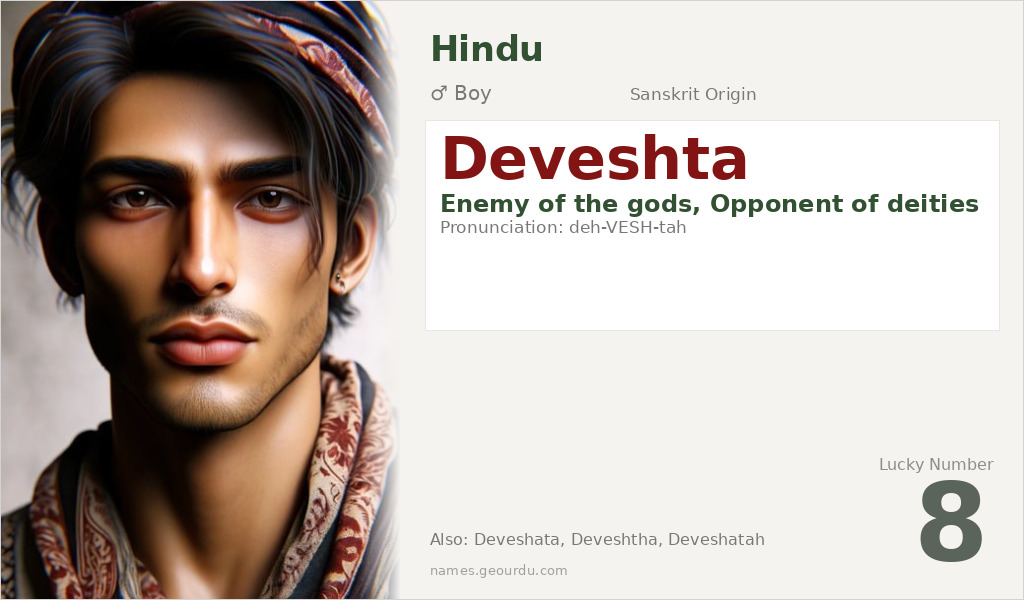
Deveshta is a compound Sanskrit name formed from two distinct elements: ‘Deva’ (देव) meaning ‘god, deity, divine being’ and ‘Shata’ (शत) meaning ‘enemy, opponent, or hater’. When combined, the name literally translates to ‘enemy of the gods’ or ‘opponent of deities’. This etymology places Deveshta within a category of Sanskrit names that describe relationships with divine beings, though in this case, an antagonistic one. The name appears in various Hindu texts and epics, typically referring to demonic figures or those who oppose the gods. Understanding this meaning requires knowledge of Hindu cosmology, where conflicts between devas (gods) and asuras (demons) form central mythological narratives.
| 📛 Name | Deveshta |
| 💎 Meaning | Enemy of the gods, Opponent of deities |
| 👤 Gender | Boy |
| 🕌 Religion | Hindu |
| 🌍 Origin | Sanskrit |
| 🗣 Pronunciation | deh-VESH-tah |
| ✍️ Urdu | دیویشتا |
| ✍️ Arabic | ديفيشتا |
| 🔢 Numerology | 8 |
| ✨ Spellings | Deveshata, Deveshtha, Deveshatah |
Origin & Cultural Significance
Deveshta originates from classical Sanskrit, the ancient liturgical language of Hinduism that has influenced numerous Indian languages. The name emerges from Hindu mythological traditions where characters are often named according to their roles or attributes in cosmic conflicts. In the context of Hindu epics like the Mahabharata and Puranas, names containing ‘deva’ (god) combined with negative prefixes or suffixes typically denote anti-god or demonic characters. While not a common given name in contemporary Hindu practice due to its negative connotations, it represents an authentic Sanskrit construction that follows established linguistic patterns. The name reflects the sophisticated naming conventions of ancient India where names carried precise semantic meanings.
Personality Traits
Given its meaning as ‘enemy of the gods’, the name Deveshta suggests a personality that challenges established norms and questions authority. Individuals with this name might exhibit strong independent thinking, determination, and a willingness to confront conventional wisdom. The mythological associations suggest someone with formidable presence and possibly controversial viewpoints. While the name carries negative connotations in its literal meaning, it could symbolize intellectual independence and courage to stand against popular beliefs.
Similar Names
If you like Deveshta, consider: Devavrata, Devadatta, Devashish, Devendra, Devansh
Famous People Named Deveshta
- No widely known contemporary figures bear this name due to its negative mythological connotations
- In Hindu mythology, various demon kings and anti-god figures are described with similar epithets meaning 'enemy of gods'
Frequently Asked Questions About Deveshta
What does Deveshta mean?
Deveshta means 'enemy of the gods' or 'opponent of deities' in Sanskrit, derived from 'deva' (god) and 'shata' (enemy).
Is Deveshta a boy or girl name?
Deveshta is exclusively a boy name in Hindu naming traditions, following Sanskrit grammatical gender rules where this construction is masculine.
What is the origin of Deveshta?
Deveshta originates from Sanskrit, the classical language of ancient India, and appears in Hindu mythological texts and epics.





