
Table of Contents
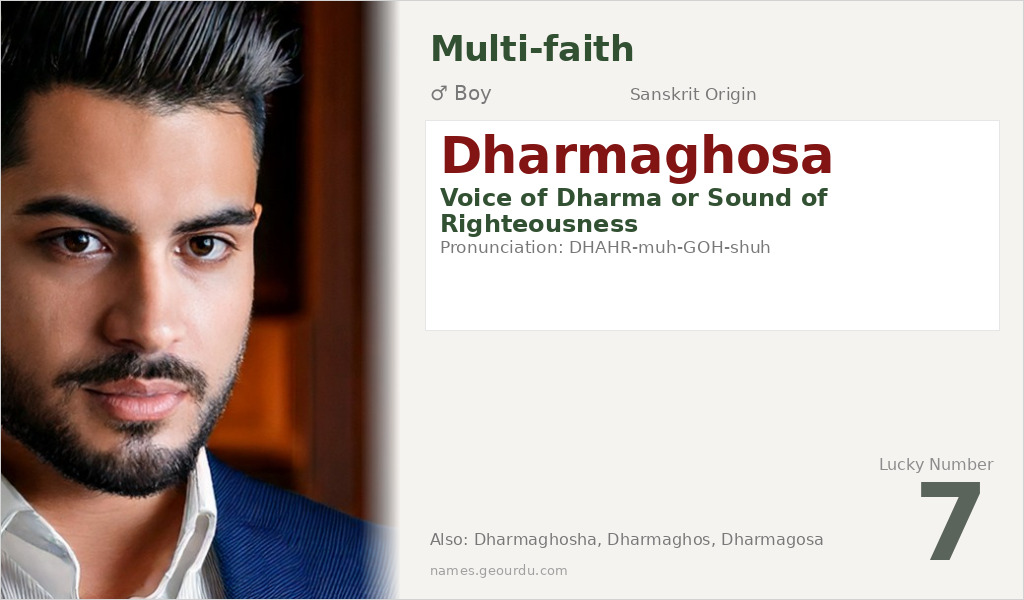
Dharmaghosa is a profound Sanskrit name that carries centuries of spiritual and philosophical significance. Meaning ‘Voice of Dharma’ or ‘Sound of Righteousness’, this name represents the embodiment and proclamation of moral principles. With roots in ancient Indian traditions, Dharmaghosa has been borne by notable Buddhist scholars while maintaining relevance in Hindu naming practices. This name offers a powerful connection to South Asian spiritual heritage and ethical philosophy.
Meaning of Dharmaghosa
Dharmaghosa derives from classical Sanskrit, combining ‘Dharma’ (धर्म) and ‘Ghosa’ (घोष). ‘Dharma’ is a multifaceted term encompassing law, righteousness, duty, virtue, and cosmic order—one of the most significant concepts in Indian philosophy. ‘Ghosa’ specifically means sound, voice, or proclamation, and in Sanskrit phonetics refers to voiced consonants. The compound thus creates a meaningful construct: one whose voice carries or proclaims dharma. This name appears in historical Buddhist texts, most notably referring to a 5th-century scholar who contributed to Buddhist literature. The linguistic construction follows standard Sanskrit compounding rules where the first element modifies the second, creating a meaningful whole rather than a simple conjunction.
| 📛 Name | Dharmaghosa |
| 💎 Meaning | Voice of Dharma or Sound of Righteousness |
| 👤 Gender | Boy |
| 🕌 Religion | Multi-faith |
| 🌍 Origin | Sanskrit |
| 🗣 Pronunciation | DHAHR-muh-GOH-shuh |
| ✍️ Urdu | دھرم گھوش |
| ✍️ Arabic | دهارما غوشا |
| 🔢 Numerology | 7 |
| ✨ Spellings | Dharmaghosha, Dharmaghos, Dharmagosa |
Origin & Cultural Significance
Dharmaghosa originates from Sanskrit, the classical language of ancient India that has influenced numerous South Asian languages and cultures. While the name appears in Hindu contexts, it has significant historical presence in Buddhism, particularly through Dharmaghosa, the 5th-century Buddhist scholar and author. This demonstrates the name’s cross-traditional appeal in Indian spiritual history. The name reflects the importance of dharma (moral law) in Indian philosophy across multiple traditions. Unlike many modern invented names, Dharmaghosa has documented historical usage, giving it authentic cultural roots in the Indian subcontinent’s intellectual and religious heritage.
Personality Traits
Those named Dharmaghosa are often associated with qualities of moral clarity, articulate expression, and principled living. The name suggests someone who communicates wisdom effectively and stands for ethical values. In cultural context, such names often inspire the bearer toward thoughtful leadership, teaching roles, or spiritual guidance. The combination of ‘dharma’ and ‘voice’ implies not just personal virtue but the ability to share and defend righteous principles with others.
Similar Names
If you like Dharmaghosa, consider: Dharmendra, Dharmapala, Ghoshak, Dharmanand, Dharmakirti
Famous People Named Dharmaghosa
- Dharmaghosa — 5th-century Indian Buddhist scholar and author of several Buddhist texts
- Dharmaghosa — Historical figure mentioned in Pali Buddhist literature as a learned monk
Frequently Asked Questions About Dharmaghosa
What does Dharmaghosa mean?
Dharmaghosa means 'Voice of Dharma' or 'Sound of Righteousness' in Sanskrit, combining 'Dharma' (law/righteousness) and 'Ghosa' (voice/sound).
Is Dharmaghosa a boy or girl name?
Dharmaghosa is traditionally a masculine name in both Hindu and Buddhist contexts, following Sanskrit grammatical gender patterns for compound names ending in '-ghosa'.
What is the origin of Dharmaghosa?
Dharmaghosa originates from Sanskrit, the classical language of ancient India, with documented usage in both Hindu and Buddhist traditions, particularly associated with a 5th-century Buddhist scholar.





