
Table of Contents
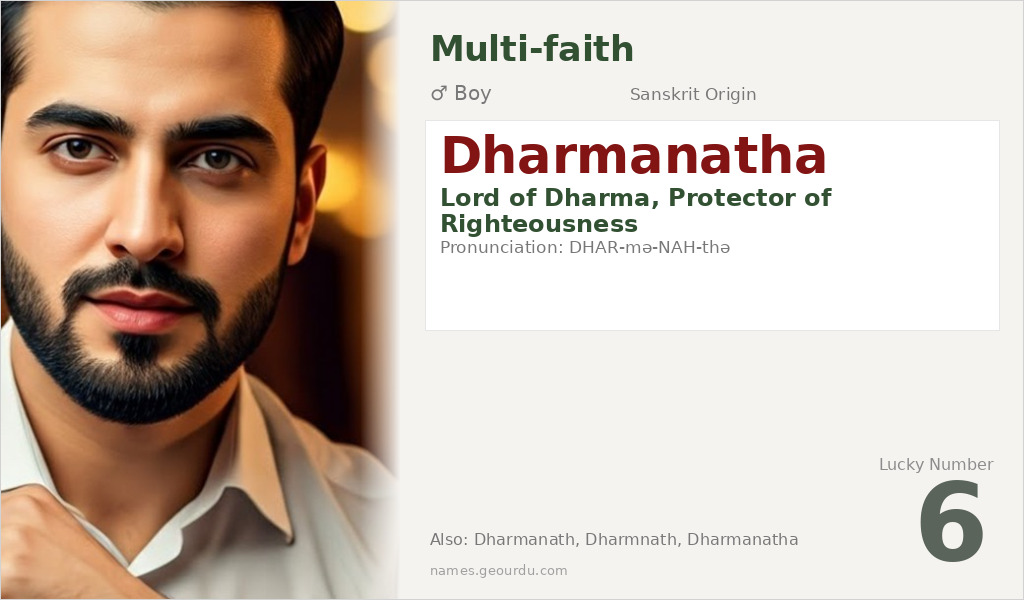
Dharmanatha is a profound Sanskrit name that carries centuries of spiritual and cultural significance. Meaning ‘Lord of Dharma’ or ‘Protector of Righteousness’, this name embodies the highest ideals of moral order and cosmic law. Used in both Hindu and Jain traditions, Dharmanatha represents a connection to ancient wisdom and ethical leadership. Parents choosing this name often seek to instill values of duty, virtue, and spiritual protection in their child.
Meaning of Dharmanatha
Dharmanatha is a classical Sanskrit compound name with deep philosophical roots. The first component, ‘Dharma’ (धर्म), originates from the Sanskrit root √dhṛ meaning ‘to hold, maintain, or support’, representing the cosmic law that upholds the universe, encompassing duty, righteousness, and moral order. The second component, ‘Natha’ (नाथ), derives from √nāth meaning ‘to seek help or to protect’, translating to ‘lord, master, or refuge’. Together, they form ‘Dharmanatha’—literally ‘Lord of Dharma’ or ‘Protector of Righteousness’. This name appears in ancient Indian texts and is particularly significant in Jainism as the name of the 15th Tirthankara. The construction follows standard Sanskrit compounding rules where two nouns combine to create a new meaningful entity.
| 📛 Name | Dharmanatha |
| 💎 Meaning | Lord of Dharma, Protector of Righteousness |
| 👤 Gender | Boy |
| 🕌 Religion | Multi-faith |
| 🌍 Origin | Sanskrit |
| 🗣 Pronunciation | DHAR-mə-NAH-thə |
| ✍️ Urdu | دھرمناتھ |
| ✍️ Arabic | دارماناثا |
| 🔢 Numerology | 6 |
| ✨ Spellings | Dharmanath, Dharmnath, Dharmanatha |
Origin & Cultural Significance
Dharmanatha originates from classical Sanskrit, the liturgical language of Hinduism, Jainism, and Buddhism. The name has been used for centuries in the Indian subcontinent, particularly within religious and philosophical contexts. In Jain tradition, Dharmanatha is revered as the 15th Tirthankara (spiritual teacher) who achieved enlightenment and taught the path of non-violence and righteousness. The name also appears in Hindu contexts, often referring to deities or spiritual leaders who embody dharma. Culturally, the name reflects the central importance of ‘dharma’ in Indian philosophy—the principle that maintains cosmic order and social harmony. While primarily associated with Indian religions, the name’s components have influenced spiritual terminology across South and Southeast Asia.
Personality Traits
Those named Dharmanatha are often associated with qualities of integrity, discipline, and moral fortitude. They tend to be natural leaders who prioritize ethical conduct and justice in their interactions. With a name meaning ‘Lord of Dharma’, they may feel a subconscious pull toward roles that involve guidance, protection, or upholding principles. Their personality typically balances spiritual depth with practical wisdom, making them respected figures in their communities.
Similar Names
If you like Dharmanatha, consider: Dharmendra, Dharmesh, Dharmapala, Dharmaraj, Nath
Famous People Named Dharmanatha
- Dharmanatha — 15th Tirthankara in Jainism, born as King Shreyans of Ratnapuri
- Dharmanatha Yogi — 19th century Hindu spiritual teacher from Gujarat
Frequently Asked Questions About Dharmanatha
What does Dharmanatha mean?
Dharmanatha means 'Lord of Dharma' or 'Protector of Righteousness' in Sanskrit, combining 'Dharma' (righteousness, duty) and 'Natha' (lord, protector).
Is Dharmanatha a boy or girl name?
Dharmanatha is exclusively a boy's name in both Hindu and Jain traditions, following the masculine grammatical forms in Sanskrit.
What is the origin of Dharmanatha?
Dharmanatha originates from Sanskrit, the classical language of India, and is significant in both Hindu and Jain religious contexts, particularly as the name of the 15th Tirthankara in Jainism.





