
Table of Contents
Dishank is a distinctive Sanskrit name for boys that carries profound celestial symbolism. Meaning ‘horizon’ or ‘part of the sky’, this name evokes imagery of where earth meets heaven—a boundary that represents both limitation and infinite possibility. Popular in Hindu communities, Dishank connects its bearer to ancient Indian philosophical concepts about cosmic geography and directional symbolism. This name offers both cultural depth and poetic resonance for parents seeking meaningful nomenclature.
Meaning of Dishank
Dishank derives from classical Sanskrit, combining ‘Disha’ (direction, quarter) and ‘Anka’ (mark, part, edge). The compound literally means ‘mark of the direction’ or ‘edge of the horizon’, specifically referring to the boundary where sky and earth appear to meet. In Vedic cosmology, the horizon represents not just a physical boundary but a symbolic threshold between different realms of existence. Sanskrit texts like the Puranas and astronomical works use similar terminology to describe celestial coordinates and directional markers. The name thus carries both geographical and metaphysical connotations, representing beginnings, meeting points, and the interface between different dimensions.
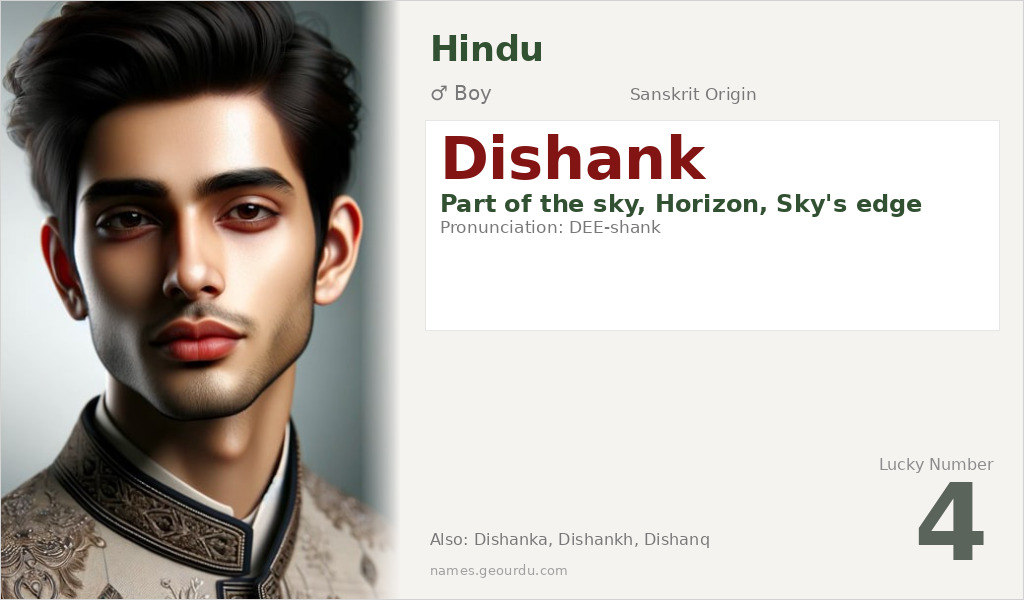
| 📛 Name | Dishank |
| 💎 Meaning | Part of the sky, Horizon, Sky's edge |
| 👤 Gender | Boy |
| 🕌 Religion | Hindu |
| 🌍 Origin | Sanskrit |
| 🗣 Pronunciation | DEE-shank |
| ✍️ Urdu | دشنک |
| ✍️ Arabic | ديشانك |
| 🔢 Numerology | 4 |
| ✨ Spellings | Dishanka, Dishankh, Dishanq |
Origin & Cultural Significance
Dishank originates from Sanskrit, the classical language of ancient India that forms the foundation of Hindu religious and philosophical texts. The name appears in various Sanskrit literary works, particularly those describing cosmic geography and directional symbolism. While primarily used in Hindu communities, the name’s linguistic roots connect to broader Indo-European language family through Sanskrit’s historical development. In contemporary usage, Dishank remains most popular in India and among Hindu diaspora communities, though its poetic meaning has attracted some interest beyond traditional cultural boundaries. The name reflects the enduring influence of Sanskrit’s rich vocabulary in modern Indian naming traditions.
Personality Traits
Those named Dishank are often associated with visionary qualities and boundary-spanning perspectives. Their namesake—the horizon—suggests someone who naturally operates at interfaces, whether between ideas, cultures, or disciplines. They may exhibit both grounded practicality and expansive imagination, able to see connections where others see divisions. This symbolic association with thresholds and meeting points often translates into personality traits of mediation, exploration, and philosophical contemplation.
Similar Names
If you like Dishank, consider: Disha, Dishant, Divyank, Ankush, Dishar
Famous People Named Dishank
- Dishank Jindal — Indian entrepreneur and business executive
- Dishank Arora — Indian cricketer who played for Delhi in domestic tournaments
Frequently Asked Questions About Dishank
What does Dishank mean?
Dishank means 'horizon', 'part of the sky', or 'edge of the direction' in Sanskrit. It combines 'Disha' (direction) and 'Anka' (mark/part).
Is Dishank a boy or girl name?
Dishank is traditionally and almost exclusively a masculine name in Hindu naming conventions, derived from Sanskrit grammatical gender patterns.
What is the origin of Dishank?
Dishank originates from Sanskrit, the classical language of ancient India, and is primarily used in Hindu cultural and religious contexts.





