
Table of Contents
Diwaker is a radiant Sanskrit name that carries the powerful symbolism of the sun. Derived from ancient Hindu traditions, this name evokes images of light, energy, and divine creation. As a boy’s name, Diwaker connects its bearer to celestial forces and positive attributes associated with solar deities. Its rich etymology and cultural significance make it a meaningful choice for parents seeking a name with deep roots.
Meaning of Diwaker
Diwaker originates from the Sanskrit compound word ‘Divākara’, which combines ‘diva’ (meaning ‘day’, ‘sky’, or ‘heaven’) with ‘kara’ (meaning ‘maker’ or ‘creator’). Thus, the name literally translates to ‘maker of the day’ or ‘sun’. In Hindu mythology, this is one of the many epithets for Surya, the sun god who brings light and life to the world. The name appears in various ancient texts including the Vedas and Puranas, where it describes both the physical sun and divine radiance. Linguistically, it belongs to the Indo-European language family and shares roots with related words in other languages. The name’s solar symbolism represents illumination, energy, and life-giving power in Hindu tradition.
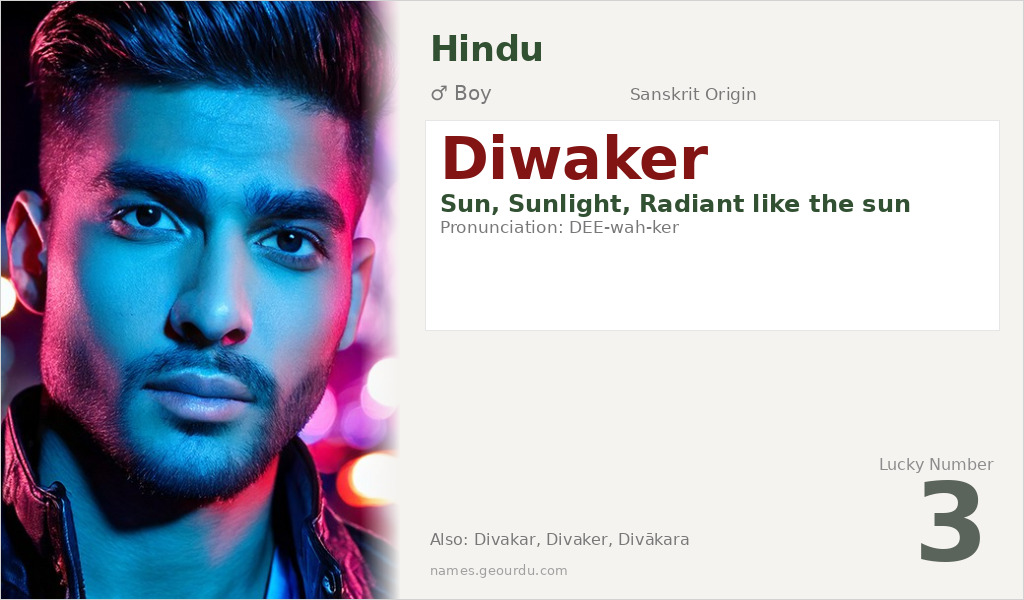
| 📛 Name | Diwaker |
| 💎 Meaning | Sun, Sunlight, Radiant like the sun |
| 👤 Gender | Boy |
| 🕌 Religion | Hindu |
| 🌍 Origin | Sanskrit |
| 🗣 Pronunciation | DEE-wah-ker |
| ✍️ Urdu | دیواکر |
| ✍️ Arabic | ديواكر |
| 🔢 Numerology | 3 |
| ✨ Spellings | Divakar, Divaker, Divākara, Deevakar |
Origin & Cultural Significance
Diwaker has its origins in ancient Sanskrit literature and Hindu religious texts dating back thousands of years. As a name derived from Vedic traditions, it reflects the importance of solar worship in early Hindu culture, where the sun was seen as a visible manifestation of the divine. The name spread through the Indian subcontinent and remains particularly popular in Hindu communities in India, Nepal, and the diaspora. While primarily associated with Hinduism, the name’s Sanskrit roots mean it’s occasionally used by Jains and Buddhists in South Asia. Its usage has been consistent through historical periods, appearing in medieval literature and continuing in modern times as both a given name and surname.
Personality Traits
Those named Diwaker are often associated with sunny, optimistic personalities that brighten their surroundings. They tend to be natural leaders who approach challenges with warmth and clarity, much like the sun dispelling darkness. Their radiant energy often makes them centers of attention in social situations, while their consistent nature reflects the reliable daily rising of the sun. These individuals typically possess both creative energy and practical wisdom in balanced measure.
Similar Names
If you like Diwaker, consider: Surya, Ravi, Bhanu, Arun, Aditya
Famous People Named Diwaker
- Divakar (Indian film director) — South Indian film director known for Tamil and Telugu movies
- Divakar (singer) — Indian playback singer in the Kannada film industry
Frequently Asked Questions About Diwaker
What does Diwaker mean?
Diwaker means 'sun', 'sunlight', or 'maker of the day' in Sanskrit. It comes from the Sanskrit word 'Divākara', combining 'diva' (day/sky) and 'kara' (maker).
Is Diwaker a boy or girl name?
Diwaker is exclusively a boy's name in Hindu naming traditions. It has masculine grammatical forms in Sanskrit and is traditionally given to male children.
What is the origin of Diwaker?
Diwaker originates from Sanskrit, the ancient language of Hindu scriptures. It has been used for millennia in the Indian subcontinent, particularly within Hindu communities, with roots in Vedic solar worship traditions.





