
Table of Contents
Drew is a classic yet contemporary name with deep historical roots and enduring appeal. Originally a nickname for Andrew, it has evolved into a standalone given name celebrated for its simplicity and strength. From Hollywood stars to sports legends, Drew carries a legacy of masculinity and resilience that transcends cultures and generations. This guide explores the rich etymology, cultural significance, and modern usage of this timeless name.
Meaning of Drew
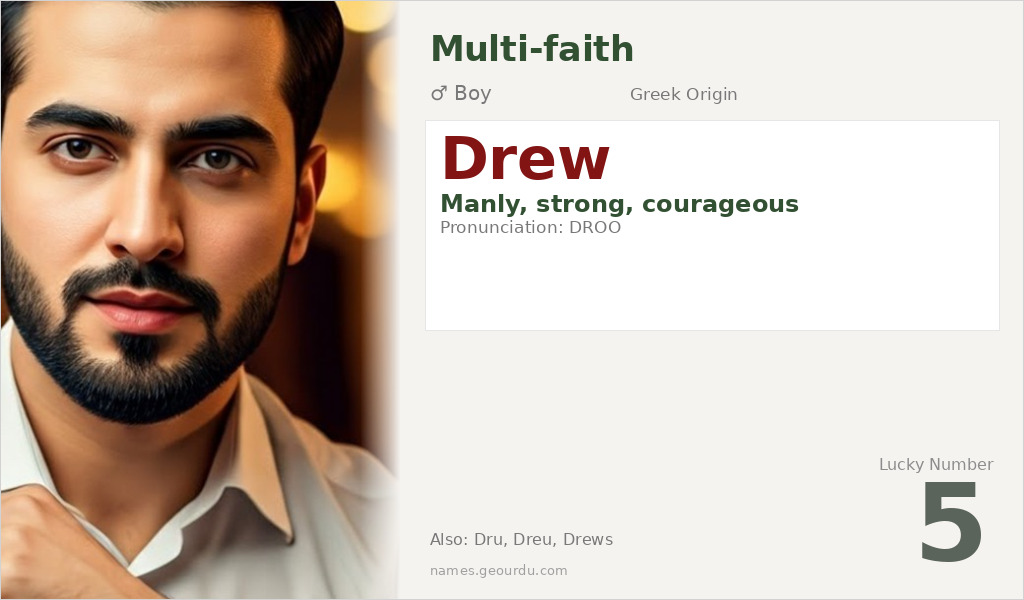
The name Drew derives from the Greek name Andreas (Ἀνδρέας), which comes from the Greek word ‘anēr’ (ἀνήρ), meaning ‘man’ or ‘warrior’. This etymology emphasizes qualities of masculinity, strength, and courage. Through Latin adoption as Andreas and subsequent evolution in Old French as Andrieu, the name entered English usage, where Drew emerged as a medieval diminutive. Today, Drew retains these core meanings while functioning as an independent given name, distinct from but historically connected to Andrew. Its linguistic journey reflects a consistent association with human fortitude and valor across millennia.
| 📛 Name | Drew |
| 💎 Meaning | Manly, strong, courageous |
| 👤 Gender | Boy |
| 🕌 Religion | Multi-faith |
| 🌍 Origin | Greek |
| 🗣 Pronunciation | DROO |
| ✍️ Urdu | ڈریو |
| ✍️ Arabic | درو |
| 🔢 Numerology | 5 |
| ✨ Spellings | Dru, Dreu, Drews |
Origin & Cultural Significance
Drew originated as a medieval English nickname for Andrew, which itself traces back to ancient Greece. The name gained prominence through Saint Andrew, one of the twelve apostles in Christian tradition, who was martyred on an X-shaped cross (the Saltire). While historically associated with Christianity due to this apostolic connection, Drew is now used across multiple faiths and secular contexts globally. In modern times, it has become particularly popular in English-speaking countries, often chosen for its crisp, one-syllable sound and classic yet approachable feel. The name’s cross-cultural adaptability demonstrates how diminutives can evolve into significant standalone names.
Personality Traits
People named Drew are often described as dynamic and versatile, with a natural ability to navigate diverse social and professional environments. They typically exhibit curiosity and enthusiasm for new experiences, making them effective innovators and communicators. While their adaptable nature serves them well in changing circumstances, they may need to cultivate focus to see long-term projects through to completion. Overall, Drews tend to leave a positive impression through their combination of strength, charm, and intellectual agility.
Similar Names
If you like Drew, consider: Andrew, Andreas, Anders, Dru, Drews
Famous People Named Drew
- Drew Barrymore — American actress and producer from the Barrymore acting dynasty
- Drew Brees — former American football quarterback and Super Bowl champion
Frequently Asked Questions About Drew
What does Drew mean?
Drew means 'manly, strong, courageous' and originates from the Greek name Andreas, derived from the word 'anēr' meaning 'man' or 'warrior'.
Is Drew a boy or girl name?
Drew is traditionally a masculine name, though it is occasionally used for girls in modern times, particularly as a variant of Drue or influenced by unisex naming trends.
What is the origin of Drew?
Drew originates from Greek, evolving through Latin and Old French as a diminutive of Andrew before becoming an independent given name in English-speaking cultures.





