
Table of Contents
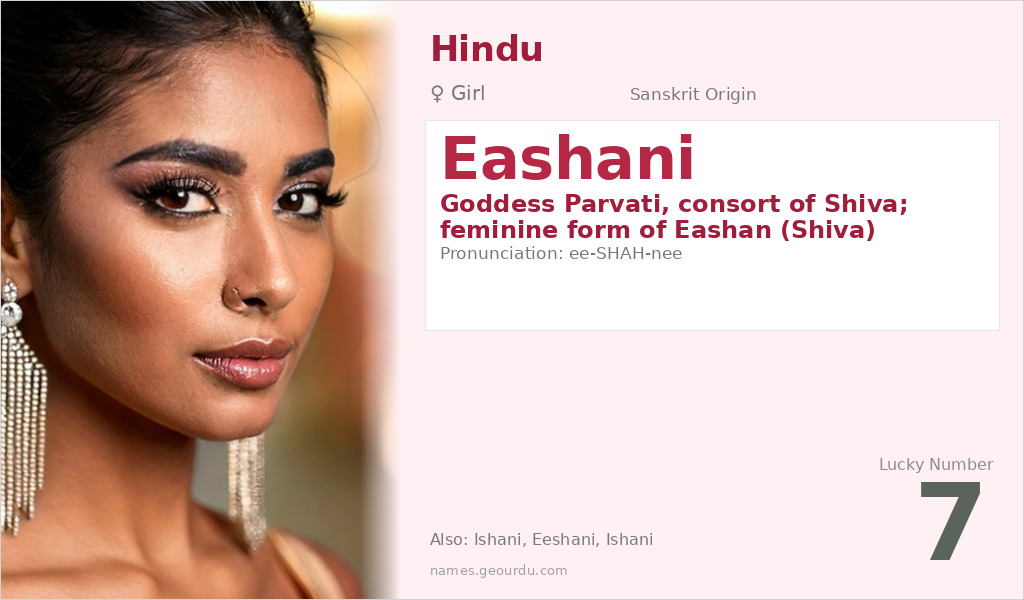
Eashani is a beautiful and meaningful name deeply rooted in Hindu tradition, often chosen for girls to honor the divine feminine. Derived from Sanskrit, it signifies ‘Goddess Parvati,’ the consort of Shiva, embodying qualities of love, strength, and devotion. This name carries spiritual significance and is popular in Indian communities worldwide. In this guide, we explore its etymology, cultural context, and personality traits associated with it.
Meaning of Eashani
Eashani originates from the Sanskrit word ‘Eashan,’ which refers to Shiva, the Hindu god of destruction and transformation, often associated with the northeast direction. The feminine suffix ‘-i’ transforms it into ‘Eashani,’ meaning ‘belonging to Shiva’ or specifically ‘Goddess Parvati.’ Parvati is revered as the goddess of fertility, marriage, and devotion, making this name a symbol of divine femininity and spiritual power. In linguistic terms, it is a compound name where ‘Eashan’ denotes lordship or rulership, and ‘-i’ indicates femininity, commonly used in Sanskrit to form feminine nouns. This etymology is well-documented in Hindu scriptures and Sanskrit dictionaries, highlighting its religious and cultural depth.
| 📛 Name | Eashani |
| 💎 Meaning | Goddess Parvati, consort of Shiva; feminine form of Eashan (Shiva) |
| 👤 Gender | Girl |
| 🕌 Religion | Hindu |
| 🌍 Origin | Sanskrit |
| 🗣 Pronunciation | ee-SHAH-nee |
| ✍️ Urdu | ایشانی |
| ✍️ Arabic | إيشاني |
| 🔢 Numerology | 7 |
| ✨ Spellings | Ishani, Eeshani, Ishani, Eshani |
Origin & Cultural Significance
The name Eashani has its origins in ancient Sanskrit, the classical language of India, and is predominantly used in Hindu communities. It is closely tied to Hindu mythology, where Parvati, as Eashani, represents the nurturing and powerful aspect of the divine feminine. Culturally, it is popular in India, Nepal, and among the Hindu diaspora, often chosen for girls to invoke blessings of prosperity and spiritual grace. Historically, names ending in ‘-i’ are common in Sanskrit for feminine forms, and Eashani fits this pattern, reflecting traditional naming practices. Its usage spans centuries, appearing in religious texts and modern contexts alike, maintaining its relevance in contemporary Hindu naming traditions.
Personality Traits
People named Eashani are often perceived as empathetic, resilient, and spiritually inclined, with a natural ability to lead and inspire others. They may exhibit a deep connection to their cultural heritage and a strong sense of duty, often thriving in roles that involve caregiving or creative expression. Their intuitive nature and compassionate demeanor make them well-loved in social circles, embodying the nurturing qualities associated with Goddess Parvati.
Similar Names
If you like Eashani, consider: Parvati, Durga, Lakshmi, Saraswati, Kali
Famous People Named Eashani
- Eashani Shetty — Indian actress known for her work in Kannada cinema
- Ishani Desai — fictional character in literature and media representing Hindu goddess themes
Frequently Asked Questions About Eashani
What does Eashani mean?
Eashani means 'Goddess Parvati' or 'consort of Shiva,' derived from Sanskrit, where 'Eashan' refers to Shiva and '-i' makes it feminine.
Is Eashani a boy or girl name?
Eashani is exclusively a girl's name, as it is the feminine form of Eashan and is associated with the Hindu goddess Parvati.
What is the origin of Eashani?
Eashani originates from Sanskrit, an ancient Indian language, and is deeply rooted in Hindu religion and mythology, specifically linked to Goddess Parvati.





