
Table of Contents
Edith is a timeless name with deep historical roots that has maintained popularity across centuries. From Anglo-Saxon queens to modern celebrities, this name carries a legacy of strength and prosperity. With its elegant sound and rich meaning, Edith continues to be a beloved choice for parents seeking a classic yet distinctive name. Its revival in recent decades speaks to its enduring appeal across cultures and generations.
Meaning of Edith
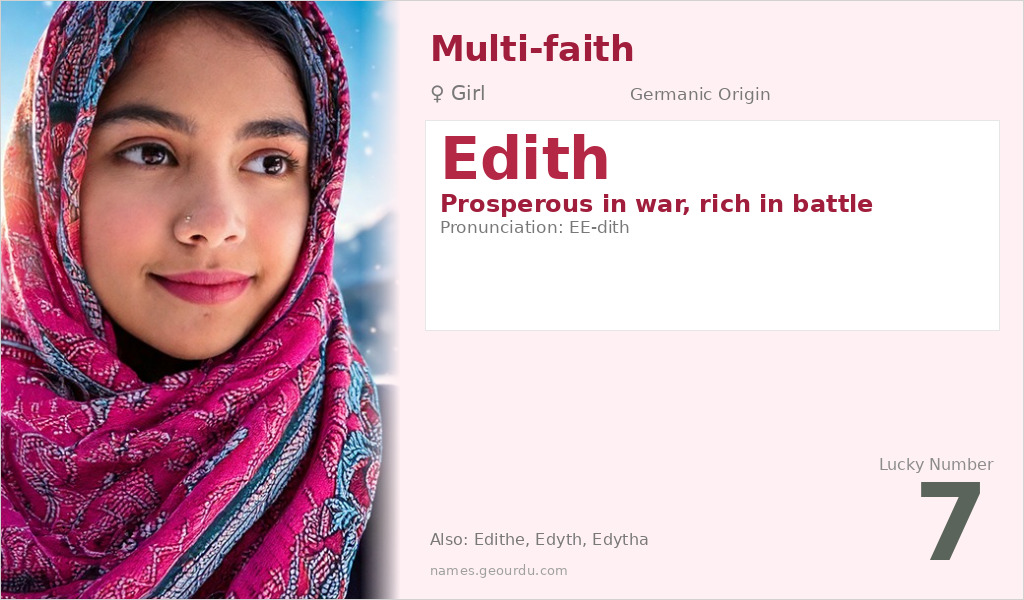
The name Edith originates from Old English, combining two elements: ‘ēad’ meaning ‘wealth, fortune, prosperity’ and ‘gȳð’ meaning ‘war, battle’. This creates the meaning ‘prosperous in war’ or ‘rich in battle’, reflecting the values of early medieval Germanic societies where martial success and material wealth were closely linked. The name appears in various forms in historical records, including Eadgyth in Old English, which was Latinized as Editha. Unlike many names that underwent significant meaning changes, Edith has maintained its original etymological sense throughout its history. The combination of prosperity and battle elements makes it a name associated with both material success and strength of character.
| 📛 Name | Edith |
| 💎 Meaning | Prosperous in war, rich in battle |
| 👤 Gender | Girl |
| 🕌 Religion | Multi-faith |
| 🌍 Origin | Germanic |
| 🗣 Pronunciation | EE-dith |
| ✍️ Urdu | ایڈتھ |
| ✍️ Arabic | إديث |
| 🔢 Numerology | 7 |
| ✨ Spellings | Edithe, Edyth, Edytha, Eadgyth |
Origin & Cultural Significance
Edith has its origins in Germanic languages, specifically Old English, where it was commonly used among Anglo-Saxon nobility before the Norman Conquest of 1066. Several notable historical figures bore this name, including Saint Edith of Wilton (daughter of King Edgar the Peaceful) and Edith of Wessex (queen consort of Edward the Confessor). The name experienced a decline after the Norman invasion but was revived during the 19th century Victorian era’s fascination with medieval history and literature. Today, it is used across English-speaking countries and has variations in other Germanic languages, maintaining its connection to early English history while adapting to contemporary naming trends.
Personality Traits
Those named Edith are often associated with qualities of resilience, practicality, and quiet strength. The name’s meaning suggests someone who can prosper through challenges, combining strategic thinking with determination. Many Ediths are perceived as traditional yet independent, valuing stability while possessing the inner fortitude to navigate difficult situations. These personality associations stem both from the name’s etymology and from cultural perceptions shaped by notable bearers throughout history.
Similar Names
If you like Edith, consider: Edwina, Ethel, Elfreda, Matilda, Gertrude
Famous People Named Edith
- Edith Piaf — French singer known as 'The Little Sparrow', famous for songs like 'La Vie en Rose'
- Edith Wharton — American novelist and short story writer, first woman to win Pulitzer Prize for Fiction
- Edith Cavell — British nurse celebrated for saving soldiers from both sides in WWI
- Edith Head — American costume designer who won eight Academy Awards
Frequently Asked Questions About Edith
What does Edith mean?
Edith means 'prosperous in war' or 'rich in battle', derived from Old English elements 'ēad' (wealth, fortune) and 'gȳð' (war, battle).
Is Edith a boy or girl name?
Edith is exclusively a feminine name with historical usage as a girl's name dating back to Anglo-Saxon England. There are no traditional masculine forms of this name.
What is the origin of Edith?
Edith originates from Old English (Germanic language family) and was commonly used among Anglo-Saxon nobility before the Norman Conquest, with historical figures like Saint Edith of Wilton and Queen Edith of Wessex.





