
Table of Contents
Edward is a classic English name with royal heritage and enduring popularity. Derived from Old English elements meaning ‘wealth’ and ‘guardian,’ this name has been borne by kings, saints, and notable figures throughout history. With its strong, protective meaning and timeless appeal, Edward continues to be a favored choice for parents seeking a traditional yet powerful name. Its variations appear in numerous languages and cultures around the world.
Meaning of Edward
The name Edward originates from the Old English elements ‘ēad,’ meaning ‘wealth, fortune, or prosperity,’ and ‘weard,’ meaning ‘guard, protector, or guardian.’ This combination creates the meaning ‘wealthy guardian’ or ‘prosperous protector.’ The name has Germanic roots and is related to similar names in other Germanic languages, such as German ‘Eduard’ and Dutch ‘Eduard.’ It entered English usage during the Anglo-Saxon period and has maintained consistent meaning throughout its history. The name’s components reflect values important in medieval society: material security and protective responsibility.
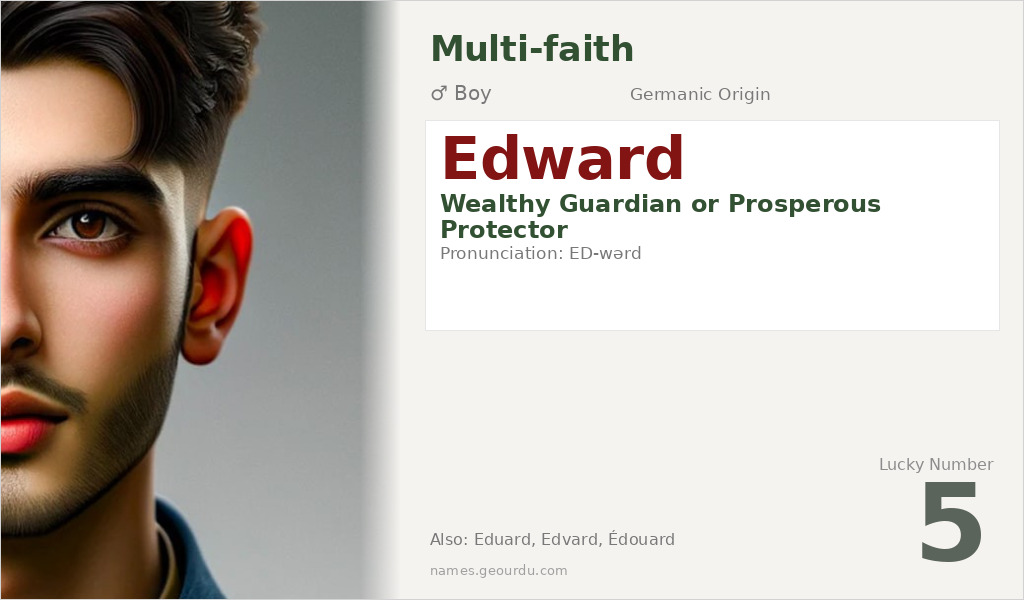
| 📛 Name | Edward |
| 💎 Meaning | Wealthy Guardian or Prosperous Protector |
| 👤 Gender | Boy |
| 🕌 Religion | Multi-faith |
| 🌍 Origin | Germanic |
| 🗣 Pronunciation | ED-wərd |
| ✍️ Urdu | ایڈورڈ |
| ✍️ Arabic | إدوارد |
| 🔢 Numerology | 5 |
| ✨ Spellings | Eduard, Edvard, Édouard, Eduardo, Edvardas |
Origin & Cultural Significance
Edward has its origins in Old English and was popularized by Anglo-Saxon royalty, most notably by Edward the Confessor, the last Anglo-Saxon king of England who ruled from 1042 to 1066. After the Norman Conquest, the name continued to be used among English nobility and eventually spread throughout Europe in various forms. The name gained particular prominence in England with three King Edwards during the Middle Ages and additional monarchs in later centuries. Today, Edward is used in English-speaking countries and has been adopted in various forms across multiple cultures and religions, not limited to Christianity as sometimes mistakenly assumed.
Personality Traits
People named Edward are often associated with qualities of reliability, protection, and traditional values. They tend to be perceived as steady, responsible individuals who value security and stability. Many Edwards develop reputations as dependable guardians in both personal and professional contexts, living up to the name’s etymological meaning. While individual personalities vary, the name carries connotations of maturity, wisdom, and protective instincts.
Similar Names
If you like Edward, consider: Edmund, Edgar, Edwin, Edric, Edwardo
Famous People Named Edward
- Edward the Confessor — 11th century King of England and saint
- Edward Jenner — English physician who developed smallpox vaccine
- Edward VIII — King of the United Kingdom who abdicated in 1936
- Edward Snowden — American whistleblower and former intelligence contractor
Frequently Asked Questions About Edward
What does Edward mean?
Edward means 'wealthy guardian' or 'prosperous protector,' derived from Old English elements 'ēad' (wealth) and 'weard' (guard).
Is Edward a boy or girl name?
Edward is traditionally a masculine name, though feminine variations like Edwina exist. It is overwhelmingly used for boys across all cultures where it appears.
What is the origin of Edward?
Edward originates from Old English (Germanic language family) and was popularized by Anglo-Saxon royalty, particularly Edward the Confessor in the 11th century.





