
Table of Contents
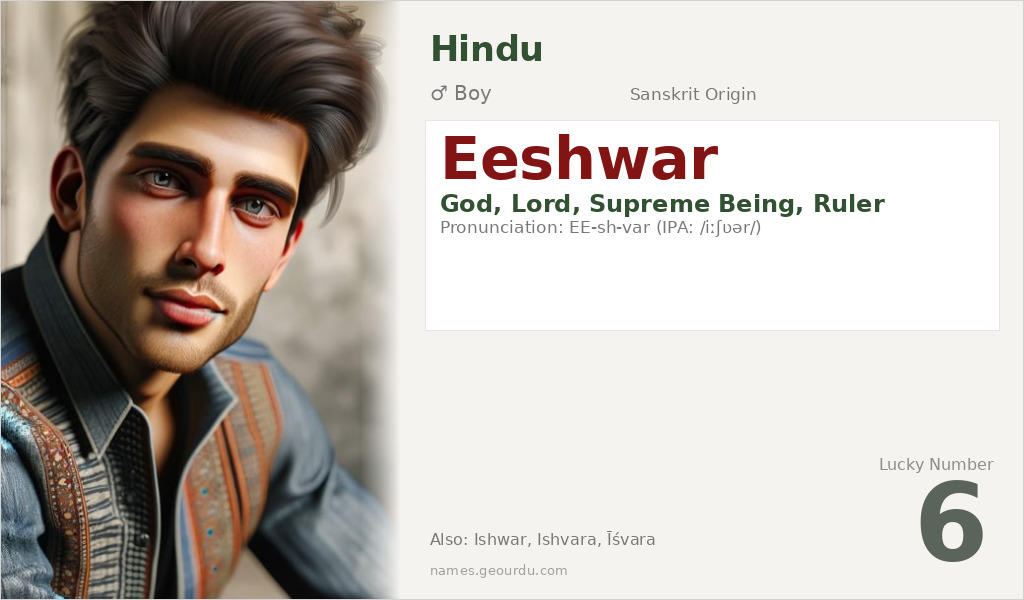
Eeshwar is a powerful and spiritually significant name of Sanskrit origin, meaning ‘God’, ‘Lord’, or ‘Supreme Being’. Primarily used in Hindu communities, this name carries profound philosophical weight from ancient Indian texts. It represents divine authority, mastery, and the personal aspect of the ultimate reality in Hindu theology.
Meaning of Eeshwar
Eeshwar (ईश्वर) originates from the Sanskrit root ‘īś’, which means ‘to own, rule, command, or be master of’. Combined with the suffix ‘-vara’, it literally translates to ‘one who has power or lordship’. In Hindu philosophy, Īśvara is a key concept referring to the personal God, distinct from the impersonal Brahman, often associated with deities like Shiva. The name appears in foundational texts such as the Upanishads, where it denotes the Supreme Controller, and in Patanjali’s Yoga Sutras as the object of meditation. Its meaning is well-documented in Sanskrit lexicons and religious scriptures, making it a name of deep theological and etymological clarity.
| 📛 Name | Eeshwar |
| 💎 Meaning | God, Lord, Supreme Being, Ruler |
| 👤 Gender | Boy |
| 🕌 Religion | Hindu |
| 🌍 Origin | Sanskrit |
| 🗣 Pronunciation | EE-sh-var (IPA: /iːʃʋər/) |
| ✍️ Urdu | ایشور |
| ✍️ Arabic | إيشوار |
| 🔢 Numerology | 6 |
| ✨ Spellings | Ishwar, Ishvara, Īśvara, Eeshwara, Ishwara |
Origin & Cultural Significance
Eeshwar has its roots exclusively in Sanskrit, the classical language of ancient India, and is deeply embedded in Hindu culture and religion. It is not found in Arabic, Persian, Pashto, Urdu, or other regional languages with this specific meaning and spelling. The name gained prominence through Hindu scriptures, where Īśvara is used to describe the Supreme Being in traditions like Shaivism and Vedanta. Over centuries, it has been adopted as a personal name in India and among Hindu diaspora communities, symbolizing devotion and spiritual authority. Its usage reflects the enduring influence of Sanskrit and Hindu philosophy on naming traditions.
Personality Traits
People named Eeshwar are often perceived as natural leaders with a strong sense of purpose and spirituality. They may exhibit qualities of wisdom, discipline, and a commanding presence, inspired by the name’s meaning of ‘Lord’ or ‘Ruler’. Their personality tends to be philosophical, with a deep interest in higher truths and ethical guidance, making them respected figures in their communities.
Similar Names
If you like Eeshwar, consider: Ishaan, Ishant, Ishita, Eshaan, Eshwar
Famous People Named Eeshwar
- Eeshwar Reddy — Indian film director known for Telugu cinema
- Eeshwar Nivas — Indian music composer and singer in Bollywood
Frequently Asked Questions About Eeshwar
What does Eeshwar mean?
Eeshwar means 'God', 'Lord', 'Supreme Being', or 'Ruler' in Sanskrit, derived from the root 'īś' meaning 'to rule or command'.
Is Eeshwar a boy or girl name?
Eeshwar is exclusively a boy's name in Hindu naming traditions, reflecting masculine divine attributes.
What is the origin of Eeshwar?
Eeshwar originates from Sanskrit, the ancient language of India, and is deeply rooted in Hindu religion and philosophy, not found in other languages with this meaning.





