Table of Contents
Eliza is a timeless and elegant name that has captivated parents for centuries. With roots in ancient Hebrew, it carries a profound spiritual meaning that resonates across cultures. This name has been immortalized in literature, history, and modern media, making it a classic choice for girls worldwide. Discover the rich heritage and enduring appeal of the name Eliza.
Meaning of Eliza
Eliza derives from the Hebrew name Elizabeth (Elisheva), which combines ‘El,’ meaning ‘God,’ and ‘sheva,’ meaning ‘oath’ or ‘seven.’ Thus, Eliza signifies ‘God is my oath’ or ‘consecrated to God,’ reflecting a deep covenant or dedication. The name entered Western traditions through the Greek form Elisabet and Latin Elisabeth, mentioned in the New Testament as the mother of John the Baptist. Over time, Eliza evolved as a diminutive in English, gaining independence as a given name by the Renaissance. Its meaning emphasizes faithfulness and divine promise, making it a meaningful choice in Judeo-Christian contexts.
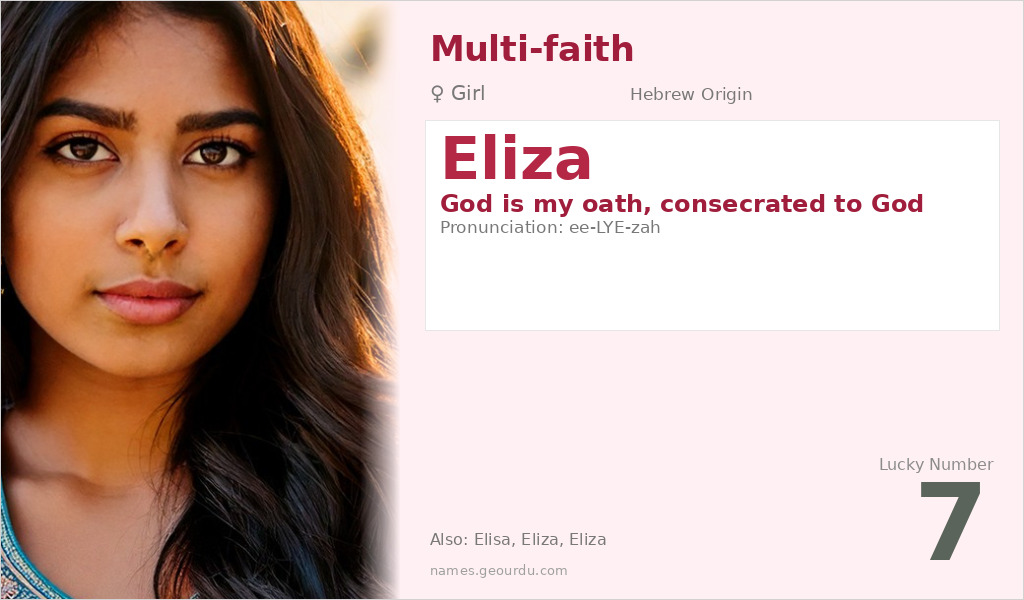
| 📛 Name | Eliza |
| 💎 Meaning | God is my oath, consecrated to God |
| 👤 Gender | Girl |
| 🕌 Religion | Multi-faith |
| 🌍 Origin | Hebrew |
| 🗣 Pronunciation | ee-LYE-zah |
| ✍️ Urdu | ایلزا |
| ✍️ Arabic | إليزا |
| 🔢 Numerology | 7 |
| ✨ Spellings | Elisa, Eliza, Eliza, Eliza |
Origin & Cultural Significance
Eliza originated from Hebrew, with biblical roots in the name Elizabeth. It spread through Greek and Latin translations of religious texts, becoming common in Christian Europe. In English, it gained popularity in the 16th century, notably through literary works like Shakespeare’s ‘The Taming of the Shrew’ (character Bianca is sometimes called Eliza). The name saw a revival in the 18th and 19th centuries, associated with figures like Eliza Hamilton in American history. Today, Eliza is used globally, transcending religious boundaries to become a multicultural favorite, though it remains most prevalent in English-speaking and Christian-majority countries.
Personality Traits
Those named Eliza are often perceived as intelligent, graceful, and determined. They may exhibit strong leadership qualities, coupled with a compassionate and intuitive nature. The name’s etymological connection to devotion suggests a person of integrity and spiritual depth, who values relationships and personal growth.
Similar Names
If you like Eliza, consider: Elizabeth, Elise, Eliana, Elsa, Ella
Famous People Named Eliza
- Eliza Doolittle — Fictional character from George Bernard Shaw's 'Pygmalion' and musical 'My Fair Lady'
- Eliza Hamilton — Philanthropist and wife of American Founding Father Alexander Hamilton
Frequently Asked Questions About Eliza
What does Eliza mean?
Eliza means 'God is my oath' or 'consecrated to God,' originating from the Hebrew name Elizabeth (Elisheva).
Is Eliza a boy or girl name?
Eliza is exclusively a girl's name, used historically and globally for females, with no common masculine variants.
What is the origin of Eliza?
Eliza originates from Hebrew, evolving through Greek and Latin into English as a diminutive of Elizabeth, with biblical and literary significance.