
Table of Contents
Elizabeth stands as one of history’s most enduring and regal names, spanning millennia from biblical times to modern royalty. With roots in ancient Hebrew scripture and branches extending across continents and cultures, this name carries profound religious significance and timeless elegance. From queens to saints, literary heroines to pioneering scientists, Elizabeths have shaped our world in remarkable ways. Discover the rich tapestry of meaning, history, and personality behind this classic name.
Meaning of Elizabeth
The name Elizabeth derives from the Hebrew Elisheva (אֱלִישֶׁבַע), a compound of ‘El’ (אֵל), meaning ‘God,’ and ‘sheva’ (שֶׁבַע), meaning ‘oath’ or ‘seven.’ In biblical context, ‘seven’ symbolizes completeness and abundance, giving the name additional layers of meaning as ‘God is my oath’ or ‘God is abundance.’ This etymology appears in Exodus 6:23, where Elisheva is identified as Aaron’s wife. Through Greek translation as Elisabet and Latin as Elisabeth, the name entered Christian tradition via Saint Elizabeth, mother of John the Baptist. The core meaning has remained remarkably consistent across languages and centuries, reflecting a covenant relationship with the divine.
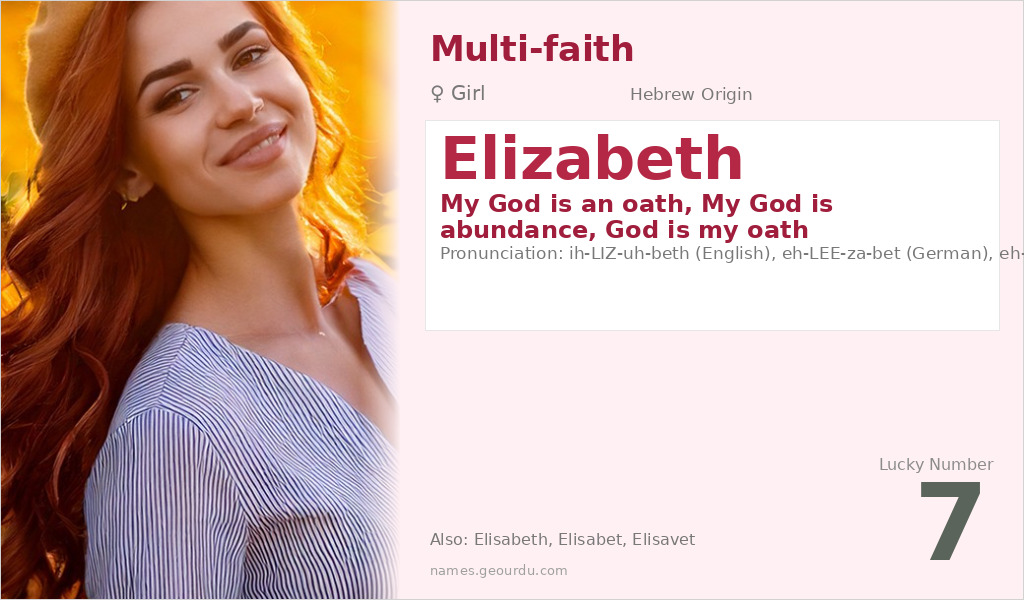
| 📛 Name | Elizabeth |
| 💎 Meaning | My God is an oath, My God is abundance, God is my oath |
| 👤 Gender | Girl |
| 🕌 Religion | Multi-faith |
| 🌍 Origin | Hebrew |
| 🗣 Pronunciation | ih-LIZ-uh-beth (English), eh-LEE-za-bet (German), eh-lee-ZA-bet (French) |
| ✍️ Urdu | ایلزبتھ |
| ✍️ Arabic | إليزابيث |
| 🔢 Numerology | 7 |
| ✨ Spellings | Elisabeth, Elisabet, Elisavet, Elżbieta, Elisheva, Elisabetta, Elizaveta |
Origin & Cultural Significance
Elizabeth originated in ancient Hebrew culture as Elisheva, appearing in the Torah as the wife of the high priest Aaron. The name gained Christian significance through Saint Elizabeth in the New Testament, mother of John the Baptist and relative of Mary. During the Middle Ages, various European forms emerged, including Isabel in Spanish and Portuguese, Elżbieta in Polish, and Elisabet in Scandinavian languages. The name’s royal associations strengthened with Queen Elizabeth I of England in the 16th century, establishing it as a regal choice. Today, Elizabeth remains popular worldwide, with variations in over 50 languages, reflecting its deep historical roots and cross-cultural adaptability.
Personality Traits
Those named Elizabeth often embody qualities of intelligence, reliability, and natural leadership. Historical and contemporary Elizabeths frequently demonstrate analytical thinking, diplomatic skills, and a strong sense of responsibility. Many exhibit a dignified presence combined with practical wisdom, making them effective in positions of authority. The name’s royal associations contribute to perceptions of grace, tradition, and resilience, while its biblical roots suggest spiritual depth and commitment to principles.
Similar Names
If you like Elizabeth, consider: Isabella, Eliza, Beth, Elise, Elsa
Famous People Named Elizabeth
- Queen Elizabeth II — Longest-reigning British monarch (1926-2022)
- Elizabeth Taylor — Academy Award-winning American actress (1932-2011)
- Elizabeth I — Queen of England during the Elizabethan era (1533-1603)
- Elizabeth Warren — American politician and former presidential candidate (born 1949)
- Elizabeth Blackwell — First woman to receive a medical degree in the United States (1821-1910)
Frequently Asked Questions About Elizabeth
What does Elizabeth mean?
Elizabeth means 'My God is an oath' or 'God is my oath,' originating from the Hebrew name Elisheva, composed of 'El' (God) and 'sheva' (oath/seven).
Is Elizabeth a boy or girl name?
Elizabeth is exclusively a feminine name across all cultures and historical periods, with no recorded masculine usage in any language tradition.
What is the origin of Elizabeth?
Elizabeth originates from ancient Hebrew (Elisheva), entering Christian tradition through Greek and Latin translations, and spreading globally through biblical, royal, and cultural diffusion.





